Real Is Beautiful: Selfies, Social Media, and Self-Determination
Citation: K. Michael and M. G. Michael, "Real Is Beautiful: Selfies, Social Media, and Self-Determination," in IEEE Technology and Society Magazine, vol. 44, no. 2, pp. 31-37, June 2025, doi: 10.1109/MTS.2025.3549210.
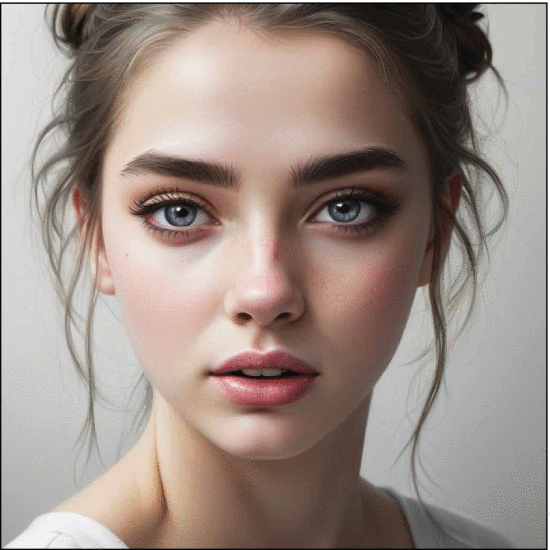
Figure 1. AI-generated image from the prompt (”real is beautiful”). Source (DALLE-2).
Many people enjoy using social media without feeling addicted or out of control. However, understanding whether our usage is within a normal range can be challenging. How might we know if our usage is excessive? Can comparison to other peoples’ smartphone usage statistics be helpful? What if addictive behaviors have been normalized to such an extent that comparisons do not mean anything in real terms [1]? For example, AntiSocial (https://antisocial.io/) is an app designed to help users monitor and compare their smartphone usage, including time spent on social media and the number of phone unlocks, against others [2]. This allows individuals to assess their habits in relation to their peers. But what exactly are people so addicted to or distracted by? In this article, we explore key themes arising from the use of social media and smartphones. Through this reflection, we examine social media’s profound influence, delving into its effects on self-esteem, media consumption habits, and exposure to targeted marketing [3].
Content generation
The “C-generation” refers to consumers who both create and consume content, a cross-generational psychographic group [4], [5], [6]. In today’s media landscape, people are exposed to up to 10,000 ads daily compared to 500–1,600 in the 1970s. Children see an average of 20,000 commercials yearly [7], [8]. Though debated, the increase in ads has clear effects on consumer behavior, driven by profit and reputation building. The global industry of online branding and marketing is now a multitrillion-dollar enterprise. As Marshall McLuhan put it so succinctly: “All media work us over completely” [53].
Filtering, fabricating, and deepfakes
In a similar timeframe, concerns have been aired in media about the front covers of glamor magazines that feature models that are too thin, too young, or heavily photoshopped. People often overlook the effort involved in these shoots, where makeup takes hours, and images are further edited before publication. Most media images are unrealistic, with enhancements such as wrinkle removal, eye and lip alterations, and color overlays [9], [10]. Campaigns such as #filterdrop in 2020 have called for the return of authentic, unfiltered beauty, arguing that real is beautiful, while the filtered look is fake [11].
Artificial intelligence (AI) has now entered the picture not just enhancing models’ images but potentially replacing them entirely [13], [14]. Generative AI can create perfect, unreal replicas (Figure 1). This shift raises existential questions: Why strive to represent the perfect-looking human when you can just generate that perfection through pretrained models in GenAI? Comparing humans to these unreal AI-generated figures introduces a new dimension of insecurity. For example, OpenAI’s “Sora” app can generate a flawless video of a stylish woman walking in Tokyo, purely from a textual prompt, blurring the line between real and artificial beauty [15].
Fame, followers, fashion, and fads
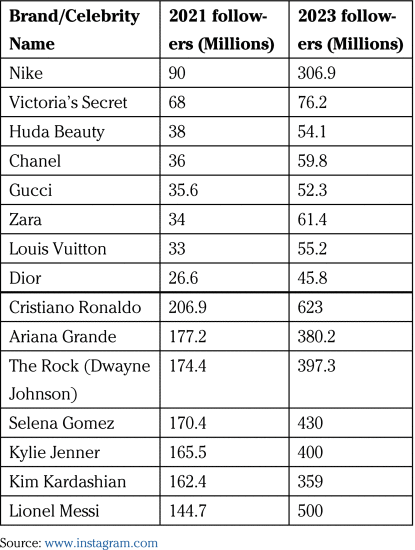
Table 1. Instagram Followers of Big Brands and Celebrities (2021 Versus 2023)
For young and impressionable boys and girls who spend increasing amounts of time on social media platforms such as Facebook, Instagram, and Snapchat (over 4 h on average per day, of which at least 25% of these users are constantly connected [16], [17], [18]), the messages coming from these top brands are usually: “you can look like this too, if you buy ‘x”’ [19]. Teens and others spend time “following” big brands, chatting about big brands, and even “liking” big brands (Table 1). But it’s not just about “things” anymore. People have become brands. And the followers are increasing by the tens of millions in a very short space of time. Maybe the allure of being one click away and somehow directly linked to the personas of the rich and famous or to popular products, makes followers feel better about themselves or somehow more beautiful or glamorous [20]. As McLuhan warned: “Once we have surrendered our senses and nervous systems to the private manipulation of those who would try to benefit from taking a lease on our eyes and ears and nerves, we don’t really have any rights left” [54].
Reality TV shows such as American Idol and Britain’s Got Talent fuel the “you could be the next celebrity” mindset. Viewers watch everyday people become stars, creating false hopes in many young people. Fashion plays a role in this transformation but often remains unaffordable to most. Through online voting, viewers feel part of the process, developing virtual partnerships with contestants, but this is far from reality. This process is part of a sophisticated marketing strategy to engage consumers and drive purchases of albums or products linked to the show’s winners. Teens, who share their likes and dislikes online, are targeted by marketers, while contestants too are often locked into restrictive contracts [21], [22]. Similarly, social media influencers (SMIs) have increased the obsession with celebrity phenomenon. Teens can become preoccupied with their idols, mimicking their fashion, or following every update. While this can be harmless fun, problems arise when it interrupts offline activities or leads to compulsive behaviors, such as obsessing over selfies or counting likes on social media [38] (Figure 2).
Social media, selfies, self-perceived attractiveness, and self-objectification
Enter the selfie. When we obsessively produce hundreds of selfies, we must ask if we risk losing something sacred—perhaps even a part of our identity. Are we chasing unattainable perfection [23]? The line between healthy self-esteem and unhealthy narcissism becomes blurred, when we take more selfies than photos facing outwards. In 2024, it was estimated that 93 million selfies were taken daily. That’s an average person taking over 450 selfies each year [25], [26], [27]. Some statistics cite an even higher number at 78 billion selfies globally for the calendar year. Millennials are expected to take 25,700 selfies over their lifetimes [28].
Women take more selfies than men, and most are edited before being posted online. Over 90% of young women alter their selfies, adjusting skin tone, reshaping features, or brightening teeth [29], [30], [31], [32]. The influence of advertising is clear as they are targeted with ads for cosmetic procedures such as Botox and fillers. This obsession with self-perceived attractiveness is now even affecting face detection algorithms. Our beliefs on acceptable conduct are shifting, with behaviors such as taking selfies at funerals becoming more common [33]. This subcultural phenomenon is only accelerating.
Going too far: Constant curation, cutting, planking, and blacking out
Self-editing selfies has become a creative curation process. If a post does not get the desired attention, young people remove it, managing their online reputation [34]. This cycle of posting, deleting, and reposting can be exhausting, as outward validation becomes the goal. Problems arise when individuals try to outdo themselves for likes, often posting images that are less representative of who they really are. Adolescent girls, especially, may feel the sting of low self-esteem when risqué posts go unnoticed, leading some to dangerous behaviors such as cutting or carving skin or even extreme stunts such as planking, which has resulted in injuries and deaths [35], [36], [37], [38].
The half-life of social media messages keeps shrinking, pushing people to post more frequently, often at the expense of truly living in the moment. When we focus on capturing an event rather than experiencing it, our spirit becomes captive to technology. Identities can become distorted, leading to self-destruction.
Researchers liken our smartphone preoccupation to a “blackout”—a temporary loss of awareness, making us oblivious to our surroundings [39], [40]. We become so immersed in our screens that we fail to notice potential dangers, such as crossing busy streets while texting. On a darker note, social media can even influence suicide-related behaviors, leading to more than just a temporary blackout, but a tragically permanent one [41], [42], [43], [55].
Seeking validation
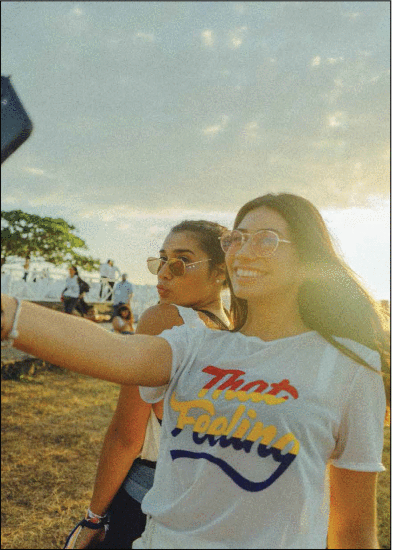
Figure 2. Two young women taking a selfie.
Social media often centers around validation. With each post, we ask, “Do you like this?”—whether it is a picture of ourselves, our thoughts, or our achievements. This manifests in various ways: from workout selfies, travel photos, or volunteer snapshots to images of socialites mingling with the elite or celebrating professional milestones. There is a fine line between celebrating success and seeking attention, and staying balanced can be a challenge. Social media adoration, such as filters, is unnatural, yet we all crave recognition. However, social media is not about genuine connection or love.
We rarely see selfies of people in pure acts of kindness, such as helping someone in need, unless the scene has been staged. These acts, though unglamorous, are essential. Real care and beauty lie in selfless actions that go unnoticed, requiring effort and sacrifice. Social media, however, does not promote this kind of real life, which demands putting others before ourselves.
It is time for more than cybersafety campaigns; we need full-blown media and digital literacy classes in all our schools, urgently.
Toward Self-Determination
Over the years, researchers have tried to advocate for change in how consumers need to be better protected from predatory advertising. However, today, the reach of the smartphone is in everybody’s hands as are social media applications. This provides a direct connection between the marketeer to someone’s thoughts and corresponding thought patterns, and it is instant. According to McBride et al., it is time for action through the law and corporate social responsibility measures to protect public health [44]. The changes required are urgent, but who will take up this call for change? Naomi Klein’s book, No Logo, called out so many things in 2000 in relation to corporate practices. It is time for more than cybersafety campaigns; we need full-blown media and digital literacy classes in all our schools, urgently. We also need companies to stop microtargeting individuals with micromessaging, especially children. There are initiatives such as the IEEE 2089-2021 standard [45] assisting organizations to design children’s apps using an age-appropriate risk register to mitigate potential harms of online social media, gaming, and other online services, to ensure the flourishing of children users, defined as any individual under the age of 18 years [46], [47]. We have a responsibility to assist the next generation in navigating their way through expectations to engage in social media and so much more [48]. So far, we have not entirely succeeded given the evidence that is emerging tying mental health concerns, such as anxiety and depression, and social media [49], [50], [51], [52]. However, first, we need to reflect on our own practices as parents, guardians, teachers, developers, designers, marketeers, social media innovators, regulators, and counselors. Are we celebrating the real, the natural, the raw, and the authentic before children?
References
1. “Are you an addict? Turns out we’re all tech junkies,” ABC News, Mar. 25, 2017. [Online]. Available: https://www.abc.net.au/news/2017-05-25/are-you-an-addict-how-australians-are-tech-junkies/8554532
2. J. Huntsdale, “Social media monitoring apps shine spotlight on Internet addiction,” ABC News, Feb. 2, 2017. [Online]. Available: https://www.abc.net.au/news/2017-02-22/social-media-addiction-monitoring-app/8292148
3. K. Michael, “Are you addicted to your smartphone, social media, and more? The new AntiSocial app could help,” IEEE Consum. Electron. Mag., vol. 6, no. 4, pp. 116–121, Oct. 2017, doi: 10.1109/MCE.2017.2714421.
4. I. El Qudsi, “How influencer marketing can become a content-generation machine for your brand,” Forbes, Jul. 15, 2020. [Online]. Available: https://www.forbes.com/councils/forbesagencycouncil/2020/06/15/how-influencer-marketing-can-become-a-content-generation-machine-for-your-brand/
5. N. Rollings, “Meet Generation-C: A generation not classified by age, income or geography,” LinkedIn, Feb. 19, 2022. [Online]. Available: https://www.linkedin.com/pulse/meet-generation-c-generation-classified-age-income-nicole-rollings/
6. S. Pitman, “All your need to know about the C-Generation and beauty,” Cosmetic Design, Oct. 16, 2018. [Online]. Available: https://www.cosmeticsdesign.com/Article/2018/10/16/All-you-need-to-know-about-the-C-Generation-and-beauty
7. Sam Carr. ( Feb. 15, 2021 ). How Many Ads Do We See A Day in 2023? Lunio. [Online]. Available: https://lunio.ai/blog/strategy/how-many-ads-do-we-see-a-day/
8. Univ. Southern California, “Thinking vs feeling: The psychology of advertising,” Nov. 17, 2023. [Online]. Available: https://appliedpsychologydegree.usc.edu/blog/thinking-vs-feeling-the-psychology-of-advertising
9. A. Demopoulos, “Model says her face was edited with AI to look white: ‘It’s very dehumanizing’,” The Guardian, Nov. 4, 2023. [Online]. Available: https://www.theguardian.com/fashion/2023/nov/04/fashion-model-ai-image-tiktok
10. C. Stokel-Walker, “AI can change a fashion model’s pose and alter their clothes to match,” New Scientist, Oct. 22, 2021. [Online]. Available: https://www.newscientist.com/article/2294683-ai-can-change-a-fashion-models-pose-and-alter-their-clothes-to-match/
11. E. Hallett, “Influencers told not to use ‘misleading’ beauty filters,” BBC News, Feb. 3, 201. [Online]. Available: https://www.bbc.com/news/uk-england-55824936
12. L. Flora, “#NoFilter 2.0: Gen Z’s beauty filter backlash is growing on TikTok and Instagram,” GLOSSY, Jun 16, 2022. [Online]. Available: https://www.glossy.co/beauty/nofilter-2-0-gen-zs-beauty-filter-backlash-is-growing-on-tiktok-and-instagram/
13. K. Hill and J. White, “Designed to deceive: Do these people look real to you? ” The New York Times, Nov. 21, 2020. [Online]. Available: https://www.nytimes.com/interactive/2020/11/21/science/artificial-intelligence-fake-people-faces.html
14. W. Oremus, “AI researchers call for ‘personhood credentials as bots get smarter’,” The Washington Post, Aug. 21, 2024. [Online]. Available: https://www.washingtonpost.com/politics/2024/08/21/human-bot-personhood-credentials-worldcoin/
15. V. Pooryousef and L. Besançon, “What is Sora? A new generative AI tool could transform video production and amplify disinformation risks,” The Conversation, Feb. 19, 2024. Accessed: Mar. 17, 2024. [Online]. Available: https://theconversation.com/what-is-sora-a-new-generative-ai-tool-could-transform-video-production-and-amplify-disinformation-risks-223850
16. G. Murray and L. Littlefield, “Stress & wellbeing: How Australians are coping with life,” Tech. Rep., Austral. Psychol. Soc., 2015. [Online]. Available: https://psychology.org.au/getmedia/ae32e645-a4f0-4f7c-b3ce-dfd83237c281/stress-wellbeing-survey.pdf
17. F. Duarte. ( Jan. 22, 2025 ). Time Spent Using Smartphones (2024 Statistics). Exploding Topics. [Online]. Available: https://explodingtopics.com/blog/smartphone-usage-stats
18. M. Anderson, M. Faverio, and E. Park, “How teens and parents approach screen time,” Tech. Rep., Pew Research Center, Mar. 11, 2024. [Online]. Available: https://www.pewresearch.org/internet/2024/03/11/how-teens-and-parents-approach-screen-time/
19. E. Wallace et al., “Outcomes for self-expressive brands followed on social media: Identifying different paths for inner self-expressive and social self-expressive brands,” J. Bus. Res., vol. 135, pp. 519–531, Oct. 2021, doi: 10.1016/j.jbusres.2021.06.058.
20. Y.-K. Kim and P. Sullivan, “Emotional branding speaks to consumers’ heart: The case of fashion brands,” Fashion Textiles, vol. 6, no. 1, pp. 1–16, Feb. 2019, doi: 10.1186/s40691-018-0164-y.
21. Dispøsable TV. ( May 13, 2017 ). The Britain’s Got Talent Contract is Disgusting. YouTube. [Online]. Available: https://www.youtube.com/watch?v=xM2OOv5rN_A
22. Freemantle Media Ltd., “Britain’s Got Talent ” Release Form, 2017. [Online]. Available: https://madpsy.uk/wp-content/uploads/2018/07/britains-got-talent-release-form.pdf
23. R. Ehmke, “What selfies are doing to self-esteem,” Child Mind Inst., Oct. 30, 2023. [Online]. Available: https://childmind.org/article/what-selfies-are-doing-to-girls-self-esteem/
24. Indiana Cybersecurity Hub. ( Jun. 21, 2024 ). National Selfie Day: Celebrate by Practicing Selfie Safety. Indiana Cybersecurity Hub. [Online]. Available: https:// www.in.gov/cybersecurity/blog/posts/national-selfie-day-celebrate-by-practicing-selfie-safety/
25. Staff. ( Dec. 23, 2017 ). Google Photos: One Year, 200 Million Users, and a Whole Lot of Selfies. Google. [Online]. Available: https://blog.google/products/photos/google-photos-one-year-200-million/
26. A. Bansal et al, ” Selfies: A boon or bane?” J. Family Med. Primary Care, vol. 7, no. 4, pp. 828–831, 2018, doi: 10.4103/jfmpc.jfmpc_109_18.
27. K. Kinnel. ( Jan. 15, 2024 ). How Many Selfies Are Taken a Day in 2024? Facts & Statistics. Eksposure. [Online]. Available: https://www.eksposure.com/selfiestatistics/
28. C. Walden, ” We take 1 million selfies every day—But what are they doing to our brains?” The Telegraph, May 24, 2016. [Online]. Available: http://www.telegraph.co.uk/women/life/we-take-1-million-selfies-every-day-but-what-are-they-doing-to/
29. K. Ateq, M. Alhajji, and N. Alhusseini, ” The association between use of social media and the development of body dysmorphic disorder and attitudes toward cosmetic surgeries: A national survey,” Frontiers Public Health, vol. 12, Mar. 2024, Art. no. 1324092, doi: 10.3389/fpubh.2024.1324092.
30. “90% of young women report using a filter or editing their photos before posting,” ScienceDaily, Mar. 8, 2021. [Online]. Available: http://www.sciencedaily.com/releases/2021/03/210308111852.htm
31. H. Burke, ” Advanced Instagram and TikTok filters allowing Barbie-like figures to appear real,” ABC News, Aug. 19, 2023. [Online]. Available: https://www. abc.net.au/news/2023-08-20/advanced-social-media-filters-allow-altering-of-body-in-videos/102748654
32. J. Fardouly and E. Holland, “Social media is not real life: The effect of attaching disclaimertype labels to idealized social media images on women’s body image and mood,” New Media Soc., vol. 20, no. 11, pp. 4311–4328, Nov. 2018, doi: 10.1177/1461444818771083.
33. C. Singh, “Why do females use botulinum toxin injections?” J. Cutaneous Aesthetic Surg., vol. 8, no. 4, p. 236, 2015, doi: 10.4103/0974-2077.172201.
34. M. Madden, “Teens, social media, and privacy,” Rep., Pew Research Center, May 21, 2013. [Online]. Available: https://www.pewresearch.org/internet/2013/05/21/teens-social-media-and-privacy/
35. M. Salamon. ( May 31, 2023 ). Cutting and Self-Harm: Why It Happens and What to Do. Harvard Health Publishing. [Online]. Available: https://www. health.harvard.edu/blog/cutting-and-self-harm-why-it-happens-and-what-to-do-202305312940
36. M. Copeland, “Social ties cut both ways: Self-harm and adolescent peer networks,” J. Youth Adolescence, vol. 48, no. 8, pp. 1506–1518, Aug. 2019, doi: 10.1007/s10964-019-01011-4.
37. A. Memon, “The role of online social networking on deliberate self-harm and suicidality in adolescents: A systematized review of literature,” Indian J. Psychiatry, vol. 60, no. 4, p. 384, Oct. 2018, doi: 10.4103/psychiatry.indianjpsychiatry_414_17.
38. In My Mind: Social Obsession. Attitude Live. Accessed: Mar. 23, 2019. [Online]. Available: https://attitudelive.com/watch/in-my-mind-social-obsession/
39. J. Hari, “Your attention didn’t collapse. It was stolen,” The Guardian, Jan. 2, 2022. [Online]. Available: https://www.theguardian.com/science/2022/jan/02/attention-span-focus-screens-apps-smartphones-social-media
40. A. Jasper, “Screentime can make you feel sick—Here are ways to manage cybersickness,” The Conversation, Jul. 22, 2021. [Online]. Available: https://theconversation.com/screentime-can-make-you-feel-sick-here-are-ways-to-manage-cybersickness-163851
41. D. D. Luxton, J. D. June, and J. M. Fairall, “Social media and suicide: A public health perspective,” Amer. J. Public Health, vol. 102, no. S2, pp. S195–S200, May 2012, doi: 10.2105/ajph.2011.300608.
42. D. Milmo, “Social media firms ’monetising misery’,says Molly Russell’s father after inquest,” The Guardian, Oct. 1, 2022. [Online]. Available: https://www. theguardian.com/uk-news/2022/sep/30/molly-russell-died-while-suffering-negative-effects-of-online-content-rules-coroner
43. R. A. Fahey, T. Matsubayashi, and M. Ueda, “Tracking the werther effect on social media: Emotional responses to prominent suicide deaths on Twitter and subsequent increases in suicide,” Social Sci. Med., vol. 219, pp. 19–29, Dec. 2018, doi: 10.1016/j. socscimed.2018.10.004.
44. C. McBride et al, “Digital manipulation of images of models’ appearance in advertising: Strategies for action through law and corporate social responsibility incentives to protect public health,” Amer. J. Law Med., vol. 45, no. 1, pp. 7–31, Mar. 2019, doi: 10.1177/0098858819849990.
45. IEEE Standard for an Age Appropriate Digital Services Framework Based on the 5Rights Principles for Children, IEEE Standard 2089–2021, IEEE Standards Association, 2021. Accessed: Nov. 30, 2021, doi: 10.1109/IEEESTD.2021.9627644.
46. R. Farthing, “Age appropriate digital services for young people: Major reforms,” IEEE Consum. Electron. Mag., vol. 10, no. 4, pp. 40–48, Jul. 2021, doi: 10.1109/ MCE.2021.3053772.
47. K. Michael, “Mitigating risk and ensuring human flourishing using design standards: IEEE 2089-2021 an age appropriate digital services framework for children,” IEEE Trans. Technol. Soc., vol. 5, no. 4, pp. 342–354, Dec. 2024, doi: 10.1109/ TTS.2024.3453396.
48. K. Roose, “Can A.I. be blamed for a teen’s suicide?” The New York Times, Oct. 23, 2024. [Online]. Available: https://www.nytimes.com/2024/10/23/technology/characterai-lawsuit-teen-suicide.html
49. L. Azem, “Social media use and depression in adolescents: A scoping review,” Behav. Sci., vol. 13, no. 6, p. 475, Jun. 2023, doi: 10.3390/bs13060475.
50. C. Vidal, “Social media use and depression in adolescents: A scoping review,” Int. Rev. Psychiatry, vol. 32, no. 3, pp. 235–253, Apr. 2020, doi: 10.1080/09540261.2020.1720623.
51. Mayo Clinic Staff, “Teens and social media use: What’s the impact? ” Mayo Clinic, Jan. 18, 2024. [Online]. Available: https://www.mayoclinic.org/healthy-lifestyle/tween-and-teen-health/in-depth/teens-and-socialmedia-use/art-20474437s
52. C. Miller, “Does social media use cause depression? How heavy Instagram and Facebook use may be affecting kids negatively,” Child Mind Inst., Apr. 16, 2024. [Online]. Available: https://childmind.org/article/is-social-media-use-causing-depression/s
53. M. McLuhan and Q. Fiore, The Medium Is the Massage: An Inventory of Effects. Richmond, CA,USA : Gingko Press, 1967.
54. M. McLuhan, Understanding Media: The Extensions of Man. New York, NY, USA : McGraw Hill, 1964.
55. B. Montgomery, “Mother says AI chatbot led herson to kill himself in lawsuit against its maker,” The Guardian. [Online]. Available: https://www.theguardian.com/technology/2024/oct/23character-ai-chatbotsewellsetzer-death?CMP=share_btn_url
Authors
School for the Future of Innovation in Society, Arizona State University, Tempe, AZ, USA
School of Computing and Augmented Intelligence, Arizona State University, Tempe, AZ, USA
Katina Michael is a visiting research scientist in the School for the Future of Innovation in Society, Arizona State University, Tempe, AZ 85287 USA, and the School of Computing and Augmented Intelligence, Arizona State University, Tempe, AZ 85281 USA. She is also an honorary professor at the University of Wollongong, Wollongong, NSW, USA, and Newcastle University Business School, Newcastle upon Tyne, U.K.
University of Wollongong, Wollongong, NSW, Australia
M. G. Michael is an independent researcher at the University of Wollongong, Wollongong, NSW 2500, Australia.
ACKNOWLEDGMENT
This article is significantly adapted from the original source, titled “Real is Beautiful” published on March 27, 2017, in Natural Beauty, https://naturalbeautyexpert.co/real-is-beautiful/.
Citation: K. Michael and M. G. Michael, "Real Is Beautiful: Selfies, Social Media, and Self-Determination," in IEEE Technology and Society Magazine, vol. 44, no. 2, pp. 31-37, June 2025, doi: 10.1109/MTS.2025.3549210.