Axis of Access—The Controllers and the Controlled
Citation: M. G. Michael and K. Michael, "Editorial Axis of Access—The Controllers and the Controlled," in IEEE Transactions on Technology and Society, vol. 6, no. 3, pp. 232-241, Sept. 2025, doi: 10.1109/TTS.2025.3567737.

In 2009, during a research retreat for our local Institute for Innovation in Business and Social Research (IIBSOR) at the University of Wollongong, we postulated if embedded technology in the body might herald the “end of marketing”. Rather than asking someone their consumer preferences, likes or dislikes, potential to purchase brand A over brand B, we posited the capability to access this information directly from them using a variety of brain-to-computer interfaces. This was of course, long before Facebook's F8 developers touted the brain-computer speech-to-text interface in 2017 in the context of social media [1]; a process akin to decoding neural signals into words [2]. Of course, as social scientists in the space of implantables since the mid-1990s, we are well aware that technologies that touch the surface of the body and brain, provide for clearer and more sustained readings, than those beyond a few meters relying on brainwave technology.
In the room were some of the world's eminent marketing scholars, who had to stop and think about the implications of our outrageous thought experiment, which received quite a bit of dissent from a few of our colleagues even for the mere mention of the possibility. Of course, all of this is now a technological potential, but certainly not politically feasible, nor capable of working successfully from an operational and market standpoint. Given consumer attitudes and acceptance, affordability issues and those related to technological limitations, it is highly unlikely that we will walk around with smart bands wrapped round our heads, or sit there jacked-in with connecting devices to invasive implants lodged on the surface of our brain, unless we required assistive technology for life-sustaining purposes. But given the increasing size of the implantable market today, and the value propositions presented by innovators in the brain-to-computer interface space, it is not too far-fetched to consider a future that was not just about life-sustaining technology but life-enhancing technology- the ability to simply think and have those thoughts recorded, near continuously. Katina's former CEO John Roth of Nortel Networks did end the manufacture of Nortel's 2G handset, not only because it was not a core competency but also because he noted that brain-to-brain interfaces (BBI) were coming, and that was 1998. For those of us in innovation circles, nothing is out of reach even if it takes several centuries to achieve (Berry 1996) [73].
The question we explore in this editorial is “who has control of your data?” in such a scenario, and how might this be utilized in a concept we allude to as the axis of access. Furthermore, what ontological implications might this have for humans as data streams might be used by multiple stakeholders with higher authority, with greater security clearance? And how might this data be used in generative artificial intelligence (GenAI) contexts toward the deconstruction of everyday people, their essence in decision-making in diverse contexts- financial, gastronomic, fitness, relationships, job tasks- and their ability to maintain their freedom and dignity?
We have been hearing rumblings from Silicon Valley of late, that the next best thing is coming. Zuckerberg has been trying to pronounce the ‘end of social media as we know it' for at least a few years now, since conceptions of the metaverse have taken form in the name of digital transformation. One might wonder, why? Are most people done with revealing their innermost thoughts? Have they at last realized that everything they share is going straight into the giant harvesting machine, despite the social capital gains? Are people sick of being surveilled and finally holding back, if not checking out altogether because of the reality that what they publicly state is fueling Generative AI? Whatever is happening, you can be sure it has something to do with that S-curve needing a disruption refresh so that we can all look on and be mesmerized by the next shiny gadget, voting with our wallets.
On May 21, 2025, OpenAI announced that it had been collaborating with former veteran Apple product designer, Jony Ive, and his new creative venture LoveFrom for two years, around the design of the so-named “io”. We read a little deeper and the proposal for a device that is continuously worn and not just carried, is etching closer to full-blown uberveillance [74]. The timing of our editorial draft could not have been more perfect. Lest anyone claim that what we are proposing is the stuff of the imagination? Then it is plainly not of our own. We quote here in full [75]:
Altman:… I think it is the coolest piece of technology that the world will have ever seen.
Ive:… everything I have learned over the last 30 years has led me to this place and this moment.
Altman:… figuring out how to create a family of devices that use AI that would let people use AI to create all sorts of wonderful things…
Ive:… we are literally on the brink of a new generation of technology that can make us our better selves.
What we know about the device from purported leaked insider reports [76] is that it will be light-weight enough to be worn around the neck; will be smaller than an iPod Shuffle with processing done by near-by IOT; it will be completely voice-activated with on-board microphones; sensor-based without a screen; and always on and always connected. This is not unlike earlier 2025 announcements by OpenAI competitors about AI wearables that will “listen to everything all the time” [77]. This is indeed the predicted fusion enabled by uberveillant technologies, finally in a form factor that will enable seamless interaction with AI, and one another.
SECTION I.
Axis of Access
A. Access Control
In the realm of security, the access control matrix is fundamental to any security profile and security blueprint. Who has read or write access determines how a resource can be utilized and by whom with what authority. Control can be granted using a number of approaches inclusive of one’s role in an organization or government agency, the attribute in question, on a discretionary basis, mandatory commensurate to one’s clearance level, and as pertaining to internal policy(ies) or external regulations or laws. In this editorial axis of access is defined and explored within the context of an extreme token of authentication that resides within the body in the form of a microchip implant with a unique identification number. This form factor is described as an embedded surveillance device that is always on and always with you, providing a platform for a thought-experiment using uberveillance as the core capability [11]. In this paradigm we explore the notion that too much security, leads to insecurity; and too much control, can act to make individuals vulnerable to a controller. We predict that the ontological implications of an uberveillance society will have metaphysical impacts that are unsustainable for people and place, and advocate for human-centered design approaches that incorporate socio-ethical considerations with respect to privacy, security, trust, control, and human rights.
B. The Axis
Given the rise of implantables in the biomedical domain, there is a pressing need to introduce a suitable framework that defines the nature of access and control, relevant to a range of stakeholder types that are present in the uberveillance ecosystem. Chiefly, the axis of access denotes the paradox of security. It is proposed here to provide a framework describing the relationship and tensions between stakeholders, increased security mechanisms, access rights and relative levels of (perceived and actual) control and freedom. The framework addresses the introduction of next generation security capabilities and the protection of sensitive personal data toward robust security models. While in theory, greater security mechanisms and security infrastructure should lead to greater freedoms, in practice these same controls may lead to insecurity at every level of the designated security profile. For example, a government may seek to keep their citizenry secure during an emergency declaration, by enabling blanket coverage smartphone location tracking capabilities, but beyond the question of whether this saves lives, might that same government seek this same visibility during times of calm, under the guise of safety and convenience [3], [4]? Beyond issues of scope creep [5], function creep [6], retrospective use and secondary use of data [7], does more security lead to the requirement of greater scrutiny and by extension greater surveillance, making humans feel more insecure and even more vulnerable? Do layers of security controls necessarily mean that our personal data and universal credentials are safe or are they simply more accessible to those who have the power and authority to scrutinize our every move?
In the context of uberveillance, the ability to monitor and track individuals behaviorally leads to the possibility that a trusted stakeholder can access granular details about one’s activities 24x7. Having a driver’s license stolen or password hacked is a very different scenario, to having an embedded surveillance device- essentially a blackbox recorder- scrutinized for predictive crime analysis, as a de facto alibi, or screening for eligibility for insurance [8]. Additional scenarios exist, such as the hacking of an implantable device or rendering the chip dysfunctional by “killing” it [9]. Apart from the embodiment of the microchip in a human being that an individual cannot freely remove, for example, with the same ease as taking off a watch at bedtime, the granularity of data accessible given the proliferation of sensors onboard devices, and the growing environmental surveillance infrastructure, leads to unforeseen levels of visibility, potentially resulting in individuals perceiving that they have been stripped of their privacy, even their dignity. These dynamics are likely exacerbated in an era of autonomic computing.
Imagine the possibility of thought-streams emanating from a human’s brain being captured and recorded. At what point does the person whose thoughts are being read, say “stop”; exclaiming “the thoughts I am about to have are highly private and have yet to be considered by me- I am not even sure what position I hold on the topic of ‘x’ or ‘y”’. And how does one go about beginning to share information in a way that protects the rights of others, with whom he or she has been in direct company? For centuries humans have used their voice to communicate, translating between languages, and motioning with their hands to convey meaning. What if communicating by thought alone was going to be a new way of being, whether with humans or other machines? Tacit knowledge is that which we carry around with us through experience in our heads, thus how might it be considered when an individual leaves a given workplace, and is amenable to sharing this knowledge openly with the world, inclusive of trade secrets and forthcoming strategies, during a time of intoxication or moment of weakness? The AI is already listening to our thoughts through the spoken word in meetings, online in our connected cars, and offline through wake words-how far are we from going one step deeper into the realm of capturing thought-streams in their rawest form?
Enter in retail uberveillance theory (RUT) as one Canadian journalist postulated in 2007 [10], after MG presented our research on the uberveillance trajectory at the 29th Privacy and Data Commissioner’s International Conference Montreal, where we showcased our work during a session dedicated to emerging location technologies. [11]. We had already begun to think about the implications of chronicling human activities through a persistent monitoring capability [12]. If we knew individual likes and dislikes, and where people frequented and with whom, alongside their complete purchasing profile, we could denote a lot about them, and predict with some level of confidence what they were going to buy or sell, or what financial decisions they would make with their available disposable income, or even how they would spend their leisure time with respect to entertainment services or even travel [13]. RUT would severely impact traditional telemarketing and sales practices, as online path routing dependencies could determine direct consumer influence.
SECTION II.
The Controllers and the Controlled
Autonomic computing is a computer’s ability to manage itself automatically through adaptive technologies [14]. It requires the identification of the self in relation to others and things. The emergent Web of Things and people (WoTaP), especially within the rising context of agentic AI, enabled by embedded microchips in subjects (people) and objects (things) leads to the question of who controls and who or what is controlled[15]. At the heart of any monitoring system is distinguishing between the powerful and the powerless, who or what may have total visibility [16], situational awareness particularly toward proactive criminalization [17], and ultimately through knowledge of techno-biological behaviors, even enslavement [18], [19]. This relates to uberveillance and the characterization of the axis of access, when we address the questions: who has access, what do they have access to, over whom and how does that reflect power and stakeholder dynamics?
This is particularly pertinent in the context of uberveillance, as the power relationship is disproportionate from the outset. First because of the dynamics between stakeholders in terms of the layered authority that is pre-determined. For instance, some stakeholders have the power to scrutinize everything and anything, while others may be at the mercy of the machine and the algorithms. Stakeholders who are powerless are essentially data gatherers (nowadays even by-default labelers / annotators), fueling the system with data to satisfy propositions, exceptions, and suspicions, despite the fallibility of uberveillance. Second, the power relationship is disproportionate because microchip implants (or any embedded technology for that matter) can monitor continuously using discrete logs that are quantifiable and not necessarily reflective of humans and their values that are analogue and qualitative in nature [20]. That is, uberveillance is always on, and the blackbox can count, it can summate, average out, and denote really fine details about someone and their relationships, potentially generating inferences about patterns of behavior. In essence, the machine may well know us better than we know ourselves [21]. Although, this declaration is arguable in and of itself.
When considering the main principles that inform the axis of access, we can return to three of the original principles stipulated in the EGE Opinion piece on ICT Implants in 2005 [70]: (1) the proportionality principle which rules out the lawfulness of implants such as those that are used, for instance, exclusively to facilitate entrance to public premises; (2) the principle of integrity and inviolability of the body rules out that the data subject’s consent is sufficient to allow all kinds of implants to be deployed; and (3) the dignity principle prohibits transformation of the body into an object that can be manipulated and controlled remotely [22]. But in a day and age where we ourselves have become the product through clever service offerings, it is important to pause and ponder the implications of a future scenario where we are locked-in to giving our data away, without agency, all for the promise of continued discounts, rewarded loyalty and convenience.
SECTION III.
Uberveillance and the Blackbox Recorder
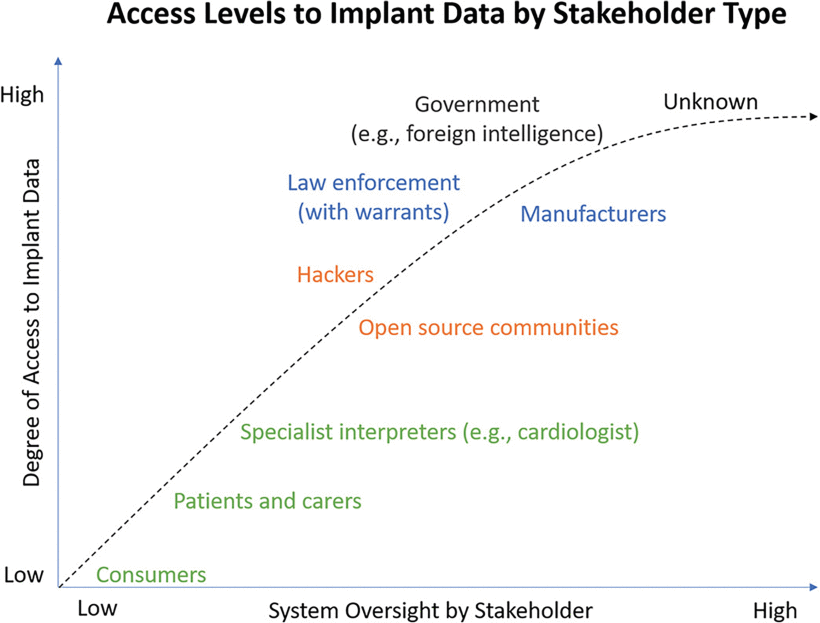

Fig. 1. Axis of Access: Second Lung of Uberveillance.
When M. G. Michael coined the idea of “axis of access” in 2009, he was going beyond access control matrices and questions related to who had read, write, execute, and delete powers in computer systems [23], or the right to oversight in systems. He described the axis of access as the “second lung” to the “machine” on account of considering the risks associated with uberveillance in its function creep and scope creep. In brief, the higher up the axis a stakeholder is situated, the clearer a picture emerges of the current and potential dangers implantees may be subjected to ahead (Fig. 1). In the context of uberveillance, this blackbox [24] masquerades as omnipresent and omniscient surveillance, which depending on a stakeholder’s position in the axis of access, may be unable to be turned on and off by the user [25], [26], in effect violating the three principles of proportionality, integrity and inviolability of the body, and dignity [27]. Furthermore, and in the current context, artificial intelligence (AI) may even be utilized to over-ride user’s decisions based on whether they are categorized as someone living with certain conditions (e.g., dementia), or whether one has a certain status (e.g., parolee), or whether one is a minor (i.e., a child).
Some key preliminary questions that might be considered with respect to the axis of access in this regard include [29]:
Who is authorized to penetrate Information and Communications Technology (ICT) systems?
Do citizens have access to their own data “on demand” (both known and unknown data collection)?
For what purposes / contexts should ultimate transparency be granted?
Can hackers, increasingly motivated by money, or by the challenge of hacking, penetrate systems that should be otherwise impenetrable?
Do law-enforcement personnel or intelligence organizations always have the last say, propelled by governments, to breach data that is, for example, encrypted?
Do governments and corporations have the right to increasingly encroach on citizenry and their unique characteristics, behavioral traits, and other sensitive information that is oftentimes of a transactional nature?
In other words, who will guard the guards themselves (Quis custodiet ipsos custodes?)[30]? Especially when we may be referencing the bulk collection of DNA [31], facial images, and increasingly, voice prints, heart rates, brain waves, and even patterns of behavior. On the one hand, there is the amassing of data for the protection of the people; on the other hand, that very same data can be used to launch calculated attacks against minorities in a given community [32]. And then there are the possibilities of deepfakes to also have to contend with [33], and the volatility of private firms that may go into liquidation [78], [79]. The axis of access framework may well be applicable to a range of security contexts and stakeholder types, but we argue that humancentric implants demand more when it comes to consent, autonomy, ethics, law, and societal considerations. The chip cannot be disassociated with the person in a humancentric implant scenario, without significant repercussions.
A. The Uberveillance Trajectory
Ultimately, the uberveillance trajectory points to a complex system of systems, that is accessible to the very few in a relative sense. We contend that the asymmetric power, access and control scenarios may lead to increased levels of insecurity, in addition to commensurate decreases in productivity, freedom of movement and one’s right to exercise their autonomy. This is shown in the hypothetical depiction of data access rights and capability by stakeholder type in Fig. 1. On the axis the question remains: which entities rank below governments [34], [35] in the quest to have the ultimate control, and might there be stakeholders who are presently “unknown” and not yet identified? Do users have the right to access their blackbox and correct inaccuracies that have been brought about by sensors that are malfunctioning or have limitations? Will citizens know who has requested access to their personal blackbox and has been granted rights to view or download the data? And what of questions to do with the physical lifetime of the dataset, and who will manage the data after an end-user’s death.
Although embodied computing technologies such as implantables may seem to introduce greater convenience and care, the dimension of control will always be prevalent [36]. Enslavement will also be a threat from those who are subjected to higher-than-normal surveillance from up the chain of data access. The result could be an unjust divide; the technological chasm between the haves and have-nots could be irreconcilable. The ontological implications are likely to be enormous. By seeking to create a framework for understanding future operational scenarios, the axis of access becomes a mechanism by which to assess the risks associated with Society 5.0 [71]. Where once it was possible to build with contingencies in place, in the event of a systems outage, the emergent infrastructure relies on the smart grid, and has few stop signs with even fewer u-turns. Anyone found off the grid- by force, by choice, by misfortune or mere happenstance- will feel the ultimate repercussions of non-personhood. If the smartphone has become an essential luggable item through airports, banks, and social services; the implant will become a persistent device carrying a unique identifier that will by default become a necessity for life.
SECTION IV.
The Paradox of Security
Where a stakeholder sits on the hierarchy, and what kind of clearance they have, is becoming increasingly important [37]. Open access to information often assumes one has an Internet connection, is (digitally) literate, and has the time and accessibility capability or knowledge or cognition to conduct a search. Some of the data people are looking for, does sit on the Internet, but much of it is behind a secure wall, despite that it resides “openly” on Internetworked infrastructure. And most of it, for the time being, is untapped- it resides in the innermost hearts and minds of people [38]. Till now, people’s thoughts and ideas have been protected merely due to the cumbersome nature of mind-reading technology (thought-to-speech technology) and people’s lack of awareness of the technology’s existence, beyond application to contexts of disability [39]. Access to information is big business, and with that access comes a commensurate level of control depending on the sensitivity of that data. It is the very reason today that social media companies are encouraging the use of AI chatbots as companions, and agents as potential digital twins [72].
The paradox of security is that at the highest levels, too much security and too much control does not allow people to live a productive life. In fact, the greatest paradox of them all is that too much security breeds insecurity. In addition, who you are provides a certain bias into what kinds of information you can ask permission to access. For example, the data that is being collected for individual members of society is not commensurate to those with security clearances, or those who can afford to live off the grid almost entirely apart from financial and health-related transactions. There are the privileged few who have access to just about anything, such as various stakeholders within intelligence agencies and bureaus, law enforcement, members of interpolicing agencies, defense personnel, government agency workers, etc. And then there are corporations who amass data and metadata on behalf of their clients and their subscriber bases, and those who work for these corporations, and then there are the end-users who generate the data on which they are judged. We cannot underestimate the lengths that governments or corporations would go to, to systematically gain access to this honeypot of data particularly from a medical prevention and socio-economic mindset [40].
SECTION V.
Data Asymmetry
In this scenario, all of this data collection creates an asymmetry, but when we are referring here to the uberveillance trajectory, who controls the chip in your body has the ultimate control because in this manner also: the stakeholder can control your movements, your patterns, your behaviors, what you do, where you work, where you live, and what activities you engage in, who you are with, and even personal thoughts you allow yourself to exercise. If these implants become the vehicle for access to the inward self, and one exists somewhere on the lower part of the axis of access, then it is likely they will be relegated to contexts where visibility is low, and transparency is lacking. This is deliberate in its effect of keeping the sheep preoccupied, ensuring there is no time to look up to get a glimpse of the realities of life, rather, the sheep follow- one after the other without question. While there are advantages that sheep have in numbers, including feeling secure, the ability to see everywhere at once, the outer sheep acting as a windbreak to the flock, and protection from predators [41]; it is this same security that precludes the sheep from roaming freely. Repetitive and cyclical behavior is common among the masses. Breaking free from this behavior is nearly impossible as the masses are too busy looking down, with the system built to maintain control over them not granting them a chance to look up.
Privacy, security, trust, control, and human rights are all concerns that need to be addressed before widespread diffusion of advanced identification, location and AI-enabled uberveillant technologies [42]. Implants for humans are not new. The installation of pacemakers in humans and a great number of other medical innovations for prosthesis are now considered straightforward procedures. Today we have even realized the potential for microchip implants to be embedded inside the human body for the purpose of acting as unique lifetime identifiers (ULIs) [43], and potentially health and wellbeing monitors [44]. Some of the major problems pertaining to microchip implants are related to who or what is in control of the personal data stored and gathered from such devices. While each new implanted device might well be in accordance with governing regulations for commercial purposes, this does not necessarily mean that the risks associated with that particular application have been nullified [45]. The popular perception is that compliance with common standards and regulations, and adherence to state laws means that the device is safe to use and legal. This we know not to be necessarily true. The question of ethics and ethical practices, however, clouds the technology, which by its very nature is penetrating, trespassing into that most sacred of spaces: the human body. The natural possession of the self becomes to a degree the property of a third-party stakeholder, someone other than the ‘I’. This condition beckons new explorations into the traditional world of ontology, that is, the nature of being, particularly to do with questions connected to identity and consciousness. We return, thus, to the age-old question of who owns your body? [50]
SECTION VI.
Raising Awareness About Humancentric Implants
Numerous attempts have been made to clarify and to solve the problems that humancentric implants have created. These fall into a number of categories:
Self-based assurance controls, like those founded on proprietary standards, and antihacking and anti-cloning devices such as metal coverings to obstruct unauthorized reads of the chip;
State legislative initiatives such as the anti-chipping bills enacted in Wisconsin and North Dakota in the United States, stipulating that if an individual forcibly chip-implants another, the commensurate penalties apply;
Technology assessment such as that conducted in the European Union to explore the question of ethics using a universal panel of experts with diverse backgrounds;
Use-case analysis whereby active chip-implant trials took place in the United Kingdom and United States, gathering participant feedback;
Clinical trials sponsored by private organizations to gauge the potential health side effects of implants in people; and
Surveys measuring consumer acceptance, and attitudes towards microchip implants for use in national security.
All of these approaches have helped to inform research at large, but none have completely addressed the complex issues surrounding the socio-technical implications of microchipping people.
A. Various Approaches to Studying Implantables
Some of the ethical issues that we address in our research can be discussed in the context of what some modern thinkers have called the precautionary principle. The fundamentals of this approach can be found in Weckert and Moor [46], who advise that, “[i]f some action has a possibility of causing harm, then that action should not be undertaken, or some measure should be put in its place to minimize or eliminate the potential harm.” Of course, the niggling question remains: who or what will be trusted to determine which action(s) should or should not be undertaken?
We have grounded previous research in the historical case method and devised best case/worst case scenarios on principles founded in commercial offerings. Additionally, if we can point to the social implications of uberveillance, then we can also point to the design and development of emerging technologies using a human-centered approach, in the hope that at least some of the socio-technical sensibilities can be embedded in the functional specifications [47], [48], [49], [50] The predictive element has been a strong force in all our studies, and we have captured the auto-ID trajectory within the field of high-tech innovation. We have encouraged, as much as possible, public discourse and critical debate on the matter, reaching out to diverse audiences—researchers, students, citizens, vendors, radio and newspapers, government agencies—in a consultative role to stimulate discussions, albeit which some have considered premature.
One might well ask whether we can prejudge ethics before an application has taken root, but post widespread diffusion of microchip implants, there will be no turning back. We have sought comprehensive interviews with key informant implantees to gauge their feelings and attitudes towards the pros and cons of RFID implants, providing hypothetical scenarios, with a focus on user-centered design. We have also simulated trials based not only on microchip implants but also on converging capabilities such as location services and condition monitoring. The big picture cannot be ignored, nor can the role of regulation be underestimated. If humans are to use these technologies toward sustainable solutions, they will need to build commensurate legal protections to allow them to flourish.
SECTION VII.
Sustainability of People and Place
The research will continue to address complex ethical questions in a predictive manner so long as diffusion of microchip implants remains ethically questionable, for a wide spectrum of applications. Issues such as whether it is ethical to embed an individual with a device they cannot remove, even if they have given their prior consent to be implanted, will be further explored [51], particularly if these technologies are used to bring together health, financial and governmental guidance. The convergence of implantable devices with mobile phones and smart wearables through tethering, and satellite and spatial technologies are utilized to provide an uber view, which will inevitably have an impact on the surveillance field. The proposed AI-enabled “io” fastened to a necklace round one’s neck will preclude the need for an implant, at least in the short term. This is particularly true, if ventures like those proposed by Zuckerberg [80], Altman and Ive, and even Musk, take firm root. It is our hope that we will continue to conduct research that will point to the consequences of emerging technologies, signaling that we are not passive bystanders in this process, but can through better ‘by design’ principles and practices operationalize clear objectives for a future that is not fatalistic or nihilistic and uses consultative processes to determine futures through value-based design. We maintain a human-centered approach is required for humancentric implants. We do not expect personal or body area networks to remain the same, but as they evolve, retaining our humanity is vital.
A. Managing Populations and Limited Resources
With the actualization of megacities, so large, that they will shortly form corridors of interconnected megalopolises, will come modern-day coverage versus congestion constraint problems for service delivery. Humancentric implants may well be touted as the solution that will allow major advancements forward toward fundamental ideals such as a functional circular economy, addressing core sustainable development goals (SDGs) with respect to poverty, hunger, good health and well-being, etc. Last mile solutions through the human cloud may well facilitate a reduction in human inequalities toward more sustainable cities but this will come through public interest initiatives in which communities will be able to determine their level of contribution and expected returns [52].
But what of more invasive technology in the human body, not just implantables that act as blackboxes, but an uberveillance that has the capacity not only to cause major existential risks [53] through brain-to-computer interfaces, but an existential crisis [54] in denoting what it means to be human [20]. The blackbox recorder embedded for health and safety purposes will sit monitoring vital signs and characteristics and offer identity and location capabilities, but the brain implants will act as a translator between the digital and the analogue (i.e., natural). For some, these brain pacemakers will be related to medical conditions, and switching off the pacemaker may not only lead to instant degradation in human capabilities but may cause “death by Internet” [55]. We will thus have to potentially contend with multiple forms of blackboxes within the body: (1) the algorithms within the autonomous implants that will work in a way that is unknown to the end-user and possibly even to the designer’s original intent, (2) the blackbox that will act as a typical recorder monitoring vital signs and characteristics providing early warnings and preventative techniques toward health and wellbeing solutions, and (3) the blackbox translator that will take over some of the human beings fundamental faculties, e.g., thought-to-speech, thought-to-action, and even more [8, pp. 123–124]. Enter in the potential of agentic AI, and the Internet of Things takes on a whole new charter.
SECTION VIII.
Conclusion
We look forward to continuing to demonstrate how the term “uberveillance” has been used, and continues to be used, by other researchers worldwide towards interdisciplinary scientific work [56], without discounting the larger corpus of research more generally on humancentric implants of all types. We also will document increasing reference to the term in a variety of contexts: national security, government reports, peer-reviewed academic sources, industry, blogs, the media, and popular culture. We remain passionate on questions dealing with the applied ethics in relation to surveillance, especially in places where the application of uberveillance would violate the body (i.e., bodily integrity [57]) that is to say, the “sacred space” or where surveillance in general would impact upon our abilities to act as free agents outside any visible or invisible coercion [58]. One area of interest is to explore multinational and corporate involvement in the area of consumption analysis in creating demand, supply, and the diffusion of identity and multiapplication schemes. Another is to investigate the need for implantables in two-factor authentication solutions (e.g., an implant token inside the body, and a physical biometric characteristic that goes with someone everywhere they go, or tethered even to the smartphone that one carries). We need to be highly discerning about what lies behind the electrified glass tubes that flash WYSIATI “what you see is all there is” [59]. It is just not true above all, when it comes to embedded surveillance devices and we will suffer awful consequences if we do not demand greater visibiity.
Competing narratives and criticisms of the research underpinning uberveillance are more than welcome. This is a complex and controversial field, and we need to update and inform each other, whether this has to do with new technologies, amendments to legislation, or as has been demonstrated by the adoption of AI, the need to ‘pause’ innovation [60]. Those of us who are genuinely concerned with the quickening erosion of our right to privacy must consider our natural rights. Locke [61] and the social contract thinkers had some momentous things to say regarding these rights, and we should heed their insights and adopt them accordingly in the new systems being rapidly developed. Individuals must possess the freedom to decide to what extent they integrate themselves into the electronic grid and so-named “smart cities”. Additionally, philosophers who have contemplated the question of technology’s impact on society such as Martin Heidegger, Ivan Illich [62], Jacques Ellul, and those from the Frankfurt School, have argued that technology must be vigorously critiqued, for the worst of all possible outcomes would be the de-humanization of the individual and the loss of dignity resulting in a “standardized subject of brute self-preservation” [63, p. 71].
One of the fundamental elements of such literature is the profound comprehension that technology has not only to do with building but that it is also a social process. Charlie Chaplin’s culturally significant Modern Times[64] is an unmatched visual accompaniment, the classic scene of the iconic Little Tramp caught up into the cogs of the giant machine, of the unintended consequences of the efficiencies of modern industrialization. A decade earlier Fritz Lang’s futuristic Metropolis (1926), the story of a mechanized underground city set in a dystopian society, would likewise leave its indelible mark [65]. It was a prescient summary of what was to follow, the troubling link between technology and teleology capture. What will be the impact of these forces on our society with respect to covert surveillance [66]? Indeed, the line between overt and covert surveillance is blurring - it becomes indistinguishable when we are surrounded by surveillance and are inside the thick fog itself. The other aspect that becomes completely misconstrued is that there is actually logic in the equation that says that there is a trade-off between privacy and convenience [67]. There is no such trade-off. The two variables cannot be discussed on equal footing – you cannot give a little of your privacy away for convenience and hope to have it still intact thereafter. No amount of monetary or value-based recompense will correct this asymmetry. There is no consolation for privacy loss, especially our personal thoughts. We cannot be made to feel better after giving away a part of ourselves. It is not like scraping one’s knee against the concrete with the expectation that the scab will heal after a few days. Privacy loss is to be perpetually bleeding, perpetually exposed [68].
Finally, ethics (rules or standards of behavior) are not irrelevant when it comes to the technologies we introduce into our lives. The ethics we promote that determine our responses and acts are vital. Technology has to be scrutinized by ethical concerns, for technology is not neutral, it is imbued with the spirit and intentions of its builders. As depicted in the axis of access, technology does create a technological elite with superior access to these new technologies, widening the gap between the haves and have nots. Is this not an ethical question of the irregular placement and uses of power? In actual fact, our freedoms are being impinged. Sadly, the Internet of Things and People mantra denigrates “People” to “Things”; “Subjects” are on an equal playing field with “Objects.” But humans are not things. They are unique individuals with spirits and the ability to think creatively. We are not 1s and 0s and never will be [69]. It is an abyss we must collectively endeavor to, at all costs, avoid.
ACKNOWLEDGMENT
This work was supported in part by the National Science Foundation Research Traineeship Award #2152254 “Design and Manufacturing of Medical Devices and Implants: Cultivating a Human-Centered Mindset”.
Katina Michael would like to thank the guest editor team of this special issue presented in Volume 6, Number 3, first for their guest editorial, and second for addressing the novel theme of “AI, Empathy, and People”. Associate Professor Shashank Vaid of the DeGroote Business School at McMaster University, in particular, wished to explore how technology and marketing interface, alongside Professors Stefano Puntoni of The Wharton School at the University of Pennsylvania and Benson Honig also at DeGroote. We pulled this issue together from a variety of perspectives, inclusive of business, innovation and entrepreneurship, providing an interdisciplinary lens to what is possible already today and the flow-on implications that will yield both positive benefits and opportunities, alongside risks that need to be addressed.
References
1. A. Glaser and K. Wagner. “Facebook is developing a way to read your mind.” Vox.com. Apr. 2017. Accessed: May 5, 2025. [Online]. Available: https://www.vox.com/2017/4/19/15361568/facebook-mark-zuckerberg-brain-mind-reader-regina-dugan-building-f8
2. “Brain-computer interface helps paralyzed man speak.” Sep. 2024. Accessed: May 5, 2025. [Online]. Available: https://www.nih.gov/news-events/nih-research-matters/brain-computer-interface-helps-paralyzed-man-speak
3. A. Aloudat and K. Michael, “Toward the regulation of ubiquitous mobile government: A case study on location-based emergency services in Australia,” Electr. Comm. Res., vol. 11, pp. 31–74, Jan. 2011, doi: 10.1007/s10660-010-9070-0.
4. K. Michael and R. Clarke, “Location and tracking of mobile devices: Überveillance stalks the streets,” Comput. Law Secur. Rev., vol. 29, no. 3, pp. 216–228, 2013, doi: 10.1016/j.clsr.2013.03.004.
5. J. Evans and C. Sibthorpe. “Facial recognition: Feature creep may impose government's software in our lives, expert warns.” ABC News. Oct. 2017. Accessed: May 5, 2025. [Online]. Available: https://www.abc.net.au/news/2017-10-05/facial-recognition-coag-privacy-concerns-about-the-capability/9017494
6. R. Abbas and K. Michael. “The coronavirus contact tracing app won't log your location, but it will reveal who you hang out with.” The Conversation. Apr. 2020. [Online]. Available: https://theconversation.com/the-coronavirus-contact-tracing-app-wont-log-your-location-but-it-will-reveal-who-you-hang-out-with-136387
7. K. Michael and R. Abbas, “What happens to COVID-19 data after the pandemic? Socio-technical lessons,” IEEE Trans. Technol. Soc., vol. 3, no. 4, pp. 242–247, Dec. 2022, doi: 10.1109/TTS.2022.3226119.
8. K. Michael, R. Abbas, G. Roussos, E. Scornavacca, and S. Fosso-Wamba, “Ethics in AI and autonomous system applications design,” IEEE Trans. Technol. Soc., vol. 1, no. 3, pp. 114–127, Sep. 2020, doi: 10.1109/TTS.2020.3019595.
9. M. Roberti. “How can I kill an RFID tag implant?,” RFID Journal. 2014. [Online]. Available: https://www.rfidjournal.com/question/how-can-i-kill-an-rfid-tag-implant
10. C. Offman. “You are tagged: Radio transmitters to track merchandise one thing, but are people ready for ID imbedded in their bodies?,” The National Post. Dec. 2007. Accessed: May 29, 2009. [Online]. Available: http://www.nationalpost.com/news/story.html?id=139966
11. M. G. Michael and K. Michael, “Überveillance: 24/7×365-people tracking and monitoring,” in Proc. 29th Int. Conf. Data Protect. Privacy Comm., Privacy Horizons, Terra Incognita, Sep. 2007, pp. 25–28.
12. K. Michael, A. McNamee, M. G. Michael, and H. Tootell, “Location-based intelligence—Modeling behavior in humans using GPS,” in Proc. IEEE Int. Symp. Technol. Soc., Queens, NY, USA, 2006, pp. 1–8, doi: 10.1109/ISTAS.2006.4375889.
13. K. Michael, A. McNamee, and M. G. Michael, “The emerging ethics of humancentric GPS tracking and monitoring,” in Proc. Int. Conf. Mobile Bus., Copenhagen, Denmark, 2006, pp. 34–34, doi: 10.1109/ICMB.2006.43.
14. J. Pitt, The Computer After Me: Awareness and Self-awareness in Autonomic Systems. London, U.K. : Imperial College, 2014.
15. K. Michael and M. G. Michael, “Networks & Infrastructure: Converging and coexisting systems towards smart surveillance.” Awareness Magazine. Jun. 2012. [Online]. Available: http://dx.doi.org/10.2417/3201206.00398910.2417/3201206.003989
16. A. J. Goldsmith, “Policing's new visibility,” Brit. J. Criminol., vol. 50, no. 5, pp. 914–934, Sep. 2010. [Online]. Available: https://www.jstor.org/stable/43610808
17. S. Bronitt and K. Michael, “Human rights, regulation, and national security,” IEEE Technol. Soc. Mag., vol. 31, no. 1, pp. 15–16, Mar. 2012, doi: 10.1109/MTS.2012.2188704.
18. K. Michael, M. G. Michael, C. Perakslis, and R. Abbas, “Uberveillance and the rise of last-mile implantables: Past, present and future,” in Embodied Computing: Wearables, Implantables, Embeddables, Ingestibles, I. Pedersen and A. Iliadis, Eds., Cambridge, MA, USA : MIT Press, pp. 97–130, doi: 10.7551/mitpress/11564.003.0007.
19. R. Abbas, K. Michael, M. G. Michael, C. Perakslis, and J. Pitt, “Machine learning, convergence digitalization, and the concentration of power: Enslavement by design using techno-biological behaviors,” IEEE Trans. Technol. Soc., vol. 3, no. 2, pp. 76–88, Jun. 2022.
20. K. Michael, J. Pitt, R. Abbas, C. Perakslis, and M. G. Michael, “CYBORGS and human–machine communication configurations,” in The SAGE Handbook of Human–Machine Communication, A. L. Guzman, R. McEwen, and S. Jones, Eds., Thousand Oaks, CA, USA : SAGE, 2023, ch. 4, pp. 32–44, doi: 10.1109/TTS.2022.3179756.
21. A. F. Winfield, K. Michael, J. Pitt, and V. Evers, “Machine ethics: The design and governance of ethical AI and autonomous systems,” Proc. IEEE, vol. 107, no. 3, pp. 509–517, Mar. 2019, doi: 10.1109/JPROC.2019.2900622.
22. M. G. Michael and K. Michael, “Toward a state of Uberveillance,” IEEE Technol. Soc. Mag., vol. 29, no. 2, pp. 9–16, Jun. 2010, doi: 10.1109/MTS.2010.937024.
23. M. Bishop, Computer Security: Art And Science. Boston, MA, USA : Addison-Wesley, 2005, pp. 28–34.
24. K. Michael and M. G. Michael, “Implementing 'Namebars' using microchip implants: The black box beneath the skin,” in This Pervasive Day: The Potential and Perils of Pervasive Computing, J. Pitt, Eds., London, U.K. : Imperial College, 2010, ch. 10, pp. 163–206.
25. R. Pringle, K. Michael, and M. G. Michael, “Unintended consequences: The paradox of technological potential,” IEEE Potentials, vol. 35, no. 5, pp. 7–10, Sep./Oct. 2016, doi: 10.1109/MPOT.2016.2569672.
26. R. Pringle, K. Michael, and M. G. Michael, “Unintended consequences of living with AI: The paradox of technological potential? Part II,” IEEE Technol. Soc. Mag., vol. 35, no. 4, pp. 17–21, Dec. 2016, doi: 10.1109/MTS.2016.2632978.
27. C. Perakslis, K. Michael, and M. G. Michael, “The converging veillances: Border crossings in an interconnected world,” IEEE Potentials, vol. 35, no. 5, pp. 23–25, Sep./Oct. 2016, doi: 10.1109/MPOT.2016.2569724.
28. M.G. Michael, K. Michael, and T. Bookman, “Can god be an AI with robo-priests?,” IEEE Trans. Technol. Soc., vol. 4, no. 1, pp. 2–8, Mar. 2023, doi: 10.1109/TTS.2023.3238960.
29. K. Michael. “Cybersecurity as public interest technology, national initiative for cybersecurity education (NICE), a program of the national institute of standards and technology in the U.S. department of commerce.” Nov. 2019. [Online]. Available: https://niceconference.org/
30. J. Pitt, K. Michael, M. G. Michael, C. Perakslis, and R. Abbas, “Safeguarding the guardians to safeguard the bio-economy and mitigate social injustices,” in Cyberbiosecurity, D. Greenbaum, Ed. Cham, Switzerland : Springer, 2023, doi: 10.1007/978-3-031-26034-6_12.
31. K. Michael, “The legal, social and ethical controversy of the collection and storage of fingerprint profiles and DNA samples in forensic science,” in Proc. IEEE Int. Symp. Technol. Soc., Wollongong, NSW, Australia, 2010, pp. 48–60, doi: 10.1109/ISTAS.2010.5514654.
32. K. Michael and M. G. Michael, “No limits to watching? ” Commun. ACM, vol. 56, no. 11, pp. 26–28, Nov. 2013, doi: 10.1145/2527187.
33. Y. Apolo and K. Michael, “Beyond a reasonable doubt? Audiovisual evidence, AI manipulation, deepfakes, and the law,” IEEE Trans. Technol. Soc., vol. 5, no. 2, pp. 156–168, Jun. 2024, doi: 10.1109/TTS.2024.3427816.
34. N. Shachtman. “A spy machine of DARPA's dreams.” WIRED. May 2003. [Online]. Available: https://www.wired.com/2003/05/a-spy-machine-of-darpas-dreams/ rightlinenumbers
35. K. Michael and M. G. Michael, “Commentary on: Mann, Steve: Wearable computing,” in Encyclopedia of Human-Computer Interaction, Aarhus, Denmark : Interact. Design Found., 2012. [Online]. Available: https://www.interaction-design.org/literature/book/the-encyclopedia-of-human-computer-interaction-2nd-ed/wearable-computing
36. K. Michael and A. Masters, “Humancentric applications of RFID implants: The usability contexts of control, convenience and care,” in Proc. Int. Workshop Mobile Comm. Services, 2005, pp. 32–41, doi: 10.1109/WMCS.2005.11.
37. K. Michael, S. Kobran, R. Abbas, and S. Hamdoun, “Privacy, data rights and cybersecurity: Technology for good in the achievement of sustainable development goals,” in Proc. IEEE Int. Symp. Technol. Soc. (ISTAS), 2019, pp. 1–13, doi: 10.1109/ISTAS48451.2019.8937956.
38. K.G. Haut, T. Sen, D. Lomakin, and E. Hoque, “A mental trespass? Unveiling truth, exposing thoughts, and threatening civil liberties with noninvasive AI lie detection,” IEEE Trans. Technol. Soc., vol. 3, no. 2, pp. 132–142, Jun. 2022, doi: 10.1109/TTS.2022.3172556.
39. S. Hamdoun, K. Michael, R. Monteleone, and T. Bookman, “Assistive technologies for greatly improved quality of life for people living with MND/ALS,” IEEE Consum. Electron. Mag., vol. 10, no. 3, pp. 76–81, May 2021, doi: 10.1109/MCE.2020.3035523.
40. C. Bormpotsis, M. Nanos, and A. Patel, “A neuroscience-informed AI framework to decode the complexities of neurofinance,” IEEE Trans. Technol. Soc., early access, Apr. 8, 2025, doi: 10.1109/TTS.2025.3556355.
41. K. McCune. “5 reasons why sheep follow each other.” Family Farm Livestock. 2021. [Online]. Available: https://familyfarmlivestock.com/5-reasons-why-sheep-follow-each-other/
42. K. Michael, R. Abbas, R. A. Calvo, G. Roussos, E. Scornavacca, and S. F. Wamba, “Smart infrastructure and technology systems ethics,” IEEE Trans. Technol. Soc., vol. 2, no. 1, pp. 2–3, Mar. 2021, doi: 10.1109/TTS.2021.3062431.
43. K. Cukier. “What if generative AI destroys biometric security? ” The Economist. May 2023. [Online]. Available: https://www.economist.com/biometrics-pod
44. K. Michael, “DARPA's ADAPTER program: Applying the ELSI approach to a semi-autonomous complex socio-technical system,” in Proc. IEEE Conf. Norbert Wiener 21st Century (21CW), 2021, pp. 1–10, doi: 10.1109/21CW48944.2021.9532581.
45. K. Michael ( Comput. Res. Assoc. (CCC), Washington, DC, USA, Hyatt, Chicago, IL, USA ). Human Autonomy in Emerging Technology Systems, Panel 3-Ethics/Policy/Societal Impacts, Feb. 2020. [Online]. Available: https://cra.org/ccc/events/assured-autonomy-workshop-2/#agenda
46. J. Weckert and J. Moor, “The precautionary principle in nanotechnology,” Int. J. Appl. Philos., vol. 20, no. 2, pp. 191–204, 2006.
47. R. Abbas, S. Marsh, and K. Milanovic, “Ethics and system design in a new era of human-computer interaction,” IEEE Technol. Soc. Mag., vol. 38, no. 4, pp. 32–33, Dec. 2019, doi: 10.1109/MTS.2019.2948448.
48. R. Abbas, J. Pitt, and K. Michael, “Socio-technical design for public interest technology,” IEEE Trans. Technol. Soc., vol. 2, no. 2, pp. 55–61, Jun. 2021, doi: 10.1109/TTS.2021.3086260.
49. J. R. Schoenherr, R. Abbas, K. Michael, P. Rivas, and T. D. Anderson, “Designing AI using a human-centered approach: Explainability and accuracy toward trustworthiness,” IEEE Trans. Technol. Soc., vol. 4, no. 1, pp. 9–23, Mar. 2023, doi: 10.1109/TTS.2023.3257627.
50. R. Abbas and K. Michael, Socio-Technical Theory: A Review, S. Papagiannidis, Ed. Newcastle, U.K. : TheoryHub Book, 2023. [Online]. Available: http://open.ncl.ac.uk/
51. K. Michael, “Can good standards propel unethical technologies? ” IEEE Trans. Technol. Soc., vol. 35, no. 3, pp. 6–9, Sep. 2016, doi: 10.1109/MTS.2016.2594663.
52. K. Michael, M. G. Michael, C. Perakslis, and R. Abbas, “Überveillance and the rise of last-mile implantables: Past, present, and future,” in Embodied Computing: Wearables, Implantables, Embeddables, Ingestibles, I. Pedersen and A. Iliadis, Eds., MIT Press, 2020, ch. 5, pp. 97–130.
53. M. Demko, K. Michael, K. Wagner, and T. Bookman, “When brain computer interfaces pose an existential risk,” in Proc. IEEE Int. Symp. Technol. Soc. (ISTAS), Tempe, AZ, USA, 2020, pp. 112–114, doi: 10.1109/ISTAS50296.2020.9462244.
54. W. Armstrong and K. Michael, “The implications of neuralink and brain machine interface technologies,” in Proc. IEEE Int. Symp. Technol. Soc. (ISTAS), Tempe, AZ, USA, 2020, pp. 201–203, doi: 10.1109/ISTAS50296.2020.9462223.
55. J. Carvalko, Death by Internet. Mechanicsburg, PA, USA : Sunbury Press, 2016.
56. C. Perakslis, J. Pitt, K. Michael, and M. G. Michael, “Pervasive technologies: Principles to consider,” Ethics Biol., Eng. Med., Int. J., vol. 5, no. 1, pp. 79–93, 2014.
57. R. Achille, C. Perakslis, and K. Michael, “Ethical issues to consider for microchip implants in humans,” Ethics Biol., Eng. Med., Int. J., vol. 3, nos. 1–3, pp. 75–86, 2012.
58. S. R. Bradley-Munn and K. Michael, “Whose Body Is It?: The body as physical capital in a techno-society,” IEEE Consum. Electron. Mag., vol. 5, no. 3, pp. 107–114, Jul. 2016, doi: 10.1109/MCE.2016.2576518.
59. D. Kahneman, Thinking, Fast and Slow, Macmillan, New York, NY, USA, 2011.
60. T. Gundersen and K. Bærøe, “Ethical algorithmic advice: Some reasons to pause and think twice,” Amer. J. Bioeth., vol. 22, no. 7, pp. 26–28, 2022, doi: 10.1080/15265161.2022.2075053.
61. J. Locke, Locke: Political Writings. Indianapolis, IN, USA : Hackett Publ., 2003.
62. I. Illich, Deschooling Society. Berlin, Germany : Walter de Gruyter, 1971, ch. 6.
63. H. Marcuse, “Social implications of technology,” in Readings in the Philosophy of Technology, D. M. Kaplan, Ed., Lanham, MD, USA : Rowman Littlefield, 2009, pp. 63–79.
64. C. Chaplin, P. Goddard, H. Bergman, T. Sandford, and C. Conklin, Modern Times, vol. 5. Beverly Hills, CA, USA : United Artists, 1936.
65. F. Lang, T. von Harbou, A. Abel, G. Fröhlich, B. Helm, and G. Huppertz, Metropolis. Toronto, ON, Canada : Lorrimer Pub, 1973.
66. R. Abbas, K. Michael, M. G. Michael, and A. Aloudat, “Emerging forms of covert surveillance using GPS-enabled devices,” J. Cases Inf. Technol. (JCIT), vol. 13, no. 2, pp. 19–33, 2011.
67. G. Ng-Kruelle, P. A. Swatman, D. S. Rebne, and J. Felix Hampe, “The price of convenience: Privacy and mobile commerce,” Quart. J. Electron. Comm., vol. 3, pp. 273–286, Jan. 2002.
68. M. G. Michael and K. Michael, Eds., Uberveillance and the Social Implications of Microchip Implants: Emerging Technologies: Emerging Technologies, Hershey : PA, USA: IGI, 2013.
69. M. G. Michael, “The paradox of the uberveillance equation,” IEEE Technol. Soc. Mag., vol. 35, no. 3, pp. 14–20, Sep. 2016, doi: 10.1109/MTS.2016.259920.
70. S. Rodotá and R. Capurro ( Eur. Comm., Brussels, Belgium ), Ethical Aspects of ICT Implants in the Human Body: Opinion of the European Group on Ethics in Science and New Technologies to the European Commission N°20. ( Mar. 16, 2005 ). Accessed: Oct. 4, 2007. [Online]. Available: http://ec.europa.eu/european_group_ethics/docs/avis20_en.pdf
71. R. Capurro, “Society 5.0.” Accessed: Oct. 20, 2022. [Online]. Available: http://www.capurro.de/quaestiones.html#SOCIETY_5.0_
72. M. Bobrowsky. “Zuckerberg's grand vision: Most of your friends will be AI.” The Wall Street Journal. May 7, 2025. Accessed: May 9, 2025. [Online]. Available: https://www.wsj.com/tech/ai/mark-zuckerberg-ai-digital-future-0bb04de7
73. A. Berry, The Next 500 Years: Life in the Coming Millennium. New York, NY, USA : Gramercy Books, 1996.
74. B. Jin. “What Sam Altman told OpenAI about the secret device He's making with Jony Ive.” The Wall Street Journal. Accessed: May 21, 2025. [Online]. Available: https://www.wsj.com/tech/ai/what-sam-altman-told-openai-about-the-secret-device-hes-making-with-jony-ive-f1384005
75. “Sam & Jony introduce io.” OpenAI. Accessed: May 21, 2025. [Online]. Available: https://openai.com/sam-and-jony/
76. T. Rank. ChatGPT's New Device Will Change EVERYTHING. Accessed: May 27, 2025. [Online Video]. Available: https://www.youtube.com/watch?v=mKZTqMyKhos
77. J. Chokkattu. “Your next AI wearable will listen to everything all the time.” Wired. Jan. 8, 2025. [Online]. Available: https://www.wired.com/story/bee-ai-omi-always-listening-ai-wearables/
78. K. Spector-Bagdady. “23andMe is potentially selling more than just genetic data—The personal survey info it collected is just as much a privacy problem.” The Conversation. Accessed: Apr. 2, 2025. [Online]. Available: https://theconversation.com/23andme-is-potentially-selling-more-than-just-genetic-data-the-personal-survey-info-it-collected-is-just-as-much-a-privacy-problem-253220
79. B. Allyn. “23andMe is on the brink. What happens to all its DNA data? ” NPR. Accessed: Oct. 3, 2024. [Online]. Available: https://www.npr.org/2024/10/03/g-s1-25795/23andme-data-genetic-dna-privacy
80. K. Chayka. “Mark Zuckerberg says its the end of social media.” The New Yorker. Accessed: Apr. 23, 2025. [Online]. Available: https://www.newyorker.com/culture/infinite-scroll/mark-zuckerberg-says-social-media-is-over
Authors
M. G. Michael received the B.A. degree from the University of Sydney, Sydney, NSW, Australia, the B.Theol. degree from the Sydney College of Divinity, Macquarie Park, NSW, Australia, the M.A. degree (Hons.) from Macquarie University, Sydney, the M.Theol. degree from the University of Sydney, and the Ph.D. degree from the Australian Catholic University, Brisbane, QLD, Australia. He was formerly an Honorary Associate Professor with the School of Information Systems and Technology, University of Wollongong, Wollongong, NSW, Australia. He is a theologian and a historian with cross-disciplinary qualifications in the humanities who introduced the concept of Überveillance into the privacy and bioethics literature to denote embedded surveillance devices in the human body. His formal studies include theology, ancient history, general philosophy, political sociology, linguistics, government, and modern Greek. He was the Co-Editor of three volumes of the Research Network for a Secure Australia’s “Human Factors” workshop proceedings from 2006 to 2008 and author and editor of several reference volumes including Uberveillance and the Social Implications of Microchip Implants: Emerging Technologies (IGI Global Scientific Publishing). He brings with him a unique perspective to emerging technologies. For more information, see https://www.mgmichael.com.
School for the Future of Innovation in Society, Arizona State University, Tempe, AZ, USA
Newcastle Business School, Newcastle upon Tyne, U.K.
University of Wollongong, Wollongong, NSW, Australia
Katina Michael (Senior Member, IEEE) received the B.S. degree in information technology from the School of Mathematical and Computing Science, University of Technology, Sydney, NSW, Australia, in 1996, the Doctor of Philosophy degree in information and communication technology from the Faculty of Informatics, University of Wollongong, Wollongong, NSW, Australia, in 2003, and the Master of Transnational Crime Prevention degree (with Distinction) from the Faculty of Law, University of Wollongong in 2009. Katina is presently a Visiting Research Scientist at Arizona State University. She has held visiting academic appointments with Newcastle University Business School, U.K., Nanjing University, Nanjing, China, and the University of Southampton, Southampton, U.K. From 1996 to 2001, she was a Senior Network Engineer with Nortel Networks, Wollongong. She was also a Systems Analyst with Andersen Consulting, North Sydney, NSW, Australia, and OTIS Elevator Company, Minto, NSW, Australia. From 2002 to 2018, she was a Professor with the School of Computing and Information Technology, as well as the Associate Dean International with the Faculty of Engineering and Information Sciences, University of Wollongong. She was also a tenured Professor with the School for the Future of Innovation in Society and the School of Computing and Augmented Intelligence, Arizona State University, Tempe, AZ, USA, from 2018 to 2024, where she was the Director of the Society Policy Engineering Collective and a Senior Global Futures Scientist in the College of Global Futures.
Citation: M. G. Michael and K. Michael, "Editorial Axis of Access—The Controllers and the Controlled," in IEEE Transactions on Technology and Society, vol. 6, no. 3, pp. 232-241, Sept. 2025, doi: 10.1109/TTS.2025.3567737.