Editorial: IEEE Transactions on Technology and Society Achieves Major Indexing Milestone
Citation: K. Michael, G. Roussos and J. Richard Schoenherr, "Editorial IEEE Transactions on Technology and Society Achieves Major Indexing Milestone," in IEEE Transactions on Technology and Society, vol. 7, no. 1, pp. 2-3, March 2026, doi: 10.1109/TTS.2026.3663947.
We are pleased to announce that IEEE Transactions on Technology and Society (TTS) has been formally accepted for indexing in both Elsevier’s Scopus[1] and Clarivate’s Web of Science[2], with confirmation received in December 2025. Inclusion in these two leading citation databases marks a defining milestone in the journal’s evolution and affirms its growing influence within the global research ecosystem.
As part of its Scopus indexing, IEEE TTS has received a 2025 CiteScore of 9.7, based on 1351 citations across 139 published documents, with the journal’s full back file incorporated from 2020 to 2025 [Fig. 1]. This early performance is particularly notable for a journal launched in 2020, reflecting strong engagement, relevance, and citation uptake across multiple disciplines. In parallel, IEEE TTS has been included in Web of Science’s Emerging Sources Citation Index (ESCI), with backdating from 2023, and is categorized under “Social Issues | Engineering, Multidisciplinary” Fig. 2. An initial Impact Factor is anticipated in 2026.
Fig. 1.
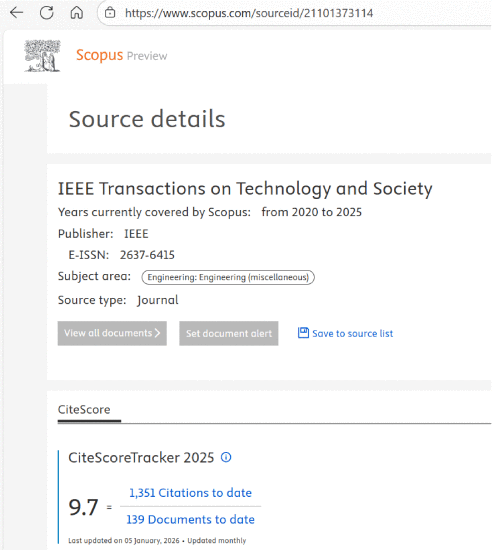
Scopus, CiteScoreTracker 2025, https://www.scopus.com/sourceid/21101373114.
Fig. 2.
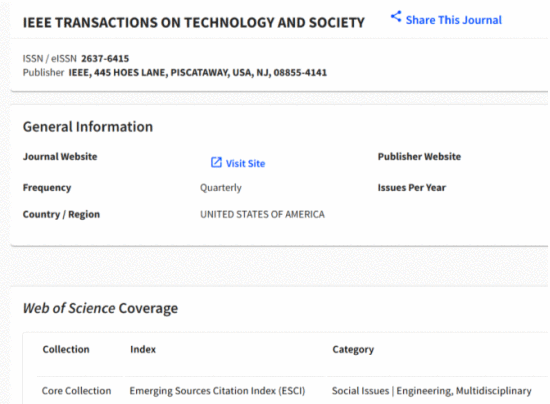
Web of Science, https://mjl.clarivate.com/journal-profile.
For a journal established with an explicit mandate to bridge technical and non-technical domains [3], indexing in both Scopus and Web of Science represents more than symbolic recognition. These databases play a central role in research discovery, evaluation, and institutional benchmarking. Their inclusion confirms that IEEE TTS has reached a level of scholarly maturity, editorial robustness, and citation visibility expected of established international journals, while remaining true to its interdisciplinary mission.
At a time when global challenges are being positioned as needing urgent attention, from artificial intelligence governance to infrastructure security, the importance of transdisciplinary scholarship cannot be overstated [4]. Such challenges rarely conform to the boundaries of a single discipline or methodological tradition, requiring instead the integration of technical expertise with social, economic, cultural, legal, and ethical perspectives.
Yet interdisciplinary journals that are neither domain- nor discipline-specific, have historically faced barriers to recognition and citation, in part due to entrenched preferences for referencing established, traditional outlets within siloed fields [5]. IEEE TTS actively challenges this paradigm by recognizing and publishing not only theoretical and empirical research articles, but also whitepapers, industry-based impact assessments, government and policy reports addressing sociotechnical mandates, standards-related documentation, informed third sector perspectives such as large-scale associations, creative works and reflective writing, and other forms of guidance that directly inform practice and decision-making [6].
The journal’s growing citation performance demonstrates that transdisciplinary work can be both rigorous and highly influential, particularly when social, economic, and cultural impacts are made visible through sustained stakeholder engagement. Increasingly, government agencies, public research organizations, non-government and not-for-profit entities, standards development bodies, and professional institutions and associations are turning to IEEE TTS as a venue for both submission and recognition of such work. This signals a meaningful shift in the research landscape and positions IEEE TTS as a distinctive and pioneering platform within contemporary scholarly publishing [7].
This achievement is also a moment to reflect with gratitude on the eight-year journey that brought IEEE TTS to this point—from early conceptualization and proposal development, through extensive review and planning processes, to sustained publication and growth. The journal’s success is inseparable from the collective effort of a dedicated and diverse community.
We extend our sincere thanks to the IEEE Society on the Social Implications of Technology (SSIT), whose vision and stewardship have been foundational. Special recognition is due to Dr. John Impagliazzo, a Professor Emeritus, whose leadership and support were instrumental at every stage of development, and to AndreAnna McLean, whose exceptional commitment as Managing Editor has ensured operational continuity, quality, and professionalism. We also acknowledge the many IEEE publications staff and administrators whose behind-the-scenes expertise enables the journal to function at scale and with consistency.
Our appreciation extends to the editorial board—past and present—including senior editors, associate editors, and reviewers, who have collectively set a benchmark for high-quality interdisciplinary peer review [8], [9]. Their willingness to engage across epistemic boundaries has been essential to creating a journal that welcomes engineering and computer science research alongside work from the social sciences, humanities, law, policy, and design. IEEE TTS has flourished precisely because of this openness and shared commitment to rigorous, constructive scholarship.
Above all, we thank the authors who entrusted their work to IEEE TTS from its earliest volumes. Submitting to a new journal requires faith—particularly in a scholarly environment where indexing, metrics, and discoverability matter. Contributions from academics, practitioners, policymakers, standards bodies, industry, not-for-profits, advocacy groups, and independent researchers have shaped IEEE TTS into a genuinely pluralistic forum. The journal’s current citation performance reflects not only visibility, but also the relevance of its published research to real-world technological challenges.
Looking ahead, indexing in Scopus and Web of Science significantly strengthens the journal’s trajectory. Over the next six years, IEEE TTS is well positioned to attract an expanded and diverse international pool of submissions, further improve citation reach, and deepen its impact on debates surrounding responsible innovation, technology governance, risk mitigation, and human-centered design. These developments will support early- and mid-career researchers who are especially seeking recognized inter-/trans-disciplinary outlets, while enabling institutions to better value scholarship that spans technical and societal domains.
As IEEE TTS enters its next phase under new editorial leadership, the journal remains firmly committed to its founding charter: openness to all disciplines (especially those that focus on science, technology and ethics), attention to diverse forms of impact (direct and indirect), and research that speaks not only to academia, but also to policymakers, practitioners, and society at large [10]. Inclusion in Scopus and Web of Science is not an endpoint, but a platform—one that will enable IEEE TTS to continue shaping how technological futures are critically examined and responsibly designed.
This milestone belongs to the entire IEEE TTS community. Together, we look forward to the next chapter.
References
1. Elsevier.( 2026 ). Scopus: Preview-source Details. Accessed : 08, Feb. 2026. [Online]. Available: https://www.scopus.com/sourceid/21101373114
2. Clarivate. ( 2026 ). Master Journals List: Emerging Sources Citation Index (ESCI). Accessed: Feb. 8, 2026. [Online]. Available: https://mjl.clarivate.com://search-results?issn=2637-6415&hide_exact_match_fl=true&utm_source=mjl&utm_medium=share-by-link&utm_campaign=journal-profile-share-this-journal
3. K. Michael, R. Abbas, G. Roussos, E. Scornavacca, and S. Fosso-Wamba, “Dealing with technological trajectories: Where we have come from and where we are going,” IEEE Trans. Technol. Soc., vol. 1, no. 1, pp. 2–7, Mar. 2020, doi: 10.1109/TTS.2020.2976425.
4. R. Abbas, K. Michael, D. Davlembayeva, S. Papagiannidis, and J. Pitt, “Public interest technology for innovation in global development: Recommendations for launching PIT projects,” IEEE Trans. Technol. Soc., vol. 5, no. 1, pp. 14–23, Mar. 2024, doi: 10.1109/TTS.2024.3375431.
5. K. Michael, R. Abbas, and G. Roussos, “Celebrating the first four years of IEEE TTS,” IEEE Trans. Technol. Soc., vol. 4, no. 4, pp. 280–290, Dec. 2023, doi: 10.1109/TTS.2024.3360830.
6. K. Michael, “In this special section: Algorithmic bias-Australia's robodebt and its human rights aftermath,” IEEE Trans. Technol. Soc., vol. 5, no. 3, pp. 254–263, Sep. 2024, doi: 10.1109/TTS.2024.3444248.
7. R. Abbas et al., “Publishing for impact: Interdisciplinary reflections,” IEEE Trans. Technol. Soc., vol. 4, no. 3, pp. 201–217, Sep. 2023, doi: 10.1109/TTS.2023.3318396.
Authors
The University of Sydney Business School, Darlington, NSW, Australia
Birkbeck, University of London, London, U.K.
School of Systems and Computing University of New South Wales, Canberra, ACT, Australia
Carleton University, Ottawa, ON, Canada
Citation: K. Michael, G. Roussos and J. Richard Schoenherr, "Editorial IEEE Transactions on Technology and Society Achieves Major Indexing Milestone," in IEEE Transactions on Technology and Society, vol. 7, no. 1, pp. 2-3, March 2026, doi: 10.1109/TTS.2026.3663947.