Cyberism: The Fourth Paradigm for the Digital Age
Citation: H. Ning, J. Ding and K. Michael, "Cyberism: The Fourth Paradigm for the Digital Age," in Computer, vol. 59, no. 4, pp. 130-134, April 2026, doi: 10.1109/MC.2026.3655852.
As the interconnected cyber-physical-social-cognitive (CPSC) space becomes a defining feature of reality, the traditional physical, social, and cognitive paradigms are no longer sufficient. This article proposes the concept of Cyberism as the fourth fundamental paradigm, asserting that cyberspace necessitates its own integrated philosophical, scientific, and ethical framework. Cyberism is the driving force behind the evolution from data to information, knowledge, and intelligence (DIKI). It plays a critical role in bridging the gap to wisdom by integrating machine efficiency with human judgment, ethical reasoning, and foresight. We advocate for formal recognition of Cyberism as the crucial lens through which to navigate and guide our digital future. This would ensure that technological advancement synergistically aligns with human values and sustainable progress.
THE EMERGENCE OF A FOURTH PARADIGM
Traditionally, the human quest for knowledge has been organized around three fundamental paradigms: physical, social, and cognitive spaces. The physical space concerns matter, energy, and natural laws; the social space encompasses human relationships and interactions between institutions; and the cognitive space involves mental processes and reasoning. These predigital models are inadequate for explaining modern reality. They fail to account for new artifacts such as Bitcoin wallets, fluid digital identities, and algorithm-driven knowledge systems.
The advent of the digital age has established a fourth primordial paradigm: cyberspace.1 Cyberspace has evolved from a mere tool into a pervasive realm that mediates and fundamentally alters our experience of the world. These interconnected CPSC spaces are increasingly shaped by artificial intelligence (AI) and represent a new layer of reality that is essential to contemporary existence.
Therefore, we propose Cyberism as the fourth essential paradigm for understanding humanity in the 21st century.2 Cyberism offers an integrated philosophical, scientific, and ethical framework for navigating a world where the digital and biological spheres are inextricably linked.
PILLARS OF THE CYBERISM PARADIGM
Cyberism is a structured, interdisciplinary paradigm with philosophical, scientific, and applied foundations.2 The primary objective of this initiative is to establish a framework for the CPSC that facilitates the transition from data to wisdom, with AI serving as the orchestrator and accelerator. The framework also addresses the implications of hybrid beings by integrating cyber philosophy and cyber science. See Figure 1.
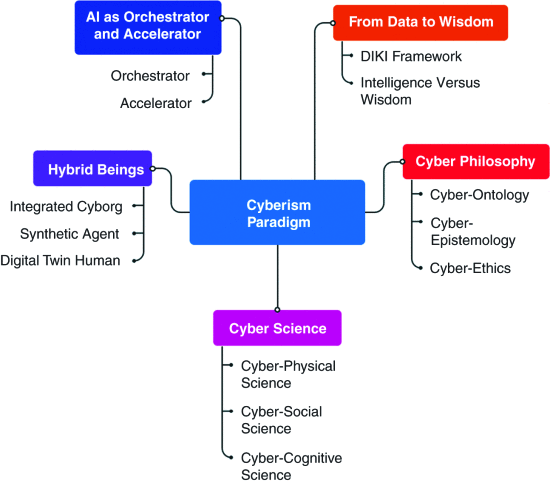
Figure 1.
Pillars of the Cyberism paradigm.
From data to wisdom
The DIKI framework is the core mechanism driving cognitive-level transitions in cyberspace. It evolves raw perception into wise decision-making through progressive refinement and value transformation. Unlike traditional, linear data processing models, this system establishes a multitiered, interconnected intelligent loop. Within this paradigm, “intelligence” manifests as the efficient, algorithmic execution of systems, such as real-time autonomous driving decisions, which rely on data-driven processes and pattern recognition. In contrast, “wisdom” encompasses value-based judgment and creative thinking. An example of this is navigating tradeoffs between privacy and efficiency, which requires human experience and ethical consideration. The fundamental distinction between the two lies in their objectives: Intelligence seeks to optimize specific metrics under deterministic rules, while wisdom handles ambiguity and possesses foresight. While contemporary AI excels in intelligence, wisdom remains a collaborative human–machine endeavor. For example, while a model like ChatGPT can generate coherent text, assessing its broader societal impact still requires human discernment. Consequently, the ultimate form of cyberspace will be a symbiotic fusion where intelligence is the body and wisdom is the soul.
Cyber philosophy (the why)
Cyber philosophy explores the fundamental nature of being, knowledge, and ethics in a digitally mediated world. It addresses Norbert Wiener’s feedback loop,3 a longstanding question, and information ethics4 to tackle the challenges posed by humans’ new coexistence with AI-influenced hybrid beings in CPSC spaces.
Cyber-ontology examines reality, identity, and agency in a world where digital constructions play a significant role. Rooted in a cybernetic paradigm that defines entities by informational patterns rather than material substance, cyber-ontology challenges classical ontologies. Unlike semantic web ontologies, which provide formal taxonomies for machine-readable data, cyber-ontology addresses foundational questions about being and identity in digitally mediated existence. Confronted with AI personas exhibiting persistent behavioral patterns and informational entities such as CryptoPunk NFTs, whose existence hinges on distributed ledger verification, this framework necessitates a reevaluation of theories of personal identity.6 These developments inevitably raise fundamental questions about machine consciousness and rights, engaging with projections of the technological singularity and the associated risks of superintelligence.
Cyber-epistemology is the study of how knowledge is generated and validated in digitally networked environments. It questions the nature of “truth” when algorithmic curation rivals factual grounding. Through “platform epistemology,”5 recommendation algorithms create customized epistemic bubbles optimized for engagement rather than truth. These data-driven environments possess properties that Wiener predicted would result in societal instability due to overwhelmingly positive feedback amplifying errors, regardless of epistemic quality.3 The core challenge lies in establishing frameworks that orient these systems toward reliable knowledge through negative feedback (that is, error correction) rather than misinformation.
Cyber-ethics addresses the moral obligations toward autonomous digital entities as artificial agents evolve into complex systems with perceived interior states. Real-world incidents, such as AI companions causing emotional harm and agents exhibiting misaligned behaviors, demonstrate ethical failures that validate the initial call for responsibility alongside the use of automated power. As the stakes escalate to matters of life, death, and fundamental rights, the focus must shift from “user safety” to “inter-agent moral consideration.”4
Cyber science (the how)
As the empirical engine of Cyberism, cyber science fulfills its integrated vision by studying computational, physical, social, and cognitive systems.
Cyber-physical science investigates the feedback loops between algorithms and physical processes. Autonomous vehicles exemplify this integration. They are networked AI systems whose collective decisions generate emergent traffic flows. However, these systems raise critical questions about machine agency.7 For example, when autonomous vehicles act based on algorithmic logic rather than human needs, they can potentially distort urban systems.
Cyber-social science analyzes how digital platforms transform social structures. The #MeToo movement is an example of decentralized, leaderless mobilization using social media. However, the same platforms also enable the “calculated manipulation of the masses” through disinformation. Decentralized autonomous organizations and extended reality (XR) environments are further redefining collective action and social interaction.
Cyber-cognitive science explores the bidirectional relationship between digital technology and human cognition. The “Google effect” exemplifies cognitive offloading, wherein the Internet serves as a transactive memory system.8 However, this reliance can lead to the internalization of unreliable information. Brain–computer interfaces and XR technologies raise fundamental questions about human agency, cognitive privacy, and the nature of thought.
Hybrid beings: New ontological categories in the CPSC space
Central to Cyberism is the examination of new hybrid entities (beings) inhabiting the CPSC space that challenge anthropocentric definitions based solely on biology.9 These present-day realities disrupt established legal, economic, and social frameworks through three emergent ontological categories.10
An integrated cyborg is a human augmented by cybernetic technologies, creating a synthesis of human biology and technology in which therapeutic devices blend with cognitive enhancement. A synthetic agent is a purely digital being with a sentient identity and agency. Examples include AI-driven synthetic influencers and actors who have secured professional roles. A digital twin human is a dynamic, high-fidelity, data-driven virtual replica of a person, with applications extending from health care and urban planning to education and climate modeling.
These hybrid beings require new metaphysical and legal frameworks that regulate their status, rights, and relationships with Homo sapiens. Questions of liability arise when digital twins sign contracts, and concerns about the manipulation of digital humanoids through deepfakes could undermine legal processes. Additionally, the economic landscape is changing due to the patenting of AI-generated entities, which forces us to reevaluate copyright for nonhuman creators. These developments call for a new governance paradigm that addresses the ownership, liability, and rights of these hybrid beings under the law.
AI as orchestrator and accelerator
While the pillars of Cyberism establish the framework for understanding the CPSC space, AI serves as the dynamic force that both orchestrates interactions within it and accelerates its evolution. AI is not merely a component within cyberspace but has become its central processing nervous system, coordinating the vast data flows between the physical, social, and cognitive realms and catalyzing feedback loops that drive rapid, often unpredictable, change.
As an orchestrator, AI integrates and manages the complex systems of the CPSC space. In smart cities, for example, AI algorithms synchronize traffic flows (cyber-physical), analyze public sentiment from social media (cyber-social), and adapt public information displays to optimize cognitive load (cyber-cognitive). This orchestration creates a cohesive, albeit algorithmically governed, experience of reality. However, this central role also positions AI as a powerful gatekeeper and mediator. The choices embedded in its models—what data to prioritize, which patterns to recognize, and what outcomes to optimize for—fundamentally shape the opportunities, interactions, and even the perceived realities of the entities within the CPSC ecosystem.
Simultaneously, AI acts as a profound accelerator. It drastically compresses the traditional timeline from data acquisition to intelligent action. This acceleration is a primary driver of the “pacing problem,” where technological capabilities surge ahead of the ethical, legal, and social structures needed to govern them.11 The generative capabilities of AI, which can produce novel content, simulate behaviors, and even create new digital entities, further compound this effect, constantly expanding the boundaries and complexity of the CPSC space itself.
The dual role of AI as both orchestrator and accelerator underscores the urgency of the Cyberism paradigm. It highlights that our digital future will not be shaped by passive systems but by active, intelligent agents whose operations require rigorous philosophical scrutiny, scientific understanding, and ethical guidance as outlined in the preceding sections. Understanding this role is crucial as we now turn to examine the new categories of hybrid beings that are emerging as a direct consequence of this AI-driven, interconnected reality.
IMPLICATIONS, CHALLENGES, AND THE PATH FORWARD
Viewing our world through a Cyberist lens reveals critical challenges that are intensified by the “pacing problem,” which is the accelerating rate of technological change that outpaces legal, social, and individual adaptation.
The cyber-syndrome necessitates acknowledging the health consequences of cyberspace as a worldwide phenomenon. Although the WHO’s classification of “gaming disorder” is a step in the right direction, Cyberism emphasizes the need for a more extensive examination of the effects of the attention economy on cognitive load and mental health. This requires developing targeted cyber-health interventions to address technology-induced, systemic stress.12
Global governance and digital equity raise fundamental questions about how to govern borderless digital spaces. Although regulatory frameworks, such as the EU’s Artificial Intelligence Act, are significant, they face challenges regarding their global applicability and potential constraints on innovation. Cyberism emphasizes the development of agile digital citizenship models that address algorithmic bias, data sovereignty, and digital divides, while ensuring meaningful human oversight in AI decision-making processes.
The consciousness conundrum necessitates that we define the moral status of potentially conscious machines. This necessitates a reevaluation of existing rights frameworks to account for nonhuman intelligence.
Implementation challenges include the interdisciplinary integration, which requires reconciling distinct methodologies, terminologies, and epistemic standards across computer science, philosophy, the social sciences, and law. The CPSC’s complexity, a dynamic, globally scaled system of systems, demands adaptable and robust governance and technical architecture, yet standardized integration metrics remain absent. Developing ethical and legal frameworks for hybrid beings and AI agency presents further difficulties: Guidelines must be specific enough to enforce yet flexible enough to accommodate rapid technological change. Scientific baselines for measuring constructs like the transition from intelligence to wisdom or entity well-being do not exist. Ultimately, institutional inertia hinders paradigm shifts, while AI’s rapid evolution outpaces theoretical frameworks, necessitating adaptive approaches.
The path forward: Human-centered Cyberism
A coordinated global effort is needed to integrate Cyberism into intellectual and policy frameworks. This effort should prioritize principles that guide the design of explainable and trustworthy AI, as well as the implementation of appropriate human oversight. Essential steps include the following:
Foster transdisciplinary collaboration through institutes that bridge computer science, philosophy, the social sciences, and the humanities to holistically address CPSC challenges.
Develop a global curriculum for human–machine coexistence across educational levels to create cyber-literate thinkers and cyber-fluent professionals who are equipped to steward our digital future with ethical foresight and technical competence.
Establish proactive ethical guardrails through sustained international cooperation. Build on frameworks like the Bletchley Accord to ensure that technological advancements align with human values and prevent “enslavement by design.”13
The profound interpenetration of the digital and biological domains has led to the emergence of Cyberism as a pivotal fourth paradigm, offering a critical framework for the conscientious and ethical design of our digital future. This paradigm shift enables us to transition from a state of passive reception of technological change to an active role as stewards, ensuring that the transition from data-driven intelligence to human-centric wisdom guides our collective future. The integration of machine efficiency with human judgment and ethical foresight enables Cyberism to function as a vital compass, thereby facilitating navigation of the intricacies inherent in the CPSC space and the construction of a hybrid reality that aligns with our collective values. This ensures a future in which technology amplifies, rather than diminishes, our humanity.
References
1. H. Ning, A Brief History of Cyberspace. Boca Raton, FL, USA : CRC Press, 2022.
2. H. Ning, “Cyberism: The theory for relationships between human and cyberspace,” Chin. J. Eng., vol. 47, no. 6, pp. 1240–1256, 2025, doi: 10.13374/j.issn2095-9389.2025.05.27.001.
3. N. Wiener, The Human Use of Human Beings: Cybernetics and Society. New York, NY, USA : Grand Central Publishing, 1988.
4. L. Floridi, The Ethics of Information. London, U.K. : Oxford Univ. Press, 2013.
5. J. Van Dijck, The Culture of Connectivity: A Critical History of Social Media. London, U.K. : Oxford Univ. Press, 2013.
6. S. Voshmgir, Token Economy: How the Web3 Reinvents the Internet. Berlin, Germany : Block-Chain Hub, 2020.
7. S. Zuboff, The Age of Surveillance Capitalism: The Fight for a Human Future at the New Frontier of Power. New York, NY, USA : PublicAffairs, 2019.
8. B. Sparrow, J. Liu, and D. M. Wegner, “Google effects on memory: Cognitive consequences of having information at our fingertips,” Science, vol. 333, no. 6043, pp. 776–778, 2011, doi: 10.1126/science.1207745.
9. D. Haraway, “A cyborg manifesto: Science, technology, and socialist-feminism in the late twentieth century,” in The Transgender Studies Reader, S. Stryker and S. Whittle, Eds. New York, NY, USA : Routledge, 2013, pp. 103–118.
10. K. Michael, J. Pitt, R. Abbas, C. Perakslis, and M. G. Michael, “Cyborgs and human-machine communication configurations,” in The SAGE Handbook of Human-Machine Communication, A. L. Guzman, S. Jones, and R. McEwan, Eds. Newbury Park, CA, USA : Sage, 2023, pp. 32–44.
11. G. E. Marchant, “The growing gap between emerging technologies and the law,” in The Growing Gap between Emerging Technologies and Legal-Ethical Oversight: The Pacing Problem, G. Marchant, B. Allenby, and J. Herkert, Eds. Dordrecht, The Netherlands : Springer-Verlag, 2011, pp. 19–33, doi: 10.1007/978-94-007-1356-7_2.
12. R. Abbas, K. Michael, M. G. Michael, C. Perakslis, and J. Pitt, “Safeguarding the guardians to safeguard the bio-economy and mitigate social injustices,” in Cyberbiosecurity: A New Field to Deal with Emerging Threats, D. Greenbaum, Ed. Cham, Switzerland : Springer-Verlag, 2023, pp. 185–215.
13. R. Abbas, K. Michael, M. G. Michael, C. Perakslis, and J. Pitt, “Machine learning, convergence digitalization, and the concentration of power: Enslavement by design using techno-biological behaviors,” IEEE Trans. Technol. Soc., vol. 3, no. 2, pp. 76–88, 2022, doi: 10.1109/tts.2022.3179756.
Authors
School of Computer and Communication Engineering, University of Science and Technology Beijing, Beijing, China
Huansheng Ning is the director of the National Science Popularization Base for Cyberspace & AI and with the School of Computer and Communication Engineering, University of Science and Technology Beijing, Beijing 100083, China. Contact him at ninghuansheng@ustb.edu.cn.
Department of Computer Science, Blekinge Institute of Technology, Karlskrona, Sweden
Jianguo Ding is an associate professor with the Department of Computer Science, Blekinge Institute of Technology, 371 50 Karlskrona, Sweden. Contact him at jianguo.ding@bth.se.
The University of Sydney Business School, The University of Sydney, Sydney, NSW, Australia
Katina Michael is professor and MBA (Technology and Digital Strategy) program director with The University of Sydney Business School, The University of Sydney, Sydney NSW 2006, Australia. Contact her at katina.michael@sydney.edu.au.
Citation: H. Ning, J. Ding and K. Michael, "Cyberism: The Fourth Paradigm for the Digital Age," in Computer, vol. 59, no. 4, pp. 130-134, April 2026, doi: 10.1109/MC.2026.3655852.