Citation: Austin, G., Bappanad, K., Henry, A.P., Materano, L., Michael, K., Reddy, B., Walker-Munro, B. and Withers, G., 2026. Comparative Technology Impact Assessment of Artificial Intelligence for Peace and Stability: Institutional Practice in Australia and India. IEEE Technology and Society Magazine, vol. 45, no. 4, pp. 1-11, 10.1109/MTS.2026.3740546

Pixabay
Since 2020, Australia and India have committed to coordinating policy on critical technologies to promote peace and stability. This is part of a deepening political, economic, and strategic relationship across many sectors. One of the tools for managing technology policy in both countries has been that of technology impact assessment (TIA), a process that has been in existence internationally for more than five decades [1]. TIA is the systematic analysis of the impacts arising from the use of technologies, combining specialist assessment of technical performance and cost–benefit characteristics with consultation across diverse stakeholder groups (government, industry, academia, and society) to determine broader social, political, legal, or economic consequences.
This article examines how, and how well, Australia and India have applied TIA to artificial intelligence (AI) specifically as it bears on peace and stability, defined here as the diplomatic and non-military dimension of national security. Peace and stability include aspects of deterrence, arms control, conflict prevention, and cooperative security regimes as distinct from national defense capability and domestic law enforcement [2]. Its contribution is threefold: 1) it maps the still modest and unevenly distributed record of AI-related TIA in the two countries against a common set of institutional benchmarks; 2) it identifies where each country’s practice is strongest and weakest relative to the other; and 3) on that comparative basis, it argues for closer bilateral and institutional learning as a practical way to close the gap between the ambition of both countries’ critical technology agendas and the resources committed to assessing their consequences.
The analysis is a comparative policy study based on documentary sources: parliamentary inquiry reports, government strategy and guidance documents, agency reviews, and secondary academic and think tank commentary. Given that much official material relevant to peace and stability is unpublished or classified, and because the two countries’ institutional vocabularies differ, the assessment offered is interpretive rather than exhaustive.
TIA’s intellectual roots lie in the wider literature on anticipatory governance [3] and responsible innovation [3], which holds that the societal and ethical implications of an emerging technology should be anticipated and deliberated, while its trajectory is still open, rather than accepted as fixed once the technology is deployed. The idea is associated with the constructive technology assessment tradition of Rip et al. [5] and developed further by Guston and Sarewitz’s [6] and Grunwald’s [7] works on real-time technology assessment. Guston and Sarewitz [6] asked, “How can technology assessment be embedded within the innovation process while technologies are still being created?” while Grunwald [7] asked, “What exactly should technology assessment assess when technologies are uncertain, socially constructed, and value-laden?” This article builds on Grunwald’s [7] conceptual and epistemological framing. Read through this lens, TIA for peace and stability is not a bureaucratic checklist but a normative commitment to shaping the trajectory of a technology such as AI in ways consistent with international stability, rather than assessing its consequences only after choices have been locked in [8].
AI as an offset strategy
One of the notable recent examples of TIA of a class of technologies affecting peace and stability has been the U.S. National Security Commission on AI [9]. Over several years, this commission addressed issues of deterrence, peacetime technological competition with other countries, and the domestic foundations of U.S. technological power while also analyzing important military applications of AI and highlighting the gray areas between a peace and stability agenda and issues of military power. What we are seeing play out today might be termed “tech wars”: a tit-for-tat contest in which states treat investment in critical and emerging technologies as a strategic offset against rivals’ military and economic advantages. Jonathan D. Moreno, in Mind Wars, traces this logic to the U.S. Department of Defense’s third offset strategy, which sought to leverage emerging technologies, including AI and neuroscience, to preserve a qualitative military edge over strategic competitors [10]. AI has become the newest instrument of this offset logic, extending the tech war into the domain of cognition and decision-making.
Meanwhile, in the global practice of TIA, there is a persistent tension between analyses that start from a technology-first approach and those that set out to address a specific policy problem, with clearer implications for systemic risks and opportunities [7]. The bias toward technology-first approaches has been aggravated by the increasing political weight attached to TIA as an instrument of geopolitical competition between the United States and its allies on one side and China on the other, for leadership in dual-use research and development. The critical technologies agenda of both Australia and India is, at present, more oriented to this tech war framing than to the positive contributions that new technologies might make to cooperative security, that is, the peace and stability agenda proper. This orientation has arisen largely from escalating activity in cyberspace and the intensifying confrontation between the United States and China.
AI as a technology category: Why differentiated TIA matters
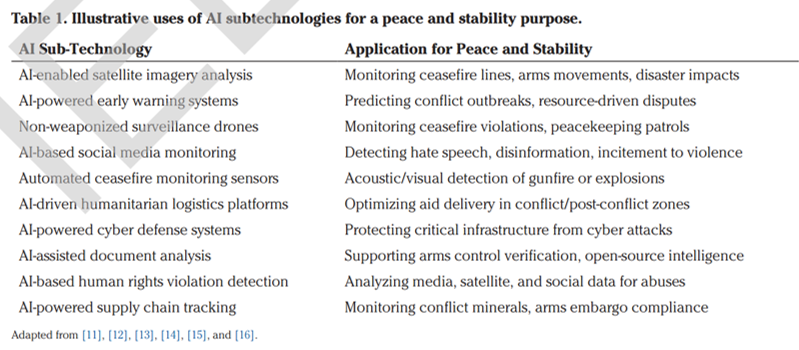
AI as a technology category encompasses many subfields with distinct maturity levels and risk profiles: established fields such as machine learning, computer vision, and natural language processing; emerging fields such as reinforcement learning, generative AI, and self-supervised learning; and frontier work such as neuromorphic and federated architectures. This heterogeneity matters directly for TIA because a review calibrated to one subfield says little about the impacts of another. An assessment of large generative language models, for example, offers scant guidance on the risks or benefits of AI-enabled satellite imagery analysis used to monitor ceasefire lines, or of facial recognition access control at a peacekeeping base. Effective TIA for peace and stability, therefore, needs to be granular and organized around the purpose for which a given AI subfield is deployed, rather than around AI as an undifferentiated whole.
Table 1 illustrates this range of purposes with representative peace and stability applications. The diversity of use cases is also why generalized studies of AI’s potential influence on international security, common in current commentary, mostly assess potential rather than demonstrated impact and are a poor substitute for purpose-specific assessment of the kind advanced TIA requires.
Table 1. Illustrative uses of AI subtechnologies for a peace and stability purpose.
AI Sub-Technology
Application for Peace and Stability
AI-enabled satellite imagery analysis
Monitoring ceasefire lines, arms movements, disaster impacts
AI-powered early warning systems
Predicting conflict outbreaks, resource-driven disputes
Non-weaponized surveillance drones
Monitoring ceasefire violations, peacekeeping patrols
AI-based social media monitoring
Detecting hate speech, disinformation, incitement to violence
Automated ceasefire monitoring sensors
Acoustic/visual detection of gunfire or explosions
AI-driven humanitarian logistics platforms
Optimizing aid delivery in conflict/post-conflict zones
AI-powered cyber defense systems
Protecting critical infrastructure from cyber attacks
AI-assisted document analysis
Supporting arms control verification, open-source intelligence
AI-based human rights violation detection
Analyzing media, satellite, and social data for abuses
AI-powered supply chain tracking
Monitoring conflict minerals, arms embargo compliance
Adapted from [11], [12], [13], [14], [15], and [16].
Australia’s AI impact assessment
The national parliament has been the main source of public-facing impact assessment of AI at the whole-of-country level in Australia. While other efforts have been substantial, they have focused on selected aspects, few of which come under the purview of peace and stability as defined above. The main exception is Australian diplomacy on potential international regimes to regulate lethal autonomous weapons systems (LAWS). Domestically, the Department of Industry, Science and Resources (DISR) has developed and is responsible for Australia’s voluntary AI Ethics Principles. On the diplomatic front, Australia supports the OECD Principles for Trustworthy AI, adopted in 2019 and updated in 2024 [17], and has been a member of the Global Partnership on AI (GPAI) since its founding in 2020.
Evolving from AI-related sectoral pilots and risk frameworks
Before 2024, Australia’s approach to technology assessment for AI evolved from sector-specific pilots and risk frameworks toward coordinated, whole-of-government policies and independent oversight, including work by Australian Taxation Office (ATO), the Digital Transformation Agency (DTA), and the Commonwealth Scientific and Industrial Research Organization (CSIRO). Part of that effort was assessed by Australian National Audit Office (ANAO) in a review of the ATO, judged to be one of the most advanced public sector organizations in the practical application of AI [18]. The review found gaps in assessment and regulatory implementation. By August 2024, the ATO had completed data ethics assessments for only 26 percent of its AI models in use, and the audit recommended improvements to risk management, information management, and the development of a comprehensive AI policy [18, pp. 6, 12–13].
In October 2024, the DTA released a pilot AI assurance framework to guide agencies through impact assessment of AI use [19]. The framework, piloted across government agencies, set out when and how to conduct impact assessments, using criteria such as project cost (over A$10 million), potential for more than insignificant harm, potential to materially influence decision-making, and the absence of human review of key outputs. These risk factors are directed at the human impacts that the concept of TIA, codified in the United States under the Technology Assessment Act of 1972 as a source of “unbiased information concerning the physical, biological, economic, social, and political effects” of new technology, was originally intended to address [1, Sec. 3]. The framework laid the groundwork for more systematic, risk-based TIA across government as a normal part of AI assurance processes [20].
AI and whole-of-country interests
The first major report addressing whole-of-country interests came when the Senate Select Committee on Adopting AI issued its final report in November 2024, focusing on the negative influence of high-risk applications on democracy, workplace safety, and intellectual property rights [21]. The committee received 245 public submissions and held six public hearings. Among the forms of AI, it identified as relevant were AI frontier models: “capabilities that could severely threaten public safety and global security” through the design of chemical weapons, exploitation of vulnerabilities in safety-critical software, or synthesis of persuasive disinformation at scale. In its submission, the Department of Home Affairs identified severe national security risks from AI [21, p. 168].
The report made 13 recommendations covering the need for transparent AI impact assessments, stronger ethical and legal guardrails, greater public engagement and education, and support for innovation balanced by risk mitigation [21, pp. xv–xvi]. The main civil service trade union proposed the creation of a federal parliamentary Office of Technology Assessment [21, p. 56]. The same committee’s October 2024 Interim Report examined how generative AI could influence electoral processes and undermine public trust in democratic institutions, proposing mandatory guardrails for high-risk applications and voluntary labeling of AI-generated content, and assessing that generative AI enables foreign and malicious actors to produce realistic but artificial content at unprecedented speed and scale, exacerbating risks to social cohesion.
Parliamentary joint committees
The Parliamentary Joint Committee on Intelligence and Security reported on its review of AI use by Australian intelligence agencies as part of its annual review of agency administration for 2022 and 2023 [22]. This AI-specific review did not involve public consultation. Submissions from intelligence agencies were classified though the Inspector General of Intelligence and Security (IGIS), the Office of National Intelligence (ONI), and ANAO released unclassified versions of their own submissions. Terms of reference required the Committee to consider, among other things, the ethical and responsible management of AI, machine learning and bio-intelligence systems, and strategic workforce planning.
The Joint Committee of Public Accounts and Audit issued a 2025 report, “Proceed with Caution,” on the governance of AI systems in Commonwealth entities, highlighting risks from inadequate datasets, bias, disinformation, and sovereign dependence [23]. The inquiry received 46 submissions and 11 supplementary submissions and held two public hearings. It identified “disinformation, propaganda and foreign interference, and electoral interference” as important AI-related risks [23, p. 41] and recommended a statutory Joint Committee on AI and Emerging Technologies for effective ongoing oversight. Submissions referenced AI’s dual-use potential in defense and cyber warfare, the risk that autonomous weapons systems lower the threshold for conflict escalation, reduced human oversight in targeting decisions, and the risk of algorithmic bias misidentifying civilian infrastructure. The Committee found no “clear Australian Public Service (APS)-wide picture” of AI deployment and called for coordinated, transparent reporting and assessment mechanisms across the public sector, noting that agencies such as the ATO and CSIRO had adopted AI without a consistent, sector-wide approach to impact assessment.
Role of Australian Academia and think tank analysis
Australian academic and think tank analysis bearing on AI’s impact on peace and stability, as defined for this paper, has been substantial but concentrated on issues that sit at the boundary between domestic security and international stability, such as electoral misinformation, erosion of institutional trust, and foreign interference, rather than squarely within the diplomacy of international security regimes. Policy recommendations have generally addressed legal reform to ensure that AI systems serve the public interest, particularly in education, employment, and civic participation, and frameworks to prevent AI from undermining democratic processes.
A 2024 University of Queensland survey found that 80% of Australian respondents ranked AI’s catastrophic risks (e.g., cyberattacks and unemployment) alongside pandemics and nuclear war as significant global risks [24], revealing a disparity between public and government priorities. Australian Institute of International Affairs has separately warned that advanced AI could become a synthetic weapon of mass destruction (WMD) through cognitive warfare, AI-driven propaganda altering human belief systems at scale.
How AI may affect peace and stability
The closest Australia has come to TIA for AI affecting peace and stability specifically has been its involvement in international deliberations on control of LAWS. This process has included regular consultation with, and submissions from, Australian specialists and interest groups such as the Australian Human Rights Commission and an overview appears in Chapter 5 of the Inquiry into the Defense Annual Report 2022 and 2023 [25]. Of the systematic analysis elements introduced above, this LAWS-related work exhibits specialist technical input, ongoing multistakeholder consultation, and explicit consideration of legal and ethical impacts, making it, on balance, the closest Australian analog to an advanced TIA of AI’s peace and stability dimension, notwithstanding its narrow subject matter.
While the government opposes new treaties to govern LAWS, Australia has participated in every formal United Nations meeting on the subject since 2016 and has hosted cross-regional expert meetings in Sydney on legal aspects. In practice, Australia has generally prioritized the interests of its principal strategic ally, the United States, over the more expansive multilateral position pressed by some domestic groups. For instance, Australian Human Rights Commission, an independent statutory body, has called for binding international constraints on fully autonomous weapons that go beyond what the government has been willing to support.
Overall, Australia appears to have undertaken only modest TIA on AI in which multistakeholder perspectives and public-facing engagement have been prominent, and this is especially true for matters affecting peace and stability specifically. While numerous analyses have been published by Australian specialists, policy analysts, and business interests, their scope has generally been broad and oriented to potential rather than observed impact.
India’s AI impact assessment
India’s large and prosperous information and communication technology (ICT) economy has led it to move robustly on developing frameworks for assessing diverse aspects of AI. The bulk of this effort has come from government agencies and some industry groups.
National strategy for AI
In June 2018, NITI Aayog, the government’s premier policy research center, which replaced the Planning Commission in 2015, published the “National Strategy for AI” (NSAI), presented as a foundation study requiring wider consultation and consensus building to develop further [26]. This set the tone for a consultative approach to assessing AI’s potential in India, drawing on substantial consultation with domestic and international specialists during preparation, and a pilot analysis in sectors such as health and agriculture. The NSAI set a goal of national leadership in ethical AI and committed to working with a diverse group of stakeholders, including civil society organizations, officials, the commercial sector, public sector bodies, and citizens [26, p. 5].
Following the practice of other leading countries, NITI Aayog subsequently published Principles of Responsible AI, setting out seven broad principles: safety and reliability; inclusivity and nondiscrimination; equality; privacy and security; transparency; accountability; and protection of positive human values [27]. This attention to transparency, privacy, and human values set the scene for later technology assessments to be consultative and multistakeholder, as reflected in the follow-up paper “Operationalizing Principles,” which focused on government intervention to drive responsible AI adoption in social sectors in partnership with the private sector and research institutes [28].
One concrete example of AI-related TIA in India was the 2022 report “Responsible AI for All: Adopting the Framework—A Use Case Approach on Facial Recognition Technology” [29], India’s first use-case study of this kind. The report reveals consultation with some private-sector and government interests, but on a limited scale, with little effort to establish a broader base of stakeholders.
IndiaAI mission
The IndiaAI Mission is the government’s flagship program for strengthening India’s AI ecosystem, with a budget of Rs. 10,372 crore (approximately A$161 million) across seven pillars [30]. Around 44% is directed to domestic computing capacity, 19% each to an innovation center and start-up financing, and the remainder to future skills, application development, a datasets platform, and a safe and trusted AI initiative. Several of these components, building domestic computing capacity and indigenous models for Indian use cases, appear to respond to geopolitical developments such as export restrictions on chips and AI models. To coincide with the Mission’s launch, the Ministry of Electronics and Information Technology (MeitY), in collaboration with UNESCO, organized multistakeholder workshops nationally on different aspects of the Mission [31].
India currently lacks comprehensive regulation for managing AI’s broader risks although between late 2024 and mid-2026, it advanced considerably on content and platform obligations, notably through the Information Technology (Intermediary Guidelines and Digital Media Ethics Code) Amendment Rules, 2026, which bring synthetically generated content within intermediaries’ due diligence, labeling, and takedown obligations [39]. In 2024, the Office of the Principal Scientific Adviser established a multistakeholder Advisory Group, including representatives from relevant ministries, tasked with guiding AI governance and regulatory oversight [27, pp. 1–2]. Its Subcommittee on AI Governance and Guidelines Development examined AI governance issues, conducted a gap analysis, and proposed a comprehensive governance approach; its 2025 guidelines propose a Technical Secretariat and voluntary disclosure and compliance requirements though implementation remains uncertain [32]. Institutions such as the Center for Responsible AI at IIT Madras focus on highlighting AI risks and harms [28]. Overall, while state effort has concentrated on enabling AI innovation and regulating content and platforms, more is needed on governance capability and on technology assessment aimed at anticipating AI’s broader impacts.
MeitY and sector-specific AI governance
MeitY, the nodal agency for technology regulation, has generally preferred a light-touch approach to AI governance, favoring an enabling environment for innovation [32]. Some sectors such as finance and health have specific regulations: the Reserve Bank of India has formed a panel to review AI adoption in financial services and recommend a compliance framework [33], and the Indian Council of Medical Research’s Ethical Guidelines provide principles for AI in healthcare [34]. In 2024, the National Association of Software and Services Companies (NASSCOM) launched “The Developer’s Playbook for Responsible AI in India,” a multistakeholder effort to establish a sector-agnostic risk mitigation framework [35].
In contrast to this light-touch approach, a March 2024 advisory required government permission before deploying certain AI models, intended to prevent algorithmic discrimination and the spread of deepfakes. It drew sharp industry criticism as regulatory overreach and was withdrawn [36], reflecting differing views within government [34]. The Prime Minister’s Economic Advisory Council, by contrast, has described AI as a “complex adaptive system” requiring proactive regulatory intervention [37].
Specific task forces on peace and stability
More specifically for the peace and stability agenda, India has been highly visible in the United Nations work on LAWS since the 2014–2016 Informal Meeting of Experts and subsequent Group of Governmental Experts. This has involved multisector and specialist consultation through mechanisms established in the defense portfolio, notably the AI Task Force on National Security and Defense, established in 2018 and chaired by N. Chandrasekaran of Tata Sons, comprising 17 members from the armed forces, academia, government research organizations, and industry, including the National Cyber Security Coordinator. With a remit for military development, it also addressed dual-use aspects and led to a Defense AI Council overseeing technology assessments, including ethics and algorithmic accountability. Consultation with civil society has, however, been limited. Beyond work on LAWS, there appear to be no prominent multistakeholder, public-facing analyses of comparable granularity on the impact of AI subfields on peace and stability in India.
Comparative synthesis
Table 2 summarizes the two countries’ practice against four benchmarks adapted from the wider TIA literature into four categories [5], [6], [7], [8]: first, institutional maturity, which is the presence of standing, repeatable assessment mechanisms; second, stakeholder inclusivity in terms of the breadth of consultation beyond government and industry; third, regulatory orientation as light-touch enablement versus precautionary interventions; and last, the explicit attention to peace and stability as distinct from broader AI governance.
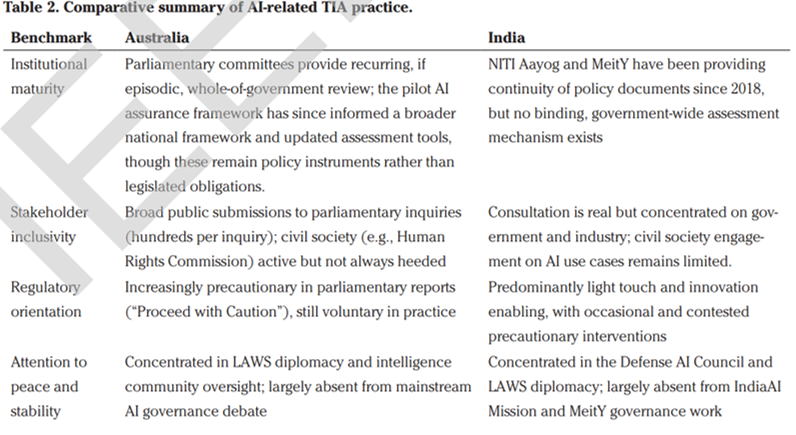
Table 2. Comparative summary of AI-related TIA practice.
Benchmark
Australia
India
Institutional maturity
Parliamentary committees provide recurring, if episodic, whole-of-government review; the pilot AI assurance framework has since informed a broader national framework and updated assessment tools, though these remain policy instruments rather than legislated obligations.
NITI Aayog and MeitY have been providing continuity of policy documents since 2018, but no binding, government-wide assessment mechanism exists
Stakeholder inclusivity
Broad public submissions to parliamentary inquiries (hundreds per inquiry); civil society (e.g., Human Rights Commission) active but not always heeded
Consultation is real but concentrated on government and industry; civil society engagement on AI use cases remains limited.
Regulatory orientation
Increasingly precautionary in parliamentary reports (“Proceed with Caution”), still voluntary in practice
Predominantly light touch and innovation enabling, with occasional and contested precautionary interventions
Attention to peace and stability
Concentrated in LAWS diplomacy and intelligence community oversight; largely absent from mainstream AI governance debate
Concentrated in the Defense AI Council and LAWS diplomacy; largely absent from IndiaAI Mission and MeitY governance work
The comparison suggests that Australia’s advantage lies in the transparency and stakeholder reach of its parliamentary process, while India’s advantage lies in the institutional continuity of a single lead agency (NITI Aayog) able to sustain a policy narrative over time. In both countries, however, the specific concern of peace and stability is handled by a narrow, defense-oriented set of institutions that operate largely apart from the broader, more consultative AI governance apparatus that each country has built for domestic purposes, the central gap that this commentary sets out to document.
One of the most important aspects underpinning current Australian and Indian approaches to critical technologies is the concept of strategic technological competition: the premise that technology will contribute a growing share of national power and that early advantage in key domains compounds over time. This is bound up with the tech war framing along fault lines of international security, most notably between the United States and China. Australia has aligned with the United States on a broad front, while India has supported the United States through several discrete channels, notably supply chain and critical infrastructure cooperation.
Both countries face choices about where in the machinery of governance the most effective TIA for peace and stability should be seated—the National Parliament, government agencies or statutory authorities, or specially convened task forces. The minimum requirement is a recognized institutional center of gravity for TIA in each country and a shared set of basic principles. Both Australia and India would benefit from a clearer commitment to regularized TIA of critical technologies for peace and stability, involving organizational reform and additional resources, justified by restoring peace and stability to the policy priority it held in the 1990s and the first decade of this century.
Bilateral cooperation offers a practical route to closing the institutional gap identified in “Comparative Synthesis.” Because Australia’s strength lies in transparent, broadly consulted parliamentary review and India’s in sustained agency-level policy continuity, each country’s practice is a plausible model for the other’s weaker area. India could draw on the Australian parliamentary committee model to widen civil society input into its AI governance process. Australia now grounds its approach in the eight AI Ethics Principles (2019) and the National AI Center’s Guidance for AI Adoption (2025, updated 2026), which operationalizes those principles into six essential practices for organizations, alongside a national AI assurance framework for government [40], [41], [42]; it could, nonetheless, draw on the continuity of NITI Aayog’s single “Responsible AI for All” reference to give this layered set of instruments greater institutional permanence. In both countries, however, these instruments remain largely nonbinding guidance rather than a comprehensive statutory regime. A standing joint working group under the Australia–India Cyber and Critical Technologies Partnership, tasked specifically with peace and stability-relevant AI assessment rather than AI governance in general, would give this shared learning a durable home and help connect the two countries’ otherwise separate LAWS diplomacy and domestic AI governance streams.
This bilateral effort would also sit naturally within existing global reference points. Both countries already endorse the OECD Principles for Trustworthy AI [17], which supply a common normative vocabulary—transparency, accountability, and human rights—which a joint TIA mechanism could operate for the peace and stability domain specifically. More broadly, the United Nations Sustainable Development Goal 16 commitment to peaceful and inclusive societies, effective and accountable institutions, and responsive, participatory decision-making [38] offers an additional benchmark against which both countries’ AI governance efforts could usefully be assessed. It is also against which their current, largely separate treatment of AI governance, peace, and stability diplomacy stands out as an anomaly rather than a settled division of labor.
There remains a basic mismatch between the scale and scope of technologies that both countries regard as critical and the resources available to assess their impact on peace and stability professionally. That mismatch itself is sufficient reason for rigorous priority setting in the choice of technology or technology class for assessment and for the kind of shared institutional learning proposed above.
Acknowledgments
This work was supported by Australia India Cyber and Critical Technologies Partnership (Fourth Round) through “Joint Impact Assessment of Critical Emerging Technologies in Support of Peace and Stability.” The ethical aspects of this research have been approved by the ANU Human Research Ethics Committee (Protocol 2024/1245).
References
[1] (Oct. 13, 1972). United States, Public Law 92-484, Technology Assessment Act of 1972. [Online]. Available: https://www.congress.gov/92/statute/STATUTE-86/STATUTE-86-Pg797.pdf.
[2] G. Austin et al., “Technology impact assessment for peace and stability: A comparative study on Australia and India,” Australia India Cyber Crit. Technol. Canberra, Tech. Rep., Jun. 2025. [Online]. Available: https://www.socialcyber.co/_files/ugd/15144d_c5acc66a4a014035a939a1b534f06822.pdf
[3] D. H. Guston, “Understanding ’anticipatory governance,” Social Stud. Sci., vol. 44, no. 2, pp. 218–242, 2014.
[4] J. Stilgoe, R. Owen, and P. Macnaghten, “Developing a framework for responsible innovation,” in The Ethics of Nanotechnology, Geoengineering, and Clean Energy. London, U.K.: Routledge, 2020, pp. 347–359.
[5] A. Rip, T. J. Misa, and J. Schot, Managing Technology in Society: The Approach of Constructive Technology Assessment. London, U.K.: Pinter Publishers, 1995.
[6] D. H. Guston and D. Sarewitz, “Real-time technology assessment,” Technol. Soc., vol. 24, nos. 1–2, pp. 93–109, Jan. 2002, doi: 10.1016/s0160-791x(01)00047-1.
[7] A. Grunwald, “Technology assessment: Concepts and methods,” in Handbook of the Philosophy of Science, vol. 9. Amsterdam, The Netherlands: Elsevier, 2009, pp. 1103–1146, doi: 10.1007/978-94-017-9103-8_12.
[8] R. Clarke, “Technological impact assessment: A framework for designing a TIA project method,” IEEE Trans. Technol. Soc., vol. 7, no. 2, pp. 118–127, Jun. 2026, doi: 10.1109/TTS.2025.3574863.
[9] National Security Commission on Artificial Intelligence, “Final Report,” 2021. [Online]. Available: https://assets.foleon.com/eu-central-1/de-uploads-7e3kk3/48187/nscai_full_report_digital.04d6b124173c.pdf.
[10] J. D. Moreno, Mind Wars: Brain Science and the Military in the Twenty-First Century. New York, NY, USA: Bellevue Literary Press, 2012.
[11] “AI’s impact on peace, security, and governance,” Amani Africa, Mar. 19, 2025. [Online]. Available: https://amaniafrica-et.org/artificial-intelligence-and-its-impact-on-peace-security-and-governance/
[12] T. Reinhold, E. Hoffberger-Pippan, A. Blanchard, M.-M. Blum, F. Lentzos, and A. Saltini, “Artificial intelligence, non-proliferation and disarmament: A compendium on the state of the art,” EU Non-Proliferation and Disarmament Consortium, no. 92, Jan. 2025. [Online]. Available: https://www.sipri.org/sites/default/files/2025-01/eunpdc_no_92_0.pdf
[13] M.-U. Tuvdendarjaa, “Artificial intelligence in contemporary peacekeeping operations,” Daniel K. Inouye Asia-Pacific Center for Security Studies, pp. 1–9, May 2025. [Online]. Available: https://dkiapcss.edu/wp-content/uploads/2025/05/N2678-Artificial-Intelligence-in-Contemporary-Peacekeeping-Operations.pdf.
[14] DigitalDefynd. (2024). 10 Examples of AI Being Used in Defense Sector. [Online]. Available: https://digitaldefynd.com/IQ/ai-use-in-defense-sector/
[15] Arms Control Association, “Beyond a human ‘in the loop’: Strategic stability and artificial intelligence,” Issue Briefs, vol. 16, no. 4, Nov. 12, 2024. [Online]. Available: https://www.armscontrol.org/issue-briefs/2024-011/beyond-the-loop
[16] M. Giovanardi, “AI for peace: Mitigating the risks and enhancing opportunities,” Data Policy, vol. 6, p. 41, Sep. 2024, doi: 10.1017/dap.2024.37.
[17] Organization for Economic Co-operation and Development. (2024). OECD Principles on Artificial Intelligence. [Online]. Available: https://legalinstruments.oecd.org/en/instruments/OECD-LEGAL-0449
[18] Australian National Audit Office. (2025). Governance of Artificial Intelligence at the Australian Taxation Office. [Online]. Available: https://www.anao.gov.au/sites/default/files/2025-02/Auditor-General_Report_2024-25_26.pdf
[19] Digital Transformation Agency, “Pilot AI Assurance Framework,” Australia, Nov. 2024. [Online]. Available: https://www.digital.gov.au/policy/ai/pilot-ai-assurance-framework/introduction
[20] R. Clarke and K. Michael, “Multi-stakeholder risk assessment of socio-technical interventions,” IEEE Trans. Technol. Soc., vol. 7, no. 3, pp. 153–169, Sep. 2026, doi: 10.1109/TTS.2026.3703434.
[21] Senate, Australia, “Select Committee on Adopting Artificial Intelligence: Final Report,” Nov. 2024. [Online]. Available: https://researchportalplus.anu.edu.au/en/publications/select-committee-on-adopting-artificial-intelligence-final-report/.
[22] Parliament, Australia, Parliamentary Joint Committee on Intelligence and Security, “Review of Administration and Expenditure No. 22 (2022–23) – Australian Intelligence Agencies,” 2025. [Online]. Available: https://www.aph.gov.au/Parliamentary_Business/Committees/Joint/Intelligence_and_Security/Completed_Inquires_of_the_47th_Parliament/AandENo22
[23] Parliament, Australia, Joint Committee of Public Accounts and Audit, “Report 510: Inquiry into the Use and Governance of Artificial Intelligence Systems by Public Sector Entities – ‘Proceed with Caution,’” 2025. [Online]. Available: https://www.aph.gov.au/Parliamentary_Business/Committees/Joint/Public_Accounts_and_Audit/PublicsectoruseofAI/Report.
[24] M. Noetel, A. Saeri, and J. Graham, “80% of Australians think AI risk is a global priority. The government needs to step up,” Univ. Queensland, Mar. 11, 2024. [Online]. Available: https://news.uq.edu.au/2024-03-11-80-australians-think-ai-risk-global-priority-government-needs-step
[25] Parliament, Australia, Joint Standing Committee on Foreign Affairs, Defense and Trade, “Inquiry into the Department of Defense Annual Report 2022–23,” 2024. [Online]. Available: https://www.aph.gov.au/Parliamentary_Business/Committees/Joint/Foreign_Affairs_Defence_and_Trade/DefenceAR2022-23
[26] NITI Aayog, “National Strategy for Artificial Intelligence #AIForAll,” India, 2018. [Online]. Available: https://council.science/wp-content/uploads/2025/02/AI-Paper-Case-Study-India_V1.pdf
[27] NITI Aayog, “Responsible AI Approach Document for India, Part 1 – Principles for Responsible AI,” India, 2021. [Online]. Available: https://www.niti.gov.in/sites/default/files/2021-02/Responsible-AI-22022021.pdf.
[28] NITI Aayog, “Responsible AI Approach Document for India, Part 2 – Operationalizing Principles,” India, 2021. [Online]. Available: https://niti-dbim-dev.inroad.in/node/463.
[29] NITI Aayog, “Responsible AI for All: Adopting the Framework – A Use Case Approach on Facial Recognition Technology,” India, 2022. [Online]. Available: https://oecd.ai/en/dashboards/policy-initiatives/approach-document-for-india-part-3-adopting-framework-a-use-case-approach-on-facial-recognition-technology-6259.
[30] Ministry of Electronics and Information Technology, “Cabinet Approves Over Rs 10,300 Crore for IndiaAI Mission,” India, 2024. [Online]. Available: https://www.pib.gov.in/PressReleasePage.aspx?PRID=2012375
[31] Ministry of Electronics and Information Technology, “UNESCO and MeitY Organise National Stakeholder Workshop on Ethics of AI,” India, 2024. [Online]. Available: https://government.economictimes.indiatimes.com/news/technology/unesco-meity-organise-national-stakeholder-workshop-on-ai-ethics/110754005.
[32] A. Mohanty and S. Sahu, “India’s advance on AI regulation,” Carnegie Endowment International Peace, New Delhi, Tech. Rep., 2024. [Online]. Available: https://carnegieendowment.org/india/research/2024/11/indias-advance-on-ai-regulation.
[33] Reserve Bank of India, “Framework for Responsible and Ethical Enablement of Artificial Intelligence in the Financial Sector,” 2024. [Online]. Available: https://regulations.ai/regulations/RAI-IN-NA-FREEAXX-2025
[34] Indian Council of Medical Research, “Ethical Guidelines for Application of Artificial Intelligence in Biomedical Research and Healthcare,” 2023. [Online]. Available: https://www.icmr.gov.in/ethical-guidelines-for-application-of-artificial-intelligence-in-biomedical-research-and-healthcare.
[35] National Association of Software and Service Companies, “The Developer’s Playbook for Responsible AI in India,” 2024. [Online]. Available: https://nasscom.in/ai/pdf/the-developer
[36] S. Barik, “After criticism, govt clarifies: AI startups don’t need IT ministry approval,” The Indian Express, Mar. 5, 2024. [Online]. Available: https://indianexpress.com/article/business/genai-startups-dont-need-to-seek-govt-nod-before-launch-rajeev-chandrasekhar-9194613/.
[37] S. Sanyal, P. Sharma, and C. Dudani, “A Complex Adaptive System Framework to Regulate Artificial Intelligence,” Economic Advisory Council to the PM New Delhi, India, Tech. Rep. EAC-PM/WP/26/2024, 2024.
[38] United Nations. Sustainable Development Goal 16: Peace, Justice and Strong Institutions.” Accessed: Sep. 25, 2026. [Online]. Available: https://sdgs.un.org/goals/goal16
[39] Ministry of Electronics and Information Technology, Government of India, “The Information Technology (Intermediary Guidelines and Digital Media Ethics Code) Amendment Rules, 2026,” Gazette of India, Extraordinary, Part II, Sec. 3(i), No. 114, G.S.R. 120(E), Feb. 10, 2026. [Online]. Available: https://egazette.gov.in/WriteReadData/2026/269993.pdf
[40] Department of Industry, Science and Resources, “Australia’s AI Ethics Principles,” Canberra, Australia, Nov. 7, 2019. Accessed: Sep. 19, 2026. [Online]. Available: https://www.industry.gov.au/publications/australias-artificial-intelligence-ethics-principles/australias-ai-ethics-principles
[41] National AI Centre, Department of Industry, Science and Resources, “Guidance for AI Adoption,” Canberra, Australia, Oct. 21, 2025. Accessed: Sep. 19, 2026. [Online]. Available: https://industry.gov.au/publications/guidance-for-ai-adoption
[42] Data and Digital Ministers Meeting, “National Framework for the Assurance of Artificial Intelligence in Government,” Dept. Finance, Canberra, Australia, Jun. 21, 2024. Accessed: Sep. 19, 2026. [Online]. Available: https://www.finance.gov.au/sites/default/files/2024-06/National-framework-for-the-assurance-of-AI-in-government.pdf.
Greg Austin is a professor and the director at the Social Cyber Institute Ltd., Canberra, ACT 2601, Australia.
Karthik Bappanad is a technologist with a keen interest in public policy and previously a consultant at InKlude Laboratories, Bengaluru, India.
Adam P. Henry is a senior fellow at the Social Cyber Institute Ltd., Canberra, ACT 2601, Australia.
Lisa Materano is the chief executive officer at the Blended Learning International Pty. Ltd., Canberra ACT 2600, Australia, and the director at Social Cyber Institute Ltd, Canberra, ACT 2601, Australia.
Katina Michael is a professor in the School of Strategy, Innovation and Technology at The University of Sydney Business School, Sydney, NSW 2006, Australia. She is the inaugural program director of the MBA (Technology and Digital Strategy).
Bharath Reddy is an associate fellow of the High-Tech Geopolitics Program at The Takshashila Institution, Bengaluru 560001, India.
Brendan Walker-Munro is an associate professor in law in the Faculty of Business, Law and the Arts at Southern Cross University, Gold Coast, NSW 4225, Australia.
Glenn Withers is an emeritus professor in the Crawford School of Public Policy at Australian National University Canberra, ACT 2601, Australia, and an adjunct professor at the University of New South Wales, Canberra, ACT, Australia.
Direct questions and comments about this article to Katina Michael, School of Strategy, Innovation and Technology, The University of Sydney Business School, Sydney, NSW 2006, Australia; katina.michael@sydney.edu.au.
Citation: Austin, G., Bappanad, K., Henry, A.P., Materano, L., Michael, K., Reddy, B., Walker-Munro, B. and Withers, G., 2026. Comparative Technology Impact Assessment of Artificial Intelligence for Peace and Stability: Institutional Practice in Australia and India. IEEE Technology and Society Magazine, vol. 45, no. 4, pp. 1-11, 10.1109/MTS.2026.3740546.