Source: IEEE SA. “Responsible AI for Children”, https://standards.ieee.org/products-programs/icap/ieee-certifaied/responsible-ai-for-children/ dated 8/11/26.
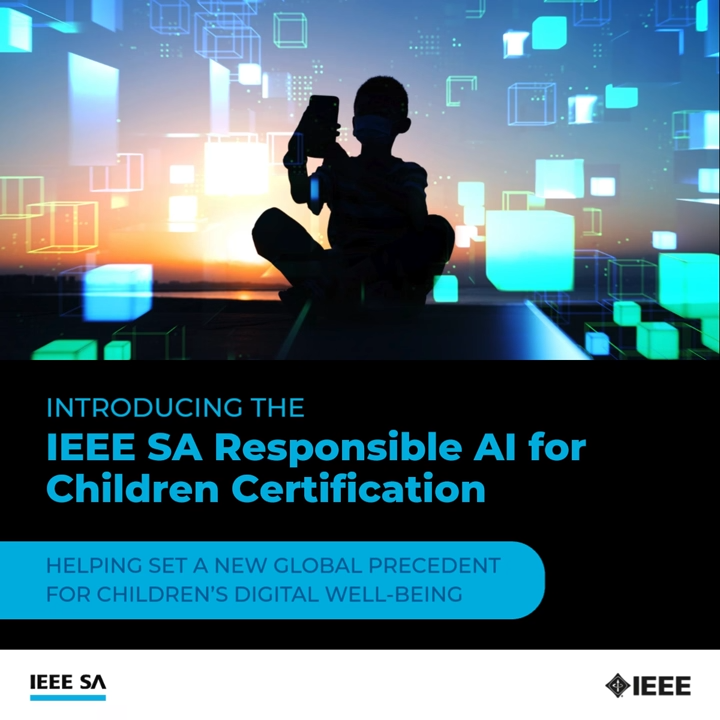
Children rely on digital and AI-enabled technologies every day, yet many products aren’t designed with their needs or rights in mind. IEEE SA addresses this through age-appropriate design and the advancement of children’s rights in online and offline environments, offering practical, standards-based tools to guide responsible innovation. As part of the IEEE CertifAIEd™ suite, this product certification program enables organizations to assess and evaluate the ethical design and use of AI solutions.
Strengthen Your Approach to Responsible Design
Children spend more time in digital environments than ever before. Organizations often want to build responsibly but face uncertainty about how to design and evaluate technology in ways that genuinely protect children, reflect their rights, and align with emerging global expectations.
Put Standards-Based Practices Into Action
The Responsible AI for Children certification program brings together two essential components that support responsible design throughout the product lifecycle.
Apply Standards-Based Design Guidance
Drawing on IEEE 2089™ (Age-Appropriate Design) and IEEE 7000™ (AI Ethics & Governance), this framework illustrates how teams can translate children’s rights, needs, and values into actionable design decisions. This provides a repeatable, globally recognized method for building technology intended for children.Leverage A Structured Assessment Model
The assessment schema provides a clear, consistent lens to evaluate how well a product supports children in practice. It helps organizations demonstrate responsible AI, strengthen trust, reduce uncertainty, plan improvements, and lay the foundation for potential certification.
Together, these components form a lifecycle-oriented approach that supports responsible design from concept through continuous improvement.
Shape a Safer Digital Future for Every Generation
When online and technology products and services designed for children are developed responsibly, children experience safer and more age-appropriate digital environments. Parents, educators, and communities gain greater trust in the tools they rely on, and institutions can adopt technology with more confidence.
Responsible practices elevate expectations across the industry, and over time, innovation becomes more closely aligned with human values. Thoughtful design and evaluation help create a digital ecosystem founded on transparency, care, and long-term societal benefits.
Design for a Better Digital Future
If you build digital or AI-enabled products for children, you’re invited to explore how this approach can support your work. Submit the form to connect with an IEEE SA team member and access more information.
“Responsible AI for Children product certification is not optional- it is foundational in a world where algorithmic systems mediate childhood itself. The certification embeds accountability by design, safeguarding dignity, agency, and developmental well-being from the outset. Without such guardrails, we risk engineering environments that privilege optimisation and profit over the rights and futures of our youngest citizens.”
— Katina Michael, Chair of the IEEE 2089-2021 Working Group and MBA Program Director (Technology and Digital Strategy) at the University of Sydney Business School.
IEEE SA
Further Resources:
Responsible AI for Children: IEEE Delivers a Trusted Safety Formula to Help Protect Kids Online
Enabling Trustworthy Digital Experiences for Children
IEEE Online Age Verification Certification Program
IEEE 7000-2021: IEEE Standard Model Process for Addressing Ethical Concerns during System Design