The Converging Veillances: Border Crossings in an Interconnected World
Citation: C. Perakslis, K. Michael and M. G. Michael, "The Converging Veillances: Border Crossings in an Interconnected World," in IEEE Potentials, vol. 35, no. 5, pp. 23-25, Sept.-Oct. 2016, doi: 10.1109/MPOT.2016.2569724.
We are rapidly entering the uncharted and precarious terrain of an interconnected world of pervasive technologies. There will be amalgamations of networks. Machines, connected to networks of other machines, will act more autonomously and make decisions for humans. Devices will continue to be far more intelligent and ubiquitous, thereby thinking and acting for us unobtrusively behind the lines of visibility. Therefore, we considered pervasive technology as a risk category to examine.
Using aspects of the International Organization of Standardization's framework for risk assessment (ISO 31000:2009), we sought to mine out risk sources, as well as risk events in pervasive environments. This article is written to invite you—the students, young professionals, and future leaders—to contemplate the consequences and consider appropriate risk treatments.
Risk Source: The Converging Veillances
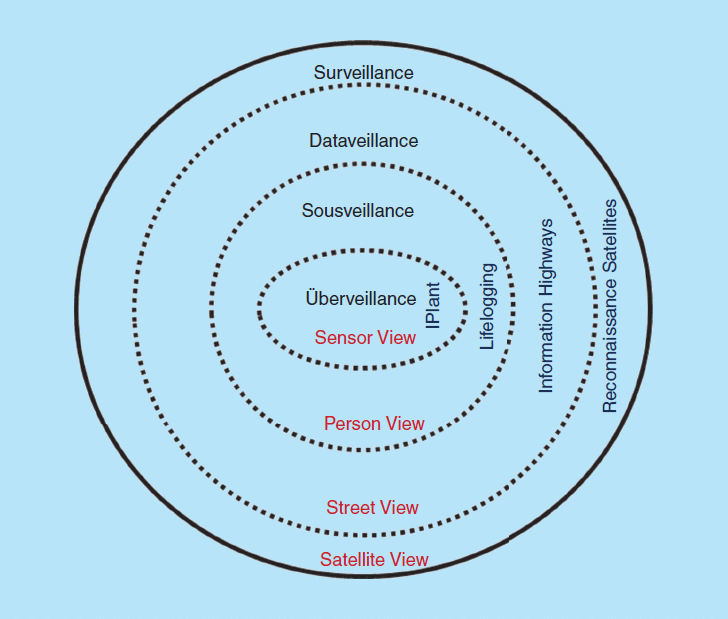
Fig 1. The veillances.
In the context of these emerging pervasive environments, we considered a veritable source of risk: the converging veillances (Fig. 1). Such environments as the Internet of Things are creating systems in which the reach and impact of the veillances may become critically extensive. Veillance, which is watching or being watched, could now extend from the sky (surveillance) to the street (dataveillance) to the person around you (sousveillance) to within you (über-veillance) and then ripple out and back to the sky. These veillances, as represented in Fig. 1, are as follows.
Surveillance (e.g., Satellite View)
Surveillance was first recognized in the early 19th century from the French “sur,” meaning “over,” and “veiller,” meaning “watch.” This is the veillance of authority, the powerful monitoring the less powerful. Examples include satellites, municipal cameras in streetlights or on/within buildings, and the interception of data for intelligence gathering by a government.
Dataveillance (e.g., Street View)
Dataveillance is the methodical and organized collection or use of digital personal data in the investigation or monitoring of one or more persons. This veillance extends from an authority watching to nonauthorities also watching us. Examples include systematic digital monitoring of people as they use the Internet or commercial data mining practices by a company with advanced capabilities in analytics to understand consumer behavior.
Sousveillance (e.g., Person View)
Sousveillance is the capturing of activities from the perspective of one participant in a shared activity with other participants. This is a veillance happening from the person's view to other people in the vicinity. Examples include a lifelogger capturing images of others attending an event or peer-to-peer social media in which your posts are viewed.
Überveillance (e.g., Sensor View)
Überveillance is electronic surveillance within the human body. Some contend it is analogous to Big Brother on the inside looking out. This veillance deals with the watching of the fundamental who (identification), where (location), and when (time) of a human being. There is the potential for deriving the why (motivation), the what (result), and the how (methods/thoughts). Examples include medical and nonmedical implants (e.g., contact lens “glass” with Internet access or iPlants within the human body) or wearables collecting health and sleep data (e.g., heart rate, perspiration, pulse, activity, and temperature).
The Convergence Intensifies
With pervasive technologies, the veillances are rapidly converging. Society is encountering shifting paradigms relative to human-machine interactions. The circles in Fig. 1, shown with faintly dotted lines, represent increasingly more permeable boundaries between the four veillances, as networks are networked to other networks. With pervasive technologies, we have more interoperable veillance networks that connect buildings to vehicles to other vehicles to wearables to spatio-temporal tracking bearables, to biosensor data from inside us and back out to be analyzed through advanced algorithms. Information exchanges can now move seamlessly and automatically in and through the human and out across multiple platforms in each of the veillances. Pervasive technologies fuel the intensification of convergence.
Überveillance is centrally positioned, because it can uniquely bring together all forms of watching from above, below, beside, and within by involuntarily or voluntarily using obtrusive or unobtrusive devices. As pervasive environments develop, internal data gleaned from the human can be combined and synthesized with additional data from across the spectrum of veillances. The consequence is rich, broad, deep, sensitive, and highly private personal data mining. The data can be analyzed relative to the current physiological and/or psychological state, and predictive analytics can help forecast the future state of the human.
Six Risk Events to Consider
Within the context of pervasive technology, which we defined as the risk category, and the converging veillances, which we defined as a source of risk, we mined out six risks events that are likely to influence the sociocultural realm, and they are as follows.
Insightfulness
With context-awareness and context-adaption, networks of ubiquitous devices will be continuously “on” and autonomously learning behaviors. With data gleaned across all veillances, devices will assess humans in multiple contexts, capacities, and over time. This is likely to lead to a capability for the system to have rich insightfulness or a precise and profound understanding of humans in the current, but also future, state. As the veillances converge, will this yield a world in which the watchers have an unique advantage with profound insight derived through an accurate, multilayered, intuitive understanding of the human?
Imperceptible
As networks are operating behind the line of visibility, humans are not likely to comprehend the scope, reach, or even timing of data practices. The processes and procedures are likely to be imperceptible. Users could be blinded to what is collected, by whom, for how long, how it is synthesized with other data, and who owns the data now—or in the future. As the veillances converge, will this yield a world in which the human does not perceive the watching and, as a result, also not the consequences of being watched?
Incomprehensibility
Our current state of terms and conditions is often murky and/or mutable. Additionally, the average human is not likely to comprehend the wide-ranging system nor the risks associated across multiple organizations sharing data. The system is likely to be incomprehensible for the consumer. Simpler technologies have already proven to be complex and convoluted to the average consumer. As the veillances converge, will this yield a world in which a human must opt-in to stipulations that are unrealistic to comprehend?
Indelibility
Data may become ineradicable. Our digital footprints are likely to leave an indelible history of analyzable behaviors, especially if we do not own our data or if data were shared and stored elsewhere in the veillances. As the veillances converge, will this yield a world in which the human's behaviors cannot be forgotten? Will humans comprehend the long-term effects of being watched?
Invasiveness
As we allow technology to listen inside of us and to our relationships, we are likely to create systems in which not only our behaviors are predicted but perhaps even our intent. As the veillances converge, will this yield a world in which such intrusion into the inner sanctum of a human could place dignity at risk—even if unintended?
Involuntariness
It is evermore compulsory for an individual to subscribe to cloud-based e-mail to be gainfully employed or to receive extensive services across disciplines (e.g., a hospital). More often, individuals are pressured to opt-in to belong and benefit socially or financially (e.g., discounts offered by an insurance company). As the veillances converge, will this yield a world in which a person must opt-in to technology to participate in society?
Conclusion
We now invite you to contemplate with us the consequences of not only the six individual risks but also the six risks collectively. If we are compelled to inattentively opt-in to a system within which we somewhat unknowingly rescind control over our data to participate in society, isn't an outcome decreased autonomy for the person? If we share personal data that can be analyzed and synthesized and reanalyzed across the veillances relative to our ongoing physiological state, while also naively rescinding our right to be forgotten, might human dignity be at stake either now or in the future?
We established the context of risk (environments of pervasive technologies), defined a substantial source (the convergence of the veillances), and identified six emerging risks. We then offered a few possible consequences to consider in the sociocultural realm. Now, in the spirit of robust risk assessment, we ask you young, brilliant students and professionals to consider the likelihood of the aforementioned risk events, so as to ensure appropriate controls are built into the design and operation of these shifting human-machine interactions.
References
1. C. Perakslis J. Pitt K. Michael M.G. Michael Pervasive technologies: Principles to consider Ethics Biol. Eng. Med. 5 1 79 93 2014
2. K. Michael M.G. Michael C. Perakslis The Computer After Me: Awareness and Self-Awareness in Autonomic Systems 189 204 2014 Imperial College Be vigilant: There are limits to veillance
3. M.G. Michael K. Michael C. Perakslis Uberveillance, the web of things, and people: What is the culmination of all this surveillance? IEEE Cons. Electron. Mag. 4 2 107 113 2015
4. K. Michael M.G. Michael From Dataveillance to Überveillance and the Realpolitik of the Transparent Society 2007 Univ. Wollongong
5. M.G. Michael S. J. Fusco K. Michael A research note on ethics in the emerging age of überveillance Comput. Commun. 31 6 1192 1199 2008
6. R. Clarke Just another piece of plastic in your wallet: The ‘Australia card’ scheme ACM SIGCAS Comput. Soc. 18 1 7 21 Jan. 1988
7. C. Roger Roger Clarke's dataveillance and information privacy home-page 1995 http://www.rogerclarke.com/DV/
8. S. Mann J. Nolan B. Wellman Sousveillance: Inventing and using wearable computing devices for data collection in surveillance environments Surveil. Soc. 1 3 331 355 Jan. 2003
9. M.G. Michael, K. Michael Uberveillance and the Social Implications of Microchip Implants: Emerging Technologies 34 45 2013 IGI
10. M.G. Michael K. Michael Toward a state of uberveillance IEEE Technol. Soc. Mag. 29 2 9 16 2010
11. K. Michael R. Clarke Location and tracking of mobile devices: Überveillance stalks the streets Comput. Law Secur. Rev. 29 3 216 228 2013
Authors
College of Management, Johnson & Wales University, Providence, Rhode Island
Christine Perakslis (christine.perakslis@jwu.edu) is an associate professor in the College of Management at Johnson & Wales University in Providence, Rhode Island.
faculty of Engineering and Information Sciences, University of Wollongong, New South Wales, Australia
Katina Michael (katina@uow.edu.au) is a professor in the faculty of Engineering and Information Sciences at the University of Wollongong, New South Wales, Australia.
School of Computing and Information Technology, University of Wollongong, New South Wales, Australia
M.G. Michael (mgm@uow.edu.au) is an honorary associate professor in the School of Computing and Information Technology at the University of Wollongong, New South Wales, Australia.
Citation: C. Perakslis, K. Michael and M. G. Michael, "The Converging Veillances: Border Crossings in an Interconnected World," in IEEE Potentials, vol. 35, no. 5, pp. 23-25, Sept.-Oct. 2016, doi: 10.1109/MPOT.2016.2569724.