RFID/NFC Implants for Bitcoin Transactions
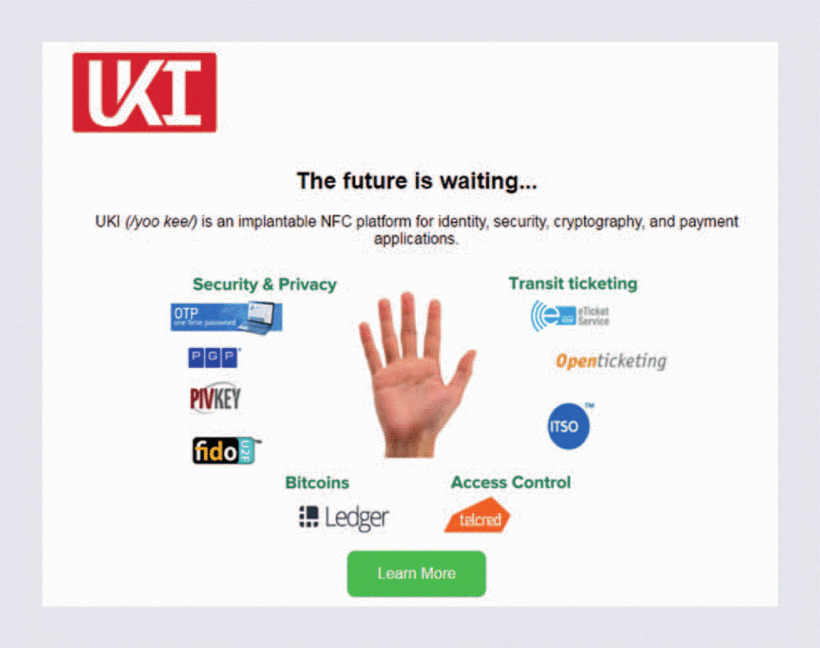
Figure 1. www.myuki.com is scheduled to launch in fall 2016.
Citations: K. Michael, "RFID/NFC Implants for Bitcoin Transactions," in IEEE Consumer Electronics Magazine, vol. 5, no. 3, pp. 103-106, July 2016, doi: 10.1109/MCE.2016.2556900.
Katina michael interviews Amal Graafstra [1] about his forthcoming initiative MyUki.com (pronounced /yoo kee/) (Figure 1). UKI is an implantable near-field communication (NFC) platform for identity’ security, cryptography, and payment applications. Graafstra is the entrepreneur who started Dangerous Things. com in 2013 (Figure 2), and, in this interview, he speaks on the changes he has witnessed since the Maker Revolution. Graafstra believes it is time to move ahead with products and services that can be consumed by the general population, not just members of the tech community. He observes the shortcomings of our online identities that are owned by companies and not individuals and is proposing a way to integrate biological identity using an embedded implant that will give the user greater control over all of his or her transactions. While UKI is mostly about security, cryptography, and bitcoin transactions, Graafstra is also looking at various ways his product might be used, everything from access control, transit ticketing, e-payments, and privacy applications [2].
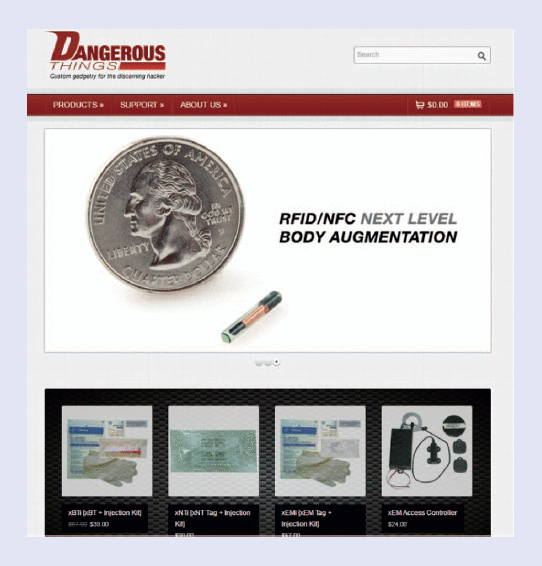
Figure 2. Graafstra's www.dangerousthings.com has been operating since 2013.
Katina Michael: It's been over ten years since you wrote your first book, RFID Toys[3], and a lot has happened since then. But in summary, what has changed for you during that time?
Amal Graafstra: Technologywise, not much. Personal philosophy, personal security, transhumanism, life extension, a lot has changed. In 2005, when I wrote the book, it was kind of a technological curiosity. There was a lot of hubbub around RFID implants, which ultimately died down [4]. There was really an argument around consent [5], but it wasn't really a practical argument. After the Maker Revolution was born, say around 2008, people started making and creating things in their garages again. Also out of that movement, the maker concepts ventured into the biological space. People started thinking why would they buy that real-time polymerase chain reaction machine for US20,000whentheycouldmakeoneforUS2,500?
The idea that hacker ethics and methodology could be applied to biology and all those things, spurred on discussion of transhumanism, of the singularity, and more. For me, the conversation started around privacy and security, and the context of that around transponders didn't make any sense. To me, there was very little impact to personal privacy and no impact really on security. I mean, my RFID-enabled door stopped being susceptible to lock pickers and became susceptible to people who had RFID emulators. So it didn't really change the security issue, except I think there are a lot less people with emulators around to get through my front door than there are lock pickers, and the requirements are more difficult. An emulator must first scan my tag then emulate it, where a lock picker can just attack the lock directly. So maybe in some small sense, I became a little bit more secure with my implants.
But, really, the discussion around humancentric implants—what it means to be human, what it means to be augmented—challenged some people fervently. I found it difficult to understand when the idea was a very simple concept, whereas a pacemaker or a cochlear implant does not get that kind of attention and, perhaps, it is because it is purely restorative medicine and not augmentation by choice. So I tried to comprehend why augmentation received so much resentment from some people, and I think it is because there is fear around the technology and people are misinterpreting or misunderstanding the technology's capability. Really, it was coming down to having to defend the technology and defend my choice to have implants, actively refining my arguments and really getting myself involved in discussions about the future of humanity and the mission of humanity beyond our capabilities. It forced me to play the philosopher a little bit. You know, this hits on everything from religion to politics to everything.
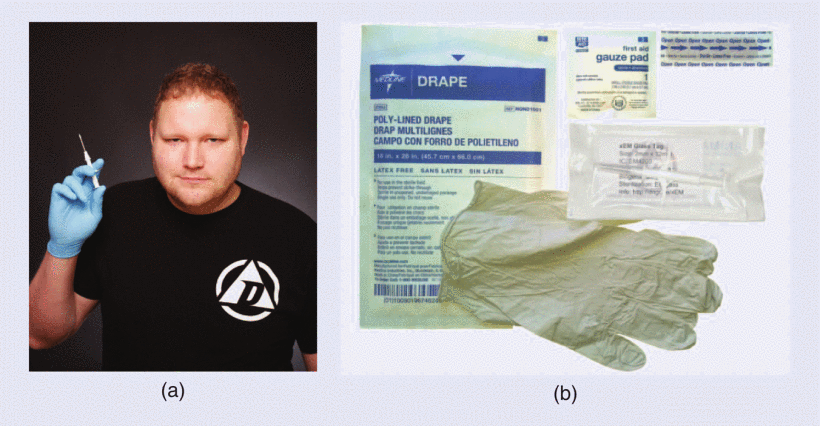
Figure 3. (a) Graafstra holding an RFID implant syringe used for injection. (b) An xEMi injection kit that graafstra sells with an RFID tag.
Michael: I think, Amal, you are right. Religion and politics are two very divisive issues when one considers their position in emerging technological issues and social implications [6]. These user sentiments and beliefs will either drive adoption of embedded systems or cause a lag in the diffusion of the technology. So I think talking about these things openly is vital [7]. From the quantitative studies we ran in 2010–2012, we found these were indeed the very dominant themes that emerged when we codified the open comments [8]. It also had to do with ethics [9], power, control, access, trust [10], security [11], and privacy [12]. But most importantly, the freedom of the individual to accept or reject such a proposition [13], [23].
Graafstra: Yes, I very much agree that individuals have the right to do what they want with their own bodies. And that is a fundamental human right, when you look at various aspects of life, not just the introduction of an implant into the human body.
Michael: I wanted to ask you about DangerousThings.com now [14] and what you have learned from the experience of launching a company on RFID/NFC implants for the wider consumer market (see Figure 3). Is there a subculture forming whether we call them body modifiers, or grinders, or biohackers, or implantees?
Graafstra: The main thing I am seeing is the fundamental change or shift in the type of customer. The first year was all about technology-aware people that understood RFID or NFC. They were building their own projects, so they understood how to build them; they were very excited. Now, the general customer is less so. The general customer is like, “Oh that's interesting, I have NFC on my phone, and what can I do with the implants? Is this something I can get into my house with?” [15]. They are not really aware of how the technology works exactly. They just think it is interesting and cool.
People are more accepting of the idea of an implant now, and they kind of view it more as body jewelry. So the question they are asking themselves is like, “Should I get a body piercing or an RFID implant?” It's all the same [16]. So as far as biohackers as a community, a small community has come together, and people are doing things, and I find society's reaction in general to be interesting. The awareness of implants of this nature, especially over a decade now from the first coverage, has seeped into people's general consciousness. I've talked to some people who say, “Oh, I've never heard of that.” But I am sure somewhere they have heard of it but it has not registered what it means exactly. So the general reaction I was getting ten years ago was very visceral responses like “ew,” but now it is like, “Oh, hmm,” and it is far less violently opposed. I think, in general, society is changing to be a little more open or understanding of these things. And even if they don't like it, it is not a kind of violent reaction [17].
Michael: Our research on uberveillance [18] and the multicountry quantitative surveys we've done are telling us something similar, although some of our responses between 2011 and 2013 were recurring: “it's creepy,” “ohh,” “stupid,” “no way,” “too scary,” “yuck,” etc. However, there are slightly more people considering RFID implants now as a plausible future [19]. We asked small business owners whether they were willing to adopt an implant, and more than 80% of people fell in the “no” or “maybe” bands. Over the three years we ran the survey, we did not see a significant change in the “yes” response, but we have seen more people move into the “maybe” band, which is also interpreted as “undecided” and “I don't know,” and so whereas in 2010 people would have just replied “no way,” more people are shifting to sitting on the fence with a decision. And most of the time, the “maybe” responses were qualified with an imperative health and safety comment or security response or ownership and access issue, etc. These figures are commensurate with last year's Lloyds Bank survey that claimed that as many as 7% of Brits would take an implant for e-payment, although we don't know the sample size of their survey [20]. In 2010, a survey run by IT industry lobby group BITKOM, found that 23 out of 1,000 German respondents “would accept a microchip implanted in their body if that would bring concrete benefits” [21]. So in just five years, that is a 5% swing, although we are speaking of two different markets in the European Union.
Graafstra: And I think that is probably the most important thing for implants as a product, that it seems that it is becoming more widely accepted in the general public.
Michael: So why create the www.myuki.com brand? I would like to ask you about what services you are going to launch (e.g., the bitcoin e-payment implant) and whether or not MyUki will be a part of the Internet of Things or will it be a separate crypto initiative that does not directly involve third parties?
Graafstra: Very briefly now: The infrastructure (and here I mean services like Facebook and online banking) of the Internet is not set up in a way that people own their identity. You are never sure when you get a response from someone whether you are really talking to that person. The reality is that we set up these proxy identities. We have our biological identities, that is ourselves, and then our digital identities, a collection of all of these proxy accounts that act as “you” online. So somebody on Facebook wants to message as you. If they have your account credentials, they can send a message as if they were “you.” Of course, people would realize it was not you if there was a radical message sent out, but if it was subtle, nobody would detect you hadn't sent the message in the first place. So if it was covert, or subversive, it would be indistinguishable from the real “you.” So if you log on to your bank account and you tell the application to transfer money out of your account, the bank just does that on your behalf. And the fundamental issue is that the bank owns that identity too; you do not. Facebook owns that identity; you do not. All of these things, the third party owns the identity elements; you do not.
Something like UKI, where you can biologically and cryptographically prove your identity and you can validate transactions, is necessary. Imagine a future where you go to the bank or log in, and that is fine because a hacker could log in too and see your account details, but they could not issue a transaction like “transfer this amount” from A to B. The bank has to put all the transactions in a blockchain ledger, which is publicly accessible. And if the bank moves your money, that transaction is moved by the bank and recorded as such in the ledger, but if you move that money, then that transaction is signed by you. If somebody else who does not have a valid signature tries to transfer your money, they cannot do it. So in one sense, you would own your bank account [22], but currently, it is still owned by the bank. The same would go for your messaging and your Facebook account. You would have ownership over your identity, and that requires a fundamental change in how identity is handled online and how it is handled within political systems.
For example, Estonia has an Estonian Residency Card, which is cryptographic, that needs to be used for setting up accounts, processing transactions, and interacting with the government as a form of identification, but it is a card, it is a token, an object. And all of these can be lost, forgotten, or stolen. You know, two-factor authentication for websites. I can turn it on, but there are always back doors subject to hacking. The back doors are there to enable people who've lost their security token to still get in. They are not locked out. But these back doors are weak and susceptible to hacking, so there is no real point to two-factor authentication because it does not solve the problem at hand. So I've tried to create something that is reliable, robust, permanent, and it bonds your biological identity to your digital identity. And that's really what I am trying to start with MyUki (Figure 1).
Michael: I see the intent here. I also see the pull away from large corporations in some sense and their hold on consumers, going with this kind of personal ID solution. I think both government and industry would find this a difficult concept to work with because, ultimately, it has to do with control and how services are provisioned. The other thing is how consumers will perceive such a service, and right now, our research is telling us that the vast majority of people don't like the idea of implants, as they believe they are losing control by having something in their body they cannot take out, which is different to closing a bank account with a company you've lost faith in because of, say, a hike in cardholder fees.
Reference
1. A. Graafstra K. Michael Innovative Automatic Identification and Location-Based Services: From Bar Codes to Chip Implants 2009 Information Science Reference The do-it-yourselfer RFID implantee
2. A. Masters K. Michael Lend me your arms: The use and implications of humancentric RFID Electron. Commerce Res. Applicat. 6 1 29 39 2007
3. A. Graafstra RFID Toys: 11 Cool Projects for Home, Office and Entertainment (ExtremeTech) 2006 Wiley Publishing
4. K. Michael M.G. Michael This Pervasive Day: The Potential and Perils of Pervasive Computing 163 206 2011 Imperial College Press Implementing namebers using microchip implants: The black box beneath the skin
5. A. Graafstra K. Michael M.G. Michael Social-technical issues facing the humancentric RFID implantee sub-culture through the eyes of Amal Graafstra 498 516 2010
6. K. D. Stephan K. Michael M.G. Michael L. Jacob E. P. Anesta Social implications of technology: The past, the present, and the future Proc. IEEE 100 4 1752 1781 2012
7. W. A. Herbert K. Albrecht R. Clarke R. Capurro M. Gasson A. Graafstra Uberveillance and the Social Implications of Microchip Implants: Emerging Technologies 334 350 2014 Information Science Reference The social implications of radio-frequency identification
8. K. Michael C. Perakslis M.G. Michael Surveillance and/in Everyday Life: Monitoring Pasts, Presents and Futures 2011 University of Sydney Microchip implants for employees in the workplace: Findings from a multi-country survey of small business owners
9. R. Achille C. Perakslis K. Michael Ethical issues to consider for microchip implants in humans Ethics Biol. Eng. Med. 3 1 75 86 2012
10. M.G. Michael S. J. Fusco K. Michael A research note on ethics in the emerging age of uberveillance Computer Commun. 31 6 1192 1199 2008
11. C. Perakslis K. Michael Indian millennials: Are microchip implants a more secure technology for identification and access control? 2012
12. L. Perusco K. Michael Control, trust, privacy, and security: Evaluating location-based services IEEE Technol. Soc. Mag. 26 1 4 16 2007
13. C. Perakslis K. Michael M.G. Michael R. Gable Perceived barriers for implanting microchips in humans: A transnational study 2014-June-24–28
14. A. Graafstra K. Michael Uberveillance and the Social Implications of Microchip Implants: Emerging Technologies 126 132 2014 Information Science Reference DangerousThings.com
15. A. Graafstra Biohacking—The forefront of a new kind of human evolution 17 October 2013 https://www.youtube.com/watch?v=7DxVWhFLI6E
16. K. Michael M.G. Michael Towards chipification: The multifunctional body art of the net generation 622 641 2006
17. K. Michael G. Roussos G. Q. Huang R. Gadh A. Chattopadhyay S. Prabhu P. Chu Planetary-scale RFID services in an age of uberveillance Proc. IEEE 98 9 1663 1671 2010
18. M.G. Michael Katina Michael Towards a state of uberveillance IEEE Technol. Soc. Mag. 29 2 9 16 2010
19. M.G. Michael K. Michael C. Perakslis Uberveillance, the web of things, and people: What is the culmination of all this surveillance? IEEE Consumer Electron. Mag. 4 2 107 113 2015
20. R. Boden Half of Brits expect to replace cash with new technologies 28 August 2015 http://www.nfcworld.com/2015/08/28/337345/half-of-brits-expect-to-replace-cash-with-new-technologies/
21. Survey on chip implants in Germany Digital Civil Rights in Europe. 10 April 2010 http://history.edri.org/edrigram/number8.5/study-human-chips-germany
22. R. Ip K. Michael M.G. Michael Amal Graafstra the do-it-yourselfer RFID implantee: The culture, values and ethics of hobbyist implantees: A case study 2008-June-24–27
23. M. Reynolds RFID implants need better privacy protection Gartner, Stamford, CT, Rep. G00124544 Oct. 2004 https://www.gartner.com/doc/456911/rfid-implants-need-better-privacy
Citations: K. Michael, "RFID/NFC Implants for Bitcoin Transactions," in IEEE Consumer Electronics Magazine, vol. 5, no. 3, pp. 103-106, July 2016, doi: 10.1109/MCE.2016.2556900.