Location-based Social Media Use in Families
Citation: S. J. Fusco, K. Michael, M. G. Michael and R. Abbas, "Location-based Social Media Use in Families : Qualitative Outcomes from Participant Observations," 2018 IEEE International Symposium on Technology and Society (ISTAS), Washington, DC, USA, 2018, pp. 139-149, doi: 10.1109/ISTAS.2018.8638283.
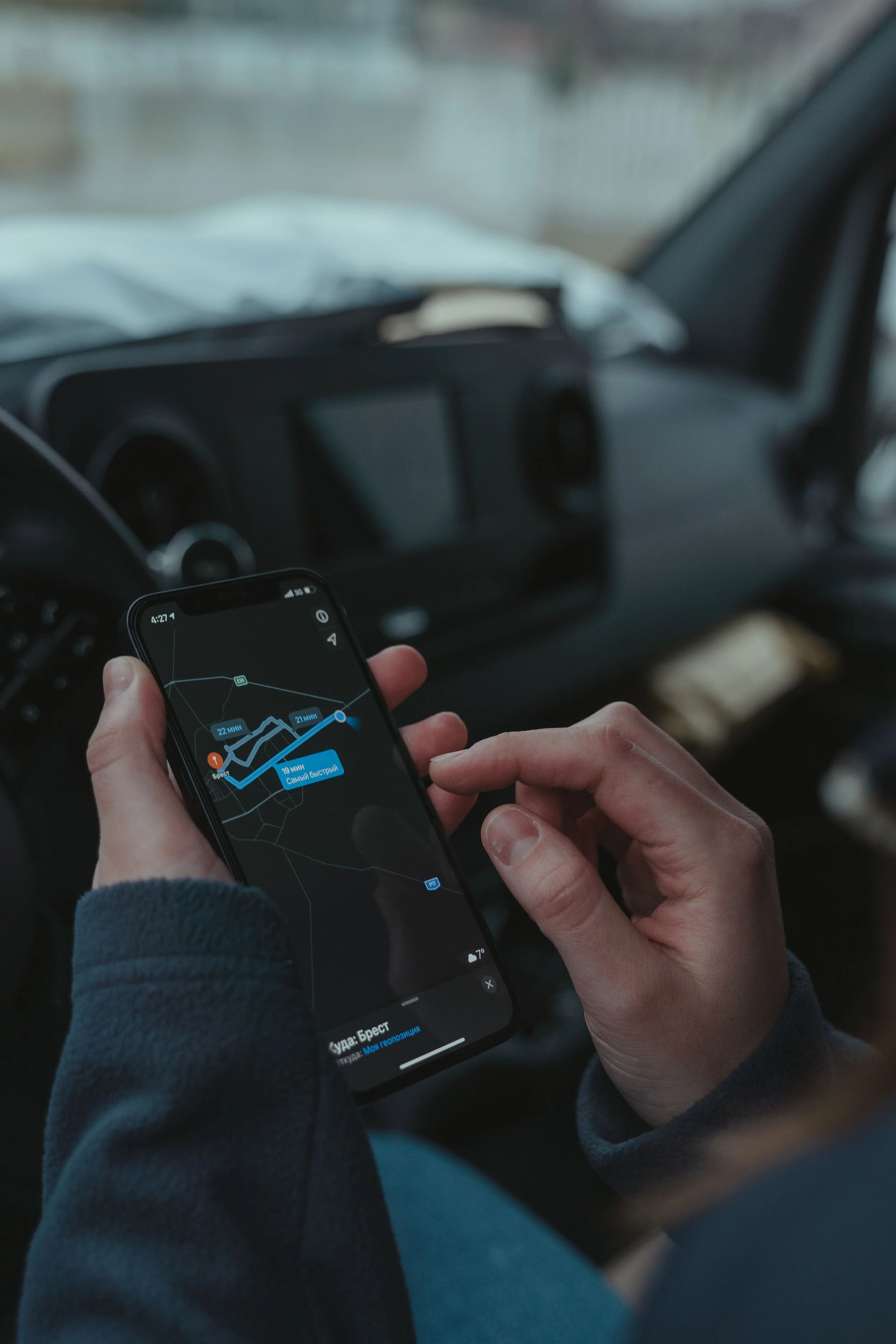
Image by Tima Miroshnichenko
Abstract
This paper is about location-based social media use within families. An experiment was devised to study different family relationships and dynamics with respect to the use and application of location-based social media services. The methodology applied was two-fold: (1) an experiment using Google Latitude, a location social media app; and (2) semi-structured interviews. The data from the study is analyzed using qualitative analysis and compares the responses between siblings with that of parent-child relationship. The results of the study raise issues about (1) use and experience; (2) the disclosure of location; and (3) and the power to view location information. In the discussion uses and benefits of this technology are presented, as well as negative issues, trust and control factors. The main finding of the study is that location-based social media use while very beneficial in families has the propensity to propagate a power asymmetry, one individual over the other, although this power is not always displayed explicitly. While location-based social media is about "sharing" one's location, the sharing is not always equitable, nor is it bidirectional.
SECTION I.
Introduction
Location-based social networking (LBSN) services have proliferated over the last decade since the inception of mobile social media, facilitated mainly via smartphones and tablets. The adoption of these services by the general community have been tremendously high, propelled mainly by navigation services such as Google Maps, that require one’s location sensor to be enabled for more accurate map readings and directions from originating point to destination point. Social media platforms such as Facebook and Google+ also allow instant messaging with location-enabled geocoding with either coordinates or civic address details. Some people in society like to have their dynamic location data "always on" disclosing their most recent location position, while others are sensitive to location-enabled data in the form of photographs EXIF (Exchangeable Image File) data for instance, preferring to turn the location sensor "off" unless they are navigating their way to a particular place.
Businesses offering devices with location-enabled applications have more recently defaulted the setting to "off" rather than "on" in upgraded systems they deliver. One example of this has been the Apple iPhone 8 and later versions of the iOS that now allows a user to customize which features can use location information via the network (i.e. cellular location determination), using Wi-Fi, the Global Positioning System (GPS) network, and/or Bluetooth to approximate the user’s location. These could be applications that rely or record location data such as Maps, the Camera, Weather, Fitness Apps or other third party Apps. While privacy settings on the iPhone for instance offer excellent controls for on-board iOS Apps, third party applications are determined "on the fly" when a user downloads the App for the very first time. It is true to say, that many users do not pay attention to Terms and Conditions when downloading a new App, and many are oblivious to what they have "agreed" to, and which Apps are/are not conducting location tracking and monitoring. Additionally, there are now services like Uber and Lyft that rely on location data to carry out basic taxi services. As penetration rates of such "on demand" services rise, more and more location information is collected. Internet search companies like Google, utilize data from their navigation applications to determine the likelihood of a busy hour of service for a given retail outlet, opening and closing times and days of operation, and much more. For the greater part, location information is shared between a human who demands a service, and a machine who provides support responses. But this paper aims at unidirectional and bidirectional flows of location information with a third party "in the middle" which happens to be a machine.
This paper is divided into four main parts: a literature review that identifies previous works in the area of location-based social networking; and the methodology that describes the observational study of the family participants and the pre-and post- interview process. The observational data results between paired individuals is then categorized into several major areas: participant use and experience, participant disclosure of location, and participant viewing location. A brief discussion is then presented before a final conclusion.
SECTION II.
Literature Review
The current literature on location based social networking explores users' willingness and motivations for disclosing location information and presents several user studies, which draw out different findings on the implications of using LBSN. Grandhi, Jones and Karam [1] conducted a survey to gauge attitudes towards disclosure of location information, and use of LBSN applications. The findings from the short survey indicated that there was a general interest in LBSN services. The majority of respondents stated that they would disclose their personal location data, that demographics and geotemporal routines did matter, and finally that social relationships are important in predicting when or with whom individuals want to share personal location data.
TABLE I. Summary of studies concerning location disclosure amongst social relations
Several user studies have been conducted on location based social networking [2]. One of the earliest studies to be conducted involved a two phased study comparing perceived privacy concerns with actual privacy concerns within a closed LBS environment [3]. Barkhuus found that although users were concerned about their location privacy in general, when confronted with a closed environment the concern diminished. Another user study observed the configuration of privacy settings on a work-related location based service [4]. The study found that grouping permissions provided a convenient balance between privacy and control. Moving away solely from the concept of privacy, Consolvo and Smith et al. [5] conducted a three-phased study. First they explored whether social networking users would use location-enhanced computing, second they recorded the response of users to in-situ hypothetical requests for information, and thirdly requested participants to reflect upon phase one and two. Some of the captured results included: what participants were willing to disclose, the relationship between participant and requestor, the effect of where participants were located, the activity or mode, privacy classifications, what people want to know about another's location, and privacy and security concerns. The limitation of the early research in the field of LBSN was the hypothetical nature of the research, or that the research took place within a controlled environment. The following studies employed the use of actual or tailored LBSN.
Brown and Taylor [6] implemented the Whereabouts Clock, a location based service that displayed the location of family members on a clock face with four values. At any given point of time, an individual had the status of being at home, at work, at school, or elsewhere. This study revealed that LBSN within the family context could help co-ordination and communication and provide reassurance and connectedness, although it also caused some unnecessary anxiety. Privacy was found not to be an issue among family members using the Whereabouts Clock. The LBSN technology used in this study was more sophisticated than prior studies but it was rather limited in geographic granularity.
Humphreys performed a year long qualitative field study on the mobile social network known as Dodgeball which allowed users to ‘check in’ at a location and then that location was broadcasted to people on their given network. The outcomes of this study revealed patterns of use of LBSN, the creation of a "third space" by LBSN, and the resultant social molecularization caused by Dodgeball use [7]. The limitation of this study is again in the technology employed, the location information was not automated or real-time as Dodgeball required the user to consciously provide manual location updates.
Barkhuus and Brown [8] conducted a trial using Connecto, in order to investigate the emergent practices around LBSN. Connecto allowed users to tag physical locations and then the phone would automatically change the users displayed location to represent the tagged location. This provided a closer simulation of real-time automated LBSN. The outcomes of this study demonstrated that users could use Connecto to establish a repartee and were self-conscious about the location they disclosed. By publishing their location, the users were found to engage in ongoing story-telling with their friends, via a process of mutual monitoring. This act was seen as a "part of friendship relations" and added to an "ongoing relationship state." There was also the additional expectation that users had to "have seen each others' location or else risk falling ‘out of touch’ with the group" [8]. Brown’s LBSN studies published after 2008 use methods that take advantage of sophisticated real-time automated LBSN applications.
Tsai and Kelley [9] developed the Locyoution Facebook application, which was used to automatically locate user laptops using wireless fidelity (Wi-Fi) access points leveraging the SkyHook technology. The aim of the study was to investigate how important feedback is for managing personal privacy in ubiquitous systems. Participants were divided into two groups; one group received no information about who had requested their location while the other group was able to view their location disclosure history. The four major findings of the study were that (1) providing feedback to users makes them more comfortable about sharing location (2) feedback is a desired feature and makes users more willing to share location information, (3) time and group based rules are effective for managing privacy, and (4) peers and technical savviness have a significant impact upon use.
Vihavaninen and Oulasvirta [10] performed three field trials of Jaiku, a mobile microblogging service that automates disclosure and diffusion of location information. The focus of the field trials was on investigating the use, user response and user understanding of automation. The results of this study revealed that automation caused issues related to control, understanding, emergent practices and privacy. This study is significant as it is one of the first studies to investigate the implication of automated location disclosure upon user perceptions. The study however does not investigate the implications of the use of automated LBSN upon social relationships.
An ethnographic study by Page and Kobsa explored people's attitudes towards and adoption of Google Latitude, a real-time and automated LBSN. The focus of this study was upon "how participants perceive[d] Latitude to be conceptually situated within the ecology of social networking and communication technologies" [11], based upon technology adoption, social norms, audience management, information filtering and benefits. This study while innovative, presented preliminary results based upon 12 interviews of users and nonusers of Latitude.
The user studies conducted upon LBSN have matured over time, with more recent studies employing sophisticated LBSN which provide automated real-time location disclosure. These studies provide insight into user perceptions and use of LBSN however issues of control, security or trust have been neglected, although they are becoming increasingly pertinent to both location based services and online social networking technologies. Furthermore there has been no more than a cursory investigation into the implications of using LBSN upon social relationships. Table 1 provides a summary of some of the previous works that address the question location-based services relationship implications partially [12]. In addition, the 129 articles retrieved from IEEEXplore using the term "LBSN" are preoccupied predominantly with non-social implications discussions and only one paper directly referenced "LBSN" and "families" scantly, that being by Basiri et al., 2014, entitled: "Overview of positioning technologies from fitness-to-purpose point of view".
SECTION III.
Methodology
A. Location-Based Social Networking Context
Cho et al. [24] point out that location-based social networks maintain explicit friendship networks. Family members are a type of "friendship" network in the Fusco et al. studies but are denoted by a terse relationship of parent(s) and their (child)ren living together as a unit. Sometimes there is a friend who sticks closer than a brother (Proverbs 18:24), but the usage of LBSN in this paper observes interactions within a family context. So while dating Apps such as Tinder connecting total strangers based on location (and other demographics) are one suite of LBSN Apps, usage within family contexts may be more relevant to Apps like WhatsApp that introduced live location sharing features late in 2017 [25]. Facebook’s WhatsApp now keeps dynamically updating your real-time location at the "chat" level, even if the App is in the background, seemingly asleep. Other competing Apps with varying degrees of location accuracy and user options for location granularity include:
Telegram: choice of the three levels of duration
Facebook Messenger: choose hourly user location only
Apple iMessage: share location with users for an hour
Google Maps: users can share their location with others for anywhere between 1 hour and ‘permanently’
Google Latitude when in operation between 2009 and 2013, allowed users to share their location data (1) in real-time, (2) obfuscated to the suburb level, or (3) manually entered by the user, even if that location was deliberately incorrect. It is also important to note, that an agreement in sharing location information between a parent and child was not automatically bi-directional (Figure 1). A child, for instance, could agree to share their location information with their parent, but not necessarily the other way around. So the aim of this paper is to document (1) use and experience; (2) disclosure of location information; and (3) viewing of location information, in the context of a family. A discussion will then follow on the usefulness and benefits, negative issues, and trust issues related to LBSN as raised in this observation.
B. Observational Study and Interviews
An observational study is defined as an empirical investigation in which "the objective is to elucidate cause-and-effect relationships… [in which] it is not feasible to use controlled experimentation, in the sense of being able to impose the procedures or treatments whose effects it is desired to discover, or to assign subjects at random to different procedures" [26]. A form of observational studies is participant observation, which is defined as: "a field strategy that simultaneously combines document analysis, interviewing of respondents and informants, direct participation and observation, and introspection" [27]. This qualitative study utilizes a form of participant observation to observe the effect of using a LBSN application between pairs of family members (siblings and parent-child relationships). The purpose of using an observational study is that it provides data on real-world experiences.
The time frame chosen for the observational period was 48 hours. The form of treatment in the observational study was the introduction of a location-based social networking (LBSN) technology. The technology chosen for the study was Google Latitude. Latitude provided real-time, constant, automated sharing of location with nominated "Friends" and was one of the first location Apps to be launched that even stored location histories. Furthermore, it was easy and intuitive to use, and offered a familiar interface as it was an add-on to Google Maps. While Google has since integrated Latitude seamlessly into Maps, Latitude served as a distinct observation mechanism focused on "location sharing". While Fusco et al., have previously reported on location sharing between "friends" [28]-[30], this paper focuses on interactions between parent-child and siblings.
Participants were recruited by sending an email request for interested parties outlining the details of the study. The observation involved three stages; pre-interview, observation (the actual use of LBSN), and a post-interview. During the pre-interview participants were provided with the device running Latitude and asked a series of questions with the purpose of understanding their level of technological literacy, and the level of trust within the friendship. The participants were then asked to use Latitude for a period of 48 hours, and refer to Latitude at least three times during that period. Participants were given general instructions on how to access latitude on the mobile phone device and view their "friend’s" location. They were then told to experiment with Latitude and use any of its features. After the completion of the period of observation the participants underwent a post-interview, the purpose of which was to gather their observations on the use and implications of Latitude. The post interview also incorporated general discussion questions to delve into the participants opinions on the device and its possible implications and uses.
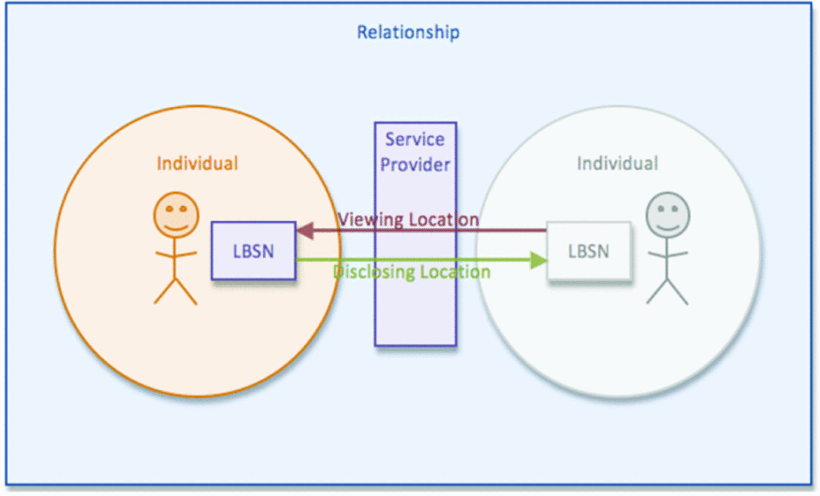
Fig. 1. Human-to-Machine-to-Human Interaction
The majority of the questions in the pre and post interview were designed to draw out from the participant their observations of using Latitude. The beginning of the interview used broad discussion and as it progressed it moved into specific discussion questions. There were questions specific to trust and also to control. The purpose of including specific questions on trust and control was to gauge the impact of LBSN on trust and distinguish it from the concept of control. The data was gathered through conducting the pre and post interviews. The interviews were conducted in a semi-structured informal manner, utilizing an interview guide to steer the line of questioning. Each interview was recorded with a voice recorder and transcribed.
Ethical issues that have been considered and taken into account in conducting the observations and interviews were:
Ensuring that participants received full disclosure about the purpose and use of the participant’s information
Ensuring that participation was voluntary
Ensuring that the interview questions were not offensive to any gender, race, religion or social group.
Following the observations the researchers ensured that all identifying information from the observation was removed from the transcripts and pseudonyms used for the reporting of the results. An obvious limitation of the observational study was the short period of time granted to participants, and yet this experiment provided rich and varied insights and did not overburden participants in the trial.
SECTION IV.
Use and Experience
The siblings described their experiences using Google Latitude differently. The older sibling commented that it was not useful and only referred to Latitude three times during the day because the study imposed this condition. The younger sibling started out with the same impression however as time went on she became intrigued with the nature of location sharing and referred to it at least 8 times in the first 24 hour period. The younger sibling commented: "[a]t the beginning I didn’t think much of it but then during the day as you check it is kind of cool because you can check out where they [sibling] are and you do tend to follow them and if it is not according to where they should be, not that I doubt her, but you would question where is she? Or where is she going?" The same participant went on to say that Latitude was "good" and could be useful in "certain situations" but then wondered if it was available on a platform like Facebook that everyone would be checking "where everyone is all the time and it would become too much of a problem in terms of privacy". The younger participant said she would not like that tracking feature. But interestingly, that same participant was also motivated to check on her older sibling for sheer curiosity: "I guess I just wanted to see where she was and to see how accurate it is and whether it changes or if it does update regularly and also to see if it positioned me right and when I went to lunch whether it showed me in the restaurant." This could come down to the nature of the novelty effect and increased interest in the new technology as an intervention.
In the case of the Mother’s experience of using Latitude, it was absolute "fascination": "[h]ow do they program this, how does it work? How can I be tracking my daughter?" The Mother distinguished also between the technological artefact and her daughter: "that is not my daughter that is the phone… she has got it with her but it is not really my daughter." During the 48 hour period the mother referred to Latitude 8 to 9 times a day: "Well, for instance, I could have rung my daughter to see if she caught the train but I thought, oh no, I will [just] check." The Mother felt she was able to discover a lot about her daughter by simply looking at her location: "She was at [place] and I thought right, she wasn’t at work, it would have been when she was at uni or something, and then later on I noticed when she was at [place] and so I thought okay so she must be at work now and then before she came home I thought, I’d check because she should nearly be at home and I noticed though that it was just saying [place] and I thought alright she must still be at the uni and this was at eight o’clock but then I noticed it said retry again, and so I thought it wasn’t able to connect, and then shortly after she was at [place] and so I knew she was on her way home. But instead of ringing her I suppose I just checked the tracking device." Thus, while a simple SMS might have resolved the location of the daughter, the Mother relied on waiting for a system location refresh, placing trust in the reliability of the system.
The reason the Mother referred to Latitude was two-fold. First, to check to make sure her daughter was at the right location, for example, "to look at whether she had caught the train and whether she was coming back home." Second, the Mother checked out of "curiosity – ‘Where is she now’ …just to work out what does she do during the day. I noticed she has a pretty busy day". The daughter’s experience was less to do with discovering detail about her Mother than it was about feeling like she was being watched by her Mother as she travelled to work and back home. "It was interesting. On the day that I was using Google Latitude I had to travel to Sydney for an exam, and then went to dinner with my boyfriend and then returned home. I found it good that my Mother could see that I had arrived in Sydney and that I was in Sydney after my exam." In fact, "I thought [this visibility] would ease my mother’s mind when I was at the train station so she would know that I was on my way home. However when I arrived home she told me that when she last checked I was in Haymarket and she thought I was going to miss the train… I felt as though I had to account for all my locations." The daughter commented that though she checked up on her Mother eight times, she knows where her mum is "most of the time": "if she is not at work, she is at home, shopping or taking my brother to swimming. I wasn’t too curious about where she was but more so about where she thought I was."
SECTION V.
Disclosure of Location
A. Tracking Me, Tracking You (Voluntary Surveillance)
Neither sibling was bothered or concerned about disclosing their location to the other. Both siblings explained this response by referring to the fact that their sibling either "already knew" where they would be, or that they would freely share this information if asked. "Well I didn’t really have a problem with that at all. She knows where I am anyway, she knows my address and she knows what I do after work and before work. I just it gave her more information as to my whereabouts and then she wouldn’t really have to call me up and have a chat and say where are you and what are you doing. And I guess that would cut out that part of the conversation and change the way that you communicate and what purposes you communicate for." The younger sibling agreed, that the device "didn’t make any difference," although the reliance on the machine to give an accurate answer is observed. Additionally, neither sibling was compelled to act differently in terms of their location behavior as a result of being tracked on Latitude.
The Mother and daughter had different responses to location disclosure. The daughter was keenly aware that the Mother was viewing her location and although most of the time she was "okay disclosing [her] location to [her mother]" there was one time in the 48 hour period where she was uncomfortable: "The only time I was uncomfortable disclosing my location was when I went to a friend’s house instead of going straight home – because I was not doing what I had said I was going to do." The daughter also felt a sense of security and vulnerability when disclosing her location: "Disclosing my location in Sydney at night to my Mother was beneficial – at times it was a safety blanket, I felt safer because I knew someone knew where I was. Although at the same time I felt vulnerable because I thought "what if someone I didn’t want to have my location knew where I was in Sydney at night?". In contrast to the daughter’s response the Mother in this experiment did not even think about whether she was being tracked by her daughter as Latitude does not ping you when someone looks your location up: "That’s interesting, I was usually thinking that I was tracking [my daughter] down. I didn’t think [my daughter] was tracking me." She followed this response with the following statement: "Well because I have got nothing to hide it didn’t worry me. That’s interesting, I didn’t even think of it, I didn’t even think that [my daughter was] tracking me. I just thought it was me tracking [her] all the time."
B. Composing Location (Obfuscation)
In composing their location to disclose neither sibling explored the privacy functions available. When asked whether they would use these functions to hide or change their location, the older sibling claimed they would use those features but only for specific purpose: "Well, if I was doing something which I didn’t want my sister to know about, or if I was going somewhere for example buying her a surprise birthday gift and I didn’t want her to know I was going to a certain location and doing that." The older sibling compared this with using the privacy settings in other relationships: "[i]t would be so that people wouldn’t know where I was full stop. And especially, I have more of an issue with my home residence rather than my place of work. I just feel that it is not just tracking me it is tracking where other people in my family live too and I think that exposes them to risk depending on who is able to track it." The younger sibling claimed they would not deliberately hide their location from their older sibling. "Basically because I have got nothing to hide from [my sibling] and I trust her with where I am."
Neither Mother nor daughter changed or hid their location during the 48 hour period. The Mother was not aware of this feature and if she was she would not use it: "Because, I have nothing to hide from her, she knows all there is to know about me." The daughter on the other hand was aware of the feature to hide or change her location. Although the daughter did not manually change her location she did feel tempted to change her location on one occasion. Neither the Mother nor daughter changed their behavior, however, the Daughter perceived that this could be a possibility: "Although I didn’t act differently on this occasion, I did have the feeling that I was being watched and was conscious of the places that I went to… It is possible that knowing that you are being tracked can cause changes in your decisions, especially when you are being tracked by your parents." This user feeling pertains to one’s freedom of movement and autonomy, and whether or not open visibility impacts physical and psychological patterns [8].
C. Receiving Feedback (Pinging)
The siblings were asked whether they would like to receive feedback detailing when the other was viewing their location. The older sibling said: "I would be interested to know what she didn’t know about my day, and what she was curious to find out about. And whether she knows where I work or what I was doing." The younger sibling on the other hand was not interested in receiving feedback. The sibling was then asked how she would feel if she knew the other sibling was looking at her location every hour, in response she said: "Well, I guess it would come to the issue that I don’t think she would need to because she knows where I am, but if she did then in a way that is like her questioning where I am and I wouldn’t like that. If she did. But I don’t think she did. She better not have!" When this same participant was asked why they had checked their sibling’s location frequently, she retorted: "Yes, but you know it’s a device." There is an obvious disconnect here.
When asked whether or not a feedback "ping" was required upon location viewing, the Mother noted: "[t]hat would be interesting, but it wouldn’t even worry me, it wasn’t something I was thinking about." However when she was asked what she would feel if she saw that her daughter viewed her location several times throughout the day she responded: "Why does she want to look at my location so many times? You kind of think what is the need?" The daughter perceived that this feature would be useful for rectifying situations where the Mother was viewing an inaccurate location, but also expressed that it could be "weird" as it would instantiate a feeling of being "monitored." She said: "On one hand, I would like to know when my mother was viewing my location. This way I would be able to know how much she knows about where I have been. As it was she thought I was in Haymarket when I was at Central, and if I knew that I could have rectified her assumption that I was (yet again) going to miss the train home from Sydney… On the other hand, it would be slightly weird knowing when she is viewing my location. It would make me really feel as though I was being monitored, especially if she viewed my location an excessive amount of times. Although –funnily enough – she could be doing that to me at the moment anyway." One of the deep problems associated with Google Latitude was that pings were unavailable. One considers the potential for an overprotective spouse to ping their partner’s location an irrational number of times and to make the erroneous assumptions of whereabouts.
SECTION VI.
Viewing Location
A. The Value of Viewing and Unintended Consequences
In being able to view the other sibling’s location, the older sibling felt it was an unnecessary access to more information, and also felt protective of the younger sibling stating that "I wonder who else knows where she is too and I guess a bit protective of that". The younger sibling said that it "didn’t impact or make an effect on me." The sibling did however, state that with other people she would probably feel "weird" if the location was viewable in a bidirectional manner. In the case of the Mother and daughter, the ability to view the others’ location provided a little bit of extra information: "I generally know where my mum is most of the time. This way I was just able to know more precisely when she was there, although the accuracy was bad I could still infer from her roundabout location where she would be based on what I know about her and where she goes." The Mother found that viewing her daughter’s location was useful: "Because rather than phoning I could just check to see when she was coming home. At times though, I remember thinking, ‘oh gee, the train is going to leave at such and such a time and she is still in a particular area and I wasn’t sure if it was near the station, and I thought she was going to miss the train’... So that was the bit that put me off a bit. Thinking that she should have been somewhere that I didn’t think she was because of the tracking device." It can be observed, that the accuracy of the location information caused the Mother unnecessary anxiety in relation to her daughter’s whereabouts.
B. Effect of Whether the Location was Up-to-Date
Both siblings would assume that an "old" location was the fault of the device not updating and not the sibling deliberately obfuscating their location. The younger sibling noted: "Well, I would assume that it was because her phone hasn’t updated her current location. If it was a fact that she was hiding it from me then I would be suspicious of why she was hiding it from me." The older sibling said she did not realize that obfuscation was possible using Latitude. The lack of up-to-date or obfuscated location had no effect on the daughter, the only problem she noted was that the location "just wasn’t that accurate". The Mother however did report the lack of current location as causing problems: "It just made me feel ‘why is she late? Why is she still there when she should be on her way? Who is delaying her or what is delaying her?’ I thought okay, I knew that she should be home at a particular time and I was nearly going to contact her but eventually [place] showed up, and that was the same with the time on the train, I thought she should be, and then after 15 or 20 minutes I checked again." When the Mother was asked why she did not telephone her daughter to validate her location or ease her concern, she responded that she assumed there was something wrong with Latitude: "Well I thought maybe there is something wrong with the tracking device, and thinking that [my daughter] couldn’t be that silly, if she said she was going to catch the train at a particular time, then she is going to catch it at a particular time, I wanted to give her the benefit of the doubt. But then if I would have checked again and after 15 minutes it still wasn’t getting the right information then I would have called her." This begs the question whether or not technology provides a false sense of safety and physical security, but at the same time might cause unnecessary concern or panic. Sometimes, it is simpler to just talk to a human, than rely on a machine (that relies on a complex set of algorithms) to just give you the straight answer.
C. Making Assumptions
The assumptions made by both siblings were based upon information they already knew about the other. For example: "Yeah, if I saw her in the area of our home then I assume she is at home, and if I saw her in [place] I’d just assume she is at work just knowing where she is generally anyway and if she was travelling in between the two I would assume that she was either on her way home or on her way to work." Both Mother and daughter drew assumptions from the location of the other. The daughter assumed the specific location of her Mother from the inaccurate general location provided by Latitude: "Yes, I made assumptions of where she would be for example if she was around the area of [Place A] I guessed she was at work, or when she was around the area of [Place B] I guessed she was at home. There are not that many suspicious assumptions you can make about my mum." The Mother also made assumptions, including on one night the Mother "thought for some reason why is she working back late and still at [place], just hoping that people were not delaying her." When in fact, the device had not updated because the daughter was travelling home via a zone that had limited or no reception. The mother only clarified the assumption when her daughter arrived home safely, having earlier conferred with her husband about their daughter’s whereabouts.
D. Sharing Location with Third Parties
The younger sibling did disclose the older siblings location to a random person in a café: "I was at the café and I was looking at it and someone asked me what I was doing and I said I can see my sister, and said, ‘here can you see her’, and I showed them where she was in [place]." She also mentioned that she would share the location of her older sibling with other members of her family. The older sibling did not disclose the location of the other sibling to a third party. In the pre-interview the older sibling said that her main concern with the device is that her location would be shared with unintended recipients, which is what the other sibling did. In the context of the Mother and daughter, the daughter did not disclose the Mother’s location to anyone else, however the mother did freely disclose her daughter’s location to other family members: "Yeah I even mentioned it to her uncle and he was amazed too, he couldn’t believe how it worked. Every now and then I used to tell her Dad, "oh she is here or there" and think even her sister."
SECTION VII.
Discussion
In summation, the results of the study can be found in Table 2. These are further elaborated in the discussion that follows between parent-child and siblings.
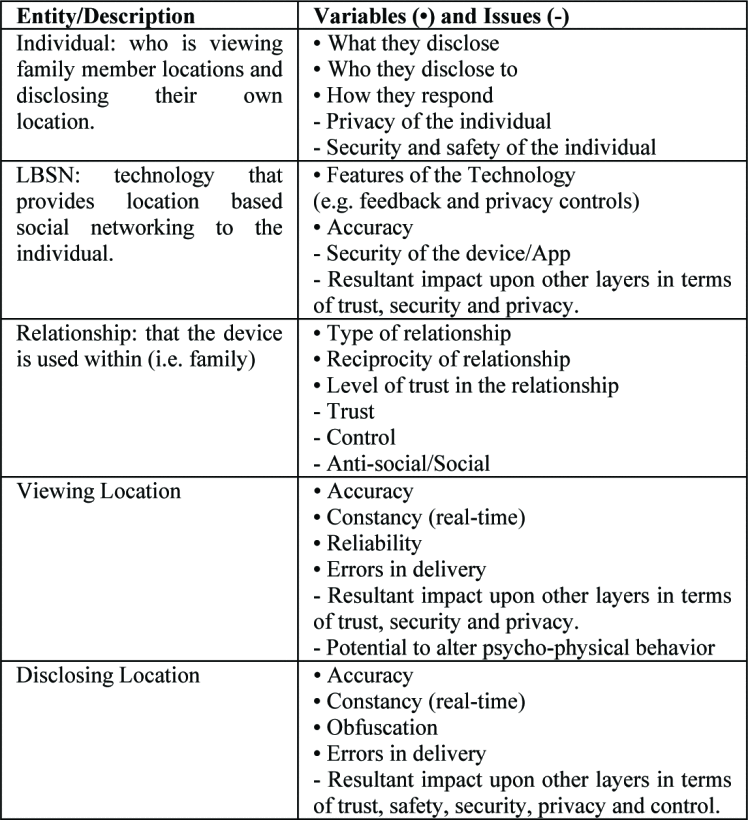
TABLE II. Issues Raised in LBSN Usage in the Family
A. Usefulness and Benefit
Both siblings said that the device was not useful between siblings. The older sibling however said that if "she was doing something out of routine, then, yes it would be. For example, if she was going away somewhere or travelling". The younger sibling was more circumspect in her reply, saying that: "I don’t think it is the best idea… generally for just friends or family to track each other. I think that would abuse the trust and then if you can hide and change it [location] then it will just become, you know, people will be questioning their trust or questioning whether they are showing them, and then if everyone knows where everyone is then I just think it is a bit of an abuse of privacy." The younger sibling saw that it would be useful "but if they are trying to track someone to prevent crime" but not for tracking friends and family. In relation to the usefulness of the device, the daughter had a mixed response. On one hand, she saw it as useful as a means of providing her mother with "peace of mind" but on the other hand it also caused her mother anxiety: "I thought the application was useful as it may have given my mother some peace of mind as to my whereabouts. However in saying that my mother was concerned when my location did not show up at the train station therefore it acted to cause anxiousness and she did not contact me as she would have done, had she not known my location." Furthermore, the daughter saw that Latitude could also provide "safety - having someone know where you were last located" in addition to "peace of mind". Although the daughter qualified this response by commenting that: "[i]t can potentially cause them to fall into a false peace of mind and a false sense of safety – as the location may not be accurate, may be fake (i.e. manually changed), or may not be connected to the person."
The Mother commented that the "phone is just as useful" as Latitude and that if she did not have Latitude she "would use the phone to find out where [her daughter] was and what she was doing". The Mother was further asked whether Latitude was more convenient then using the phone and in response the Mother stated that it was: "because any time I could just check instead of annoying her by ringing all the time. And it was cheaper because I didn’t have to use my phone. I would have normally rang her… but then again I knew that she was going to be home by a certain time and I would not have normally rang, but having the device I would just check and verify that she was on her way home so it was useful in the sense that it made me check – ‘okay good she is on the way home’- instead of having to use my phone to check and annoy her especially if she was with friends." In addition to this use the Mother commented that Latitude was beneficial as it satisfied her "curiosity so that [she knew] where [her daughter] was" and also that it would enable her to more easily physically find her daughter as she could follow mapped directions.
B. Negative Issues
The negative issue of use was stalking and the potential for the device to raise suspicion and break down trust in a family relationship. "Well, it could lead to a lot of cases of stalking and problems in the sense of trust with, if say two people or if the parents are tracking the children’s location, I guess it would come to the fact that the parents will be basing their trust on this device and also the children will probably feel that their trust is neglected with their parents as they are basing it on the device. And also I suppose another problem will be if it is not accurate or if it is not updated regularly then it could cause problems with the– say if it is not regularly updated or not the right position then it could cause problems in terms of the people that are tracking each other, if they believe that they should be in one location but then latitude says they are in another then it may cause problems between them, whereas it is just the device that is wrong not the actual person. I think it could cause a lot of problems. I just seem to look at it very closely with Facebook… If your friends see you at one place … you know sometimes you may not want to go to some place or you don’t want to disclose all your locations to your friends just for individual reasons but if it comes to the point where they can see and track where you are then it will probably cause conflicts between them." Furthermore, she noted, "[j]ust the potential for it to raise suspicion, if suspicion is unnecessary and the potential to break down trust in any relationship of high trust… it could break it down a little bit, it could destroy that high trust. And I guess [if] you rely on the application instead of the person’s word and having faith in the person’s word."
The daughter identified that using Latitude could impact upon the actions which individuals take as well as affecting the trust between siblings, parent and child, and even friends in general: "In addition in knowing that you are being tracked it could impact upon the actions you take. Furthermore, as there is more visibility of peoples’ whereabouts then if the person does not do exactly as they said they were going to do – i.e. go home straight away – then the parent or friend may develop suspicion surrounding the person, and it would essentially erode the trust or dependence they had in individual – although the divergence in action would not, without the device, cause such suspicion or reduction in trust." Similarly, the Mother also identified that Latitude could impact negatively upon the trust between parent and child: "You wouldn’t want to have to do it all the time. I think after a time, the child would get annoyed with the parent asking ‘why were you there when you shouldn’t be there’." Upon reflection the Mother noted: "It’s nice to know that you can have a certain element of trust between mother – daughter, you wouldn’t want to live like that [i.e. tracking them] all the time." The mother also saw that the device could cause unnecessary "panic" if a stranger was able to access the location information of their child.
C. Trust
When asked specifically whether the device would impact upon trust, both sibling responses indicated that Latitude does have the potential to impact upon trust. The older sibling described this elaborately: "I think you begin to give more credit, or credibility to the application rather than what the person says. So because you feel that the Google Latitude application is objective then you assume that it is accurate and you assume that what it says is true and therefore you begin to be more trusting of the application and rely more on the application. Whereas people can be not as accurate and are subject to lying and deceiving, for possibly good reasons, and knowing that you are probably more willing to accept what Latitude says over the person, and the trust that you have in the person is secondary to the trust that you have in the application. And I think that could be a problem because it doesn’t make people as accountable. I think that even the person who is being tracked, will know that the person tracking is using a program which is correct and therefore they do not need to disclose everything because they can get that information elsewhere. So I think that on both sides you are not really communicating properly anymore and not really trusting enough." The younger sibling also noted: "[i]t would cause a problem with trust because I guess instead of having the pure sense of trust in the person we are trusting this application and if it is not always accurate and if it [location] can be changed or hidden from other people then we are in a sense altering the trust. We are not just… trusting a person with the normal sense of trust, we are trusting the person through this application."
Both Mother and daughter identified that Latitude would have a negative impact upon trust, when asked about any detrimental effects that Latitude had or may have had. The dialogue below between the interviewer and the Mother identified that the device also caused the Mother to doubt her daughter, and lose "a bit of trust". The Mother recounts the example of assuming for a "split second" that her daughter had deliberately missed the train on the way home from work. The Mother later emphasized: "I suppose it just verified that that was exactly the path which she was [on].”
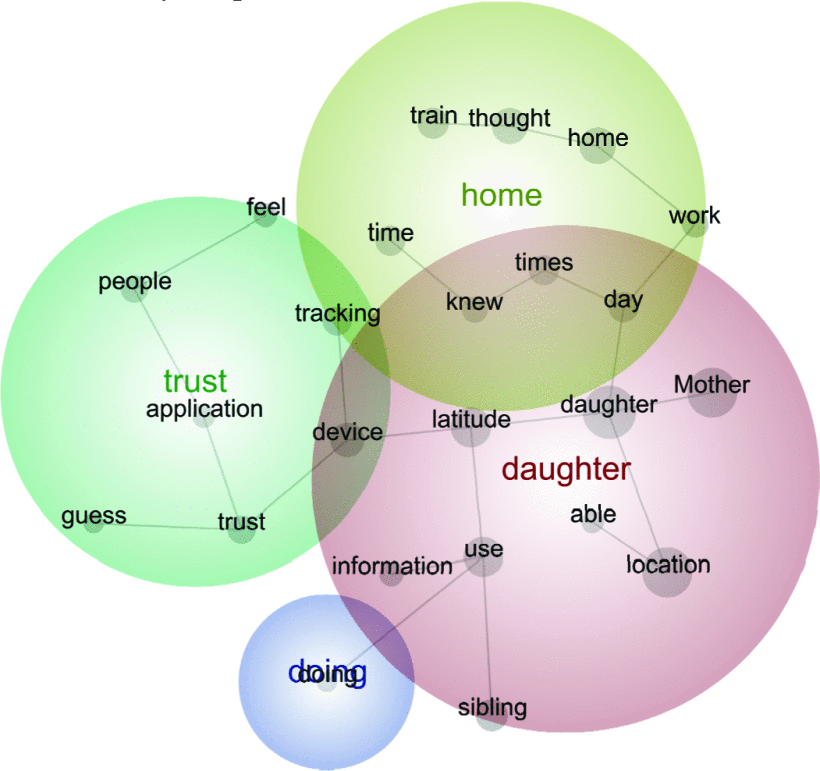
Fig. 2. Concept Map of the LBSN Family Observation
A concept map of the interviews between parent-child and siblings is presented in Figure 2. Although the observation lasted only 48 hours, it can be seen that interactions between participant observers using the LBSN App Latitude raised issues relation to place-time-context (e.g. work/home-day-train), device and App and the ability to track (location), and guessing or trusting what someone was feeling, thinking, and doing. While Google Latitude was found to be useful in certain contexts, the mediating technology also had some unintended consequences in that the participant observers relied more on the App than on human conversation, trusted the App over the human, and even felt their autonomy impacted somewhat considering an altered pattern of behavior while being watched by a family member. The technology was considered to be useful for safety and security, but was also questioned in the event that a third party, particularly "outside" the family unit, would somehow gain access to rich location chronicles to stalk or cause harm.
SECTION VIII.
Conclusion
The power of LBSN within a family context is in providing near real-time information about a loved one’s whereabouts for safety, security and well-being. Very few could argue that the availability of location details within a harmonious family, where the existing bond is already strong, could have anything but a beneficial and positive impact on relationships (e.g. Parent-Child, or siblings) [32]. In fact, if anything, such a trusting bond would be made even stronger through the use of location-based social networking Apps that indeed verify and validate that an individual is where they say they are. Interestingly, however, there was an element of guessing, assumption-driven reflection that was exacerbated in this observation study that predominantly came about as an over-reliance on online location viewing in place of human-to-human contact via the telephone. This study also further validated the findings of Aloudat et al. [33], who emphasized the need for accurate location information availability that is reliable for the stability of social relationships (e.g. in emergency situations). Beyond "trust", privacy, freedom, and autonomy in the context of 24x7 "tracking" and "monitoring" were also aspects addressed in this two-day study. Additionally, the need to disclose when a user’s location information is "pinged" in a reciprocal relationship is vital. When one user has the power to view what another has disclosed, but not vice-versa, the power differential may cause long-term relationship issues.
References
1. S. A. Grandhi and Q. Jones, “Sharing the Big Apple: A survey study of people, place, and locatability,” in CHI '05 Extended Abstracts on Human Factors in Computing Systems, Portland, OR, USA, 2005.
2. S. J. Fusco, K. Michael, M. G. Michael, and R. Abbas, “Exploring the social implications of location-based social networking: An inquiry into the perceived positive and negative impacts of using LBSN between friends,” in Proceedings of the 9th International Conference on Mobile Business (ICMB), Athens, Greece, 2010, pp. 230–237.
3. L. Barkhuus, “Privacy in location-based services: Concern vs. coolness,” in HCI 2004 Workshop on Location Systems, Privacy and Control, 2004.
4. S. Patil and J. Lai, “Who gets to know what when: Configuring privacy permissions in an awareness application,” in Proceedings of the SIGCHI Conference on Human Factors in Computing Systems (CHI), 2005.
5. S. Consolvo, I. E. Smith, T. Matthews, A. LaMarca, J. Tabert, and P. Powledge, “Location disclosure to social relations: Why, when, and what people want to share,” in Proceedings of the SIGCHI Conference on Human Factors in Computing Systems (CHI), 2005, pp. 81–90.
6. B. Brown, A. S. Taylor, S. Izadi, A. Sellen, J. Kaye, and R. Eardley, “Locating family values: A field trial of the Whereabouts Clock,” in Proceedings of the 9th International Conference on Ubiquitous Computing (UbiComp), 2007, pp. 354–371.
7. L. Humphreys, “Mobile social networks and social practice: A case study of Dodgeball,” Journal of Computer-Mediated Communication, vol. 13, no. 1, pp. 341–360, 2008.
8. L. Barkhuus, B. Brown, M. Bell, M. Hall, S. Sherwood, and M. Chalmers, “From awareness to repartee: Sharing location within social groups,” in Proceedings of the SIGCHI Conference on Human Factors in Computing Systems (CHI), 2008, pp. 497–506.
9. J. Y. Tsai and P. Kelley, “Who's viewed you? The impact of feedback in a mobile location-sharing application,” in Proceedings of the 27th International Conference on Human Factors in Computing Systems (CHI), 2009.
10. S. Vihavainen and A. Oulasvirta, “‘I can't lie anymore!’: The implications of location automation for mobile social applications,” in Proceedings of the 6th Annual International Conference on Mobile and Ubiquitous Systems: Networking and Services (MobiQuitous), 2009.
11. X. Page and A. Kobsa, “The circles of latitude: Adoption and usage of location tracking in online social networking,” in International Conference on Computational Science and Engineering, 2009.
12. R. Abbas, K. Michael, and M. G. Michael, “What can people do with your spatial data? Socio-ethical scenarios,” in A. Marrington, D. Kerr, and J. Gammack, Eds., Managing Security Issues and the Hidden Dangers of Wearable Technologies. Hershey, PA: IGI Global, 2017, pp. 206–237.
13. K. Michael, A. McNamee, M. G. Michael, and H. Tootell, “Location-based intelligence: Modeling behavior in humans using GPS,” in Proceedings of the IEEE International Symposium on Technology and Society (ISTAS), New York, NY, USA, 2006.
14. A. Dey, D. Kotz, and T. Henderson, “Privacy in location-aware computing environments,” IEEE Pervasive Computing, vol. 6, no. 4, pp. 64–72, 2007.
15. M. U. Iqbal and S. Lim, “Privacy implications of automated GPS tracking and profiling,” in K. Michael and M. G. Michael, Eds., From Dataveillance to Überveillance and the Realpolitik of the Transparent Society. Wollongong, NSW, Australia: University of Wollongong, 2007, pp. 225–240.
16. J. Seeburger and R. Schroeter, “Disposable maps: Ad hoc location sharing,” in Proceedings of OZCHI 2009, 2009, pp. 377–380.
17. E. Toch, J. Cranshaw, P. H. Drielsma, J. Y. Tsai, P. G. Kelley, J. Springfield, and N. Sadeh, “Empirical models of privacy in location sharing,” in Proceedings of UbiComp, 2010, pp. 129–138.
18. J. Boesen, J. A. Rode, and C. Mancini, “The domestic panopticon: Location tracking in families,” in Proceedings of UbiComp, 2010, pp. 65–74.
19. L. Jędrzejczyk, B. A. Price, A. K. Bandara, and B. Nuseibeh, “On the impact of real-time feedback on users' behaviour in mobile location-sharing applications,” in Proceedings of the Symposium on Usable Privacy and Security (SOUPS), 2010.
20. C. Mancini, L. Jędrzejczyk, K. Thomas, B. A. Price, A. K. Bandara, Y. Rogers, and B. Nuseibeh, “Predators and prey: Ubiquitous tracking, privacy and the social contract,” in Proceedings of UbiComp, 2010.
21. K. P. Tang, J. Lin, J. Hong, D. P. Siewiorek, and N. Sadeh, “Rethinking location sharing: Exploring the implications of social-driven versus purpose-driven location sharing,” in Proceedings of UbiComp, 2010.
22. S. J. Fusco, K. Michael, A. Aloudat, and R. Abbas, “Monitoring people using location-based social networking and its negative impact on trust: An exploratory contextual analysis of five types of ‘friend’ relationships,” in Proceedings of the IEEE International Symposium on Technology and Society (ISTAS), Chicago, IL, USA, 2011.
23. M. N. Gasson, E. Kosta, D. Royer, M. Meints, and K. Warwick, “Normality mining: Privacy implications of behavioral profiles drawn from GPS-enabled mobile phones,” IEEE Transactions on Systems, Man, and Cybernetics, Part C: Applications and Reviews, vol. 41, no. 2, pp. 251–261, 2011.
24. E. Cho, S. A. Myers, and J. Leskovec, “Friendship and mobility: User movement in location-based social networks,” in Proceedings of the 17th ACM SIGKDD International Conference on Knowledge Discovery and Data Mining (KDD), 2011, pp. 1082–1090.
25. K. Dua, “WhatsApp live location sharing launched: Here's how it works,” Gadgets360, Oct. 18, 2017. [Online]. Available: https://gadgets.ndtv.com/apps/news/whatsapp-live-location-sharing-feature-tracking-apk-android-how-to-get-it-1764236
26. W. G. Cochran, “The planning of observational studies on human populations,” Journal of the Royal Statistical Society, Series A, vol. 128, no. 2, pp. 134–155, 1965.
27. N. K. Denzin, The Research Act. Englewood Cliffs, NJ: Prentice Hall, 1989.
28. S. J. Fusco, R. Abbas, K. Michael, and A. Aloudat, “Location-based social networking: Impact on trust in relationships,” IEEE Technology and Society Magazine, vol. 31, no. 2, pp. 39–50, Summer 2012.
29. K. Pretz, “If you track me, will we still trust each other?,” The Institute, Nov. 5, 2012. [Online]. Available: http://theinstitute.ieee.org/technology-topics/smart-technology/if-you-track-me-will-we-still-trust-each-other
30. R. Abbas and K. Michael, “Methodological approaches to location-based social networking (LBSN) research,” in Proceedings of the 2017 IEEE/ACM International Conference on Advances in Social Networks Analysis and Mining (ASONAM), Sydney, NSW, Australia, Jul. 31–Aug. 3, 2017.
Authors
School of Computing and Information Technology, University of Wollongong, NSW, Australia
School for the Future of Innovation in Society, Arizona State University, Phoenix, Arizona
School of Computing and Information Technology, University of Wollongong, NSW, Australia
School of Management, Operations and Marketing, University of Wollongong, NSW, Australia
Citation: S. J. Fusco, K. Michael, M. G. Michael and R. Abbas, "Location-based Social Media Use in Families : Qualitative Outcomes from Participant Observations," 2018 IEEE International Symposium on Technology and Society (ISTAS), Washington, DC, USA, 2018, pp. 139-149, doi: 10.1109/ISTAS.2018.8638283.