ISTAS 2018: Technology, Ethics, and Policy
Citation: J. Pitt, K. Michael and T. Bookman, "ISTAS 2018: Technology, Ethics, and Policy [Special Issue Introduction]," in IEEE Technology and Society Magazine, vol. 38, no. 3, pp. 21-23, Sept. 2019, doi: 10.1109/MTS.2019.2930266.
In November 2018, the IEEE International Symposium on Technology and Society (ISTAS 2018) was held in Washington, D.C., U.S.A., encouraging contributions on the broad theme of “Technology, Ethics and Policy.” The event, the Proceedings of which are available [1], was fruitful in terms of underpinning the interplay of ethical considerations, policy interventions, and technological innovations when evaluating the prosocial benefits of new technology against the possibly unintended and undesirable negative consequences that may follow from unregulated design and deployment.
This Special Issue is inspired by, and seeks to build on the outcomes of, both ISTAS 2018 in particular and its predecessor conferences in general. As such, it continues to refine and pose potentially awkward questions that should nevertheless be addressed by designers, developers, regulators, and other key stakeholders — i.e., citizens themselves — both in the creation and adoption of technological innovation: where does it come from and does it fulfil a social need or satisfy a human value? In solving a problem does it create a new and possibly worse problem? How can technological offerings be regulated such that pragmatic technological solutions are not only beneficial to individuals and society but that they constructively engage those individuals and the society? And to keep asking the same question over and over again [2]: “Are there any additional and perhaps previously unaccounted for considerations, particularly when reflecting on technological developments in fields such as Artificial Intelligence (AI)?”
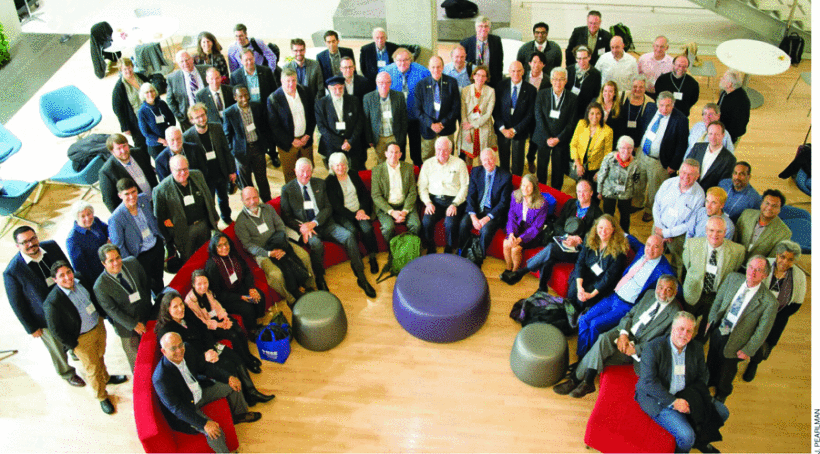
Attendees at the 2018 IEEE International Symposium on Technology and Society, SSIT’s annual flagship conference, in Washington DC, Nov. 13-14, 2018.
The balance and interplay between technological innovation, policy regulation, and ethical implications needs deep and continuous consideration.
The four articles selected for this Special Issue reflect on these questions in some depth, and can be considered under two headings insofar as they dealt with the themes of the conference: technology and ethics, and technology and policy.
Technology and Ethics
We start with the article “If Technology is a Parasite Masquerading as a Symbiont, Are We the Host?” by Jeff Robbins, which considers the similarity between a parasite that exploits its victim by injecting it with a massive dopamine hit straight to the brain, and technology that is intended to do much the same (addiction by design, cf., [3, 4]). The author invokes the second law of thermodynamics as the main theoretical justification for why the development of AI must result in the decline of the cognitive capacities of humanity and exacerbate an asymmetric distribution of power. In particular, Robbins stresses that thinking is negentropic. It creates mental order, or “exergy.” Its elimination constitutes mental entropy as the extinguishing of order that would have, or at least could have, been created via thought. The elimination of critical thinking is partly due to the ultra high organization in attention-seeking technology, and in those corporations deploying it, all the while, apparently, donning the cape of righteous and benevolent activism [5]. The ethical question here is the nature and symmetry of the exchange: symbiosis or parasitism. Even convenience comes at a cost.
The article “Human Value as the Basis for Sustainable Information Systems Design,” by Till Winkler, contributes to a growing body of knowledge on system and software design that elevates human values to first-class requirements [6]–[9], but concentrates on the issue of sustainability, a critical concern as awareness of the pressing need to address the climate emergency increases. Of particular significance is the exhaustive inventory and categorization of values, which may serve as either a checklist or a wayfinding tool for Information Systems developers who are determined to address sustainability issues by acknowledging the power of their artefacts to “carry values,” enacting that in the design process so that end users themselves can leverage that power. However, one of the critical issues here, linking back to the Robbins article, is the notion of responsibility [11]–[12]. It could be argued that persisting with an economic system that elevates the maximization of shareholder returns over other values, such as social responsibility, is not going to alter corporate behavior with respect to issues, such as sustainability, that can be deferred.
Technology and Policy
The third article in this ISTAS 2018 Special Issue is by Efraín O’Neill-Carrillo, Emmanuel Mercado, Oscar Luhring, Isaac Jordán, and Agustín Irizarry-Rivera, and is entitled “Community Energy Projects for Socio-Economic Development and Energy Transitions in the Caribbean.” It is a strongly interdisciplinary study of decentralized energy resources, in particular addressing the issue of transforming users from passive consumers into active participants. It requires addressing the exchange of control for convenience by leveraging such values as a sense of community [12], conceptual resources based on shared values, and norms embedded in the social structure of a community that facilitate the coordination of actions among the members of that community for the achievement of shared and common goals [13] (one definition of social capital), and empowerment, which requires using the (so-called) Smart Meter as a means of fostering inter-connection, status visualisation and collective action [14], rather than a means of monitoring and/or revenue maximization. In making a transition to a decentralized power generation system, promoting and increasing participation in governance through devolution, subsidiarity, and grassroots institutions can facilitate consensus-formation and decision-making regarding energy policy, and can produce a variety of solutions and options that are more sensitive and responsive to local conditions. This might be particularly important in the Caribbean, which may be exposed to more extreme events, but the principles should be applicable to energy consumption and production throughout the world.
The fourth and final article, “Where does innovation come from?,” by Zach Pirtle and Jared Moore, is a thorough comparative history of research and development. It looks at two initiatives, the first being Project Hindsight, which was a U.S. Department of Defence case study that examined innovations in military weapons systems from the end of the Second World War until 1962; and the second being Project TRACES, which was a National Sciences Foundation (counter) case study, which undertook a retrospective review of innovation in five different civilian technologies. The comparison is revealing, and supports the conclusion that a better understanding of the sources of innovation could help policy makers and engineers target their work on achieving more desirable societal benefits, such as sustainability.
The Future
In summary, this special issue recognizes the broad range of issues facing the designers of socio-technical systems. In particular, it calls for a deeper consideration of the balance and interplay between technological innovation, policy regulation, and ethical implications. It calls for engineers to shoulder the burden of social responsibility, and to consider not just unintended consequences, but to make ethical design choices. These design choices make manifest choices in interfaces to their systems, through not just participatory design, but also participatory empowerment.
ACKNOWLEDGMENT
Many thanks from the editors and the authors to all the reviewers of the papers for this special issue. Their many helpful and insightful comments have been very supportive in the publication process.
References
1. Proc. 2018 IEEE Int. Symp. Technology and Society (ISTAS`18), Washington, D.C., Nov. 13–14, 2018 ; https://ieeexplore.ieee.org/xpl/conhome/8636433/proceeding.
2. R. Abbas, B. Traynor and H. Tootell, “From good ideas to practical solutions: The changing nature of participation in our evolving digital landscape,” IEEE Technology and Society Mag., vol. 37, no. 3, pp. 27–18, 2018.
3. N. Dow Schüll, Addiction by Design: Machine Gambling in Las Vegas. Princeton, NJ : Princeton Univ. Press, 2014.
4. N. Eyal, Hooked: How to Build Habit-Forming Products. Penguin, 2014.
5. A. Mahdawi, “Amazon’s attack on Alexandria Ocasio-Cortez is corporate gaslighting,” Guardian, Jun. 18, 2019 ; https://www.theguardian.com/commentisfree/2019/jun/18/amazon-attack-alexandria-ocasio-cortez-corporate-gaslighting.
6. B. Friedman, P. Kahn, and A. Borning, “Value sensitive design and information systems,” in The Handbook of Information and Computer Ethics, K. Himma and H. Tavani, Eds. Wiley, 2008, pp. 69–101.
7. I. Van de Poel, “Translating values into design requirements,” in Philosophy and Engineering: Reflections on Practice, Principles and Process, D. Mitchfelder, N. McCarty, and D.E. Goldberg, Eds. Springer, 2013, pp. 253–266.
8. A. Cavoukian, “Privacy by design,” IEEE Technology Society Mag., vol. 31, no. 4, pp. 18–19, 2012.
9. J. Pitt and J. Ober, Democracy by design: Basic democracy and the self-organisation of collective governance, in Proc. IEEE SASO, 2018, pp. 20–29.
10. I. Van de Poel and M. Sand, “Varieties of responsibility: Two problems of responsible innovation,” Synthese, 2018.
11. H. Aldewereld and V. Dignum, “Social responsibility in system design,” (extended abstract), ECSI, pp. 286–290, 2014.
12. E. Ostrom, “Thinking about climate change as a commons,” in 15th Annual Philip Gamble Memorial Lecture. Amherst, UMass, 2011, pp. 1–34.
13. A. Christoforou, “On the identity of social capital and the social capital of identity,” Cambridge J. Econ, vol. 37, pp. 719–736, 2012.
14. A. Bourazeri and J. Pitt, “Collective attention and active consumer participation in community energy systems,” Int. J. Hum.-Comput. Stud., vol. 119, pp. 1–11, 2018.
Authors
Intelligent and Self-Organizing Systems, Imperial College London, U.K.
Jeremy Pitt is Professor of Intelligent and Self-Organizing Systems at Imperial College London, U.K. Email: j.pitt@imperial.ac.uk.
School for the Future of Innovation in Society, School of Computing, Informatics and Decision Systems Engineering, Arizona State University, Tempe, AZ
Katina Michael is with the School for the Future of Innovation in Society, School of Computing, Informatics and Decision Systems Engineering, Arizona State University, Tempe, AZ.
Managing Editor, IEEE Technology and Society Magazine
Terri Bookman is Managing Editor of IEEE Technology and Society Magazine.
Citation: J. Pitt, K. Michael and T. Bookman, "ISTAS 2018: Technology, Ethics, and Policy [Special Issue Introduction]," in IEEE Technology and Society Magazine, vol. 38, no. 3, pp. 21-23, Sept. 2019, doi: 10.1109/MTS.2019.2930266.