You Want to Do What with RFID?
Citation: K. Michael, A. Aloudat, M. G. Michael and C. Perakslis, "You Want to Do What with RFID?: Perceptions of radio-frequency identification implants for employee identification in the workplace," in IEEE Consumer Electronics Magazine, vol. 6, no. 3, pp. 111-117, July 2017, doi: 10.1109/MCE.2017.2684978.
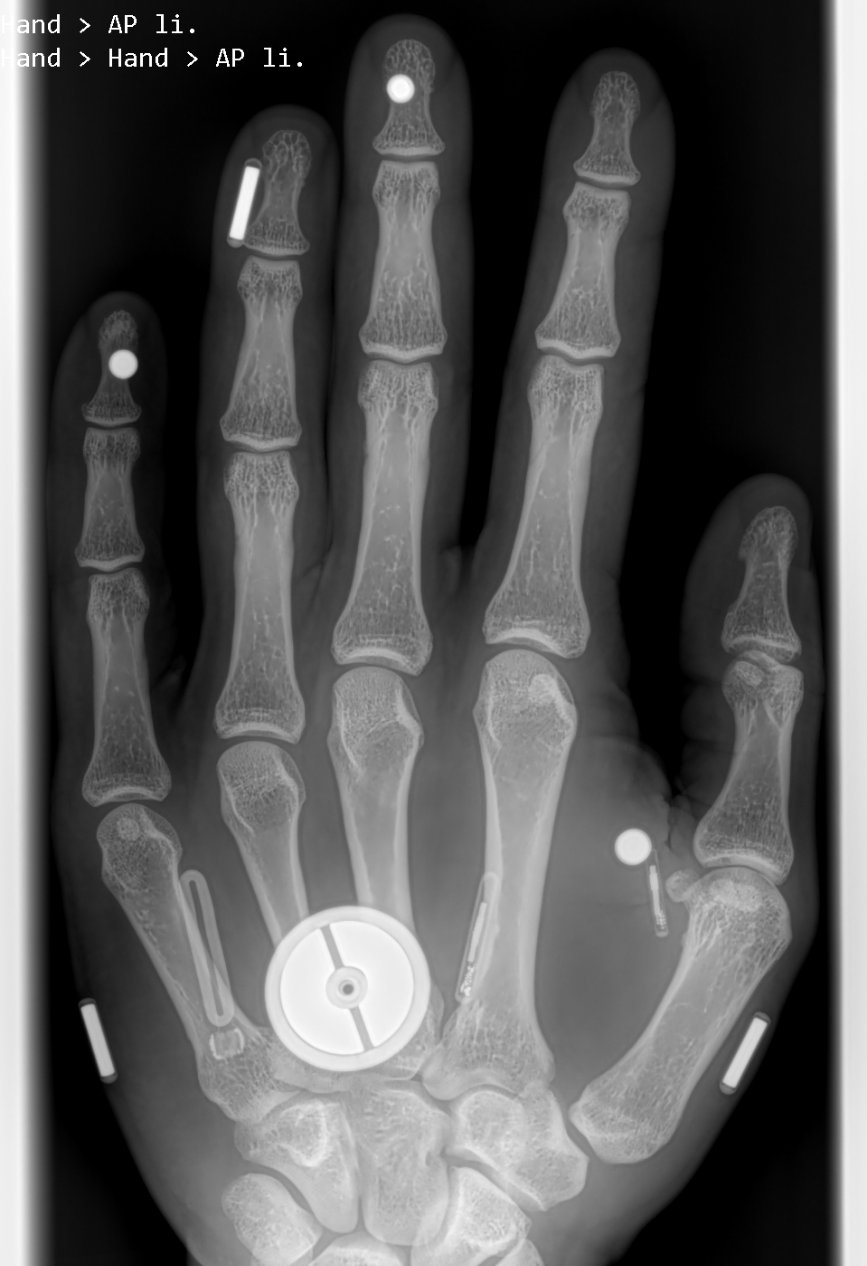
Electronic employee identification (ID) has transformed the workplace. Handheld tokens, such as contactless smartcards and wearable clip-on infrared badges, are now fundamental to security practices across the globe. Medium-to-large organizations continually stress the importance of employees carrying their staff cards at all times and displaying them for security purposes. Staff badges have been increasingly linked to physical access control in build ings, dynamic computer log-in, and even for e-payment using stored value. Most employees carry their electronic ID in a plastic sleeve attached to a lanyard, but given the card can be removed, it can be left behind, misplaced, or stolen.
Biometric systems have been used to log employee hours for payroll and for registering time and attendance since the late 1980s. However, given the cost of biometric readers, dispersing them around a large, closed campus for access con trol purposes is considered prohibitive. Radio-frequency identi fication (RFID) implants have been touted by proponents as being more secure, nontransferable, and an overall cheaper solution with the potential for multifunctionality and multiapplication growth. They also have the ability to be programmed dynamically. In 2004, in the aftermath of 9/11, VeriChip had an RFID chip approved for use by the U.S. Food and Drug Administration that it believed could be used to ensure employee safety, among other uses. By 2005, the Baja Beach Club chain had introduced the VeriChip to several of its clubs, and in 2006, the small business Citywatcher.com had likewise offered implants to its employees.
Literature review
Electronic RFID implants are capable of omnipresent electronic surveillance. RFID tags or transponders can be implanted into the human body to track the who, what, where, when, and how of human life [1]. This act of embedding devices into human beings for surveillance purposes is known as uberveillance (see www.uberveillance.com) [2]. While the tiny embedded RFID chips do not have global positioning capabilities, an RFID reader (fixed or mobile) can capture time stamps, exit and entry sequences to denote when someone is coming or going, and in which direction he or she is traveling and then make inferences on time, location, distance, and speed. For the greater part, RFID microchips in the wearable form have been used to track prison inmates, hospital patients, or visitors in various market niches.
However, their use is now being considered in a variety of human-centric military applications for soldiers (e.g., dog tags) and for the tracking of suspected terrorists and convict ed pedophiles [3], [4], [5]. Alzheimer’s sufferers, along with dementia patients, are also being considered as potential recipi ents of RFID microchips to aid in identification and as wander alerts [6], [7]. But it is the first time that we are witnessing the deployment of RFID implants for the sole purpose of con venience, for example, for ease of access to a premises as opposed to using security measures at the location to counter the act of unauthorized access.
Recent Momentum of Implantable Devices
Between 2014–2016, international media covered numerous Internet of Things stories that make this article timely. In April 2014, GroupM’s Irwin Gotlieb said that the “Wearable is cool, but the next form of media will be implantable—devices which are implanted in the human body” [8]. Director of engi neering at Google, Ray Kurzweil, concurred that we would have “millions of blood-cell-sized computers in our blood stream” within ten to 20 years [9]. In June 2014, IEEE Spec trum reported that Medtronic wanted to implant sensors in everyone [10].
In November 2014, Peter Diamandis, well-known chief executive officer of the X PRIZE Foundation and cofounder of Singularity University, got a near-field communication (NFC) implant on the spur of the moment at the Singularity Summit in Amsterdam. He said in his own blog: “Many big companies like Apple, Samsung, and Google are working on technology to measure your biology from outside of your body. Wearable devices ranging from watches to contact lenses will track every thing…footsteps, heart rate, blood glucose, blood pressure, and other critical vitals. The challenge is that they only work when you remember to wear them, and there are some things you can’t measure from the outside. The question is: when would you be ready to start incorporating technology into your body?” [11].
To demonstrate that this thinking about next-generation information technology is not isolated to the United States, in December 2014, eight Swedes held an implant party in Stockholm. BBC News reporter Jane Wakefield noted that Hannes Sjoblad, chief disruption officer and founder of BioNyfiken (of Epicenter), hoped that his implant party would spark a conversation about our possible cyborg future. He said: “The idea is to become a community that is why they get implants done together… People bond over the experience and start asking questions about what it means to be a man and machine… Curiosity is one of the biggest driv ers for us humans. I come from a maker hacker culture and I just want to see what I can do with this” [12].
In January 2015, it was reported by the BBC that a hi-tech office block in Sweden known as Epicenter was granting employees the option to take a microchip implant under the skin for physical access control to the building, among other functions [13]. As of April 2017, there are 150 employees of 2000 in the EpiCenter complex that are microchipped. And most of these chippings take place at “implant parties” [14]. In August 2015, Lloyds Bank announced that about 7% of U.K. consumers would adopt microchip implants in their body for making electronic payments [15]. In September of the same year, Kaspersky Labs became intrigued with the security issues related to microchip implants and engaged Sjoblad to participate in its Asia Pacific Cyber Security Sum mit in Malaysia to demonstrate the implantation process [16].
In January 2016, Andreas Sjöström used an NFC chip implanted beneath his skin as a boarding pass on a Lufthansa aircraft to travel from Stockholm’s Arlanda Airport [17]. He claimed it was purely for experimental purposes. In Septem ber of 2016, Shanti Korporaal launched ChipMyLife, an Aus tralian distribution service, with husband Skeeves Stevens [18]. She uses her implant to enter the physical premises of her building [19].
This is all while DangerousThings.com has been creating a recognized brand with NFC/RFID implant solutions for bio hackers since 2013. Visiting the home page of Dangerous Things, one is greeted by the following messages: “We believe biohacking is the forefront of a new kind of evolution” and “RFID/NFC next-level body augmentation.” On the “About Us” page, it is noted, “We believe our bodies are our own, to do with what we want. The ‘socially acceptable’ of tomorrow will be defined by boundaries pushed today, and we’re excited to be a part of it” [20].
Amal Graafstra then launched the myUKI concept, a mul tiapplication RFID chip, which has now been rebranded as Vivokey, with integrated smartphone features [21], [22]. He writes: “You can be you (and nobody else can), anywhere, all the time. You + VivoKey means your biological and digital identities can be cryptographically merged, ensuring the one true you is the only you using your devices, sending your messages, reading your e-mail, accessing your accounts, opening your doors, driving your vehicles, and spending your money” [23].
MethodoLogy
The transnational quantitative survey was held 4–18 April 2011 that took an average of 10 min to complete each online survey and included one optional open-ended question. Participants, who were small-business owners (N = 453) within four coun tries, including Australia (n = 114), India (n = 111), the United Kingdom (n = 111), and the United States (n = 117), were asked “How would you personally feel about being implanted for ease of identification with your own organization?” Relative to gen der, 51.9% of participants were male; 48.1% were female. The participants ranged from 18 to 71 years of age, the mean age was 44, and the median age was 45. Eighty percent of organiza tions surveyed had fewer than five employees. The chi-square analysis on the quantitative data was presented at 2014 IEEE Norbert Wiener; no significant chi-square analyses were report ed with respect to countries of residence and religious issues, social issues, and cultural issues [24].
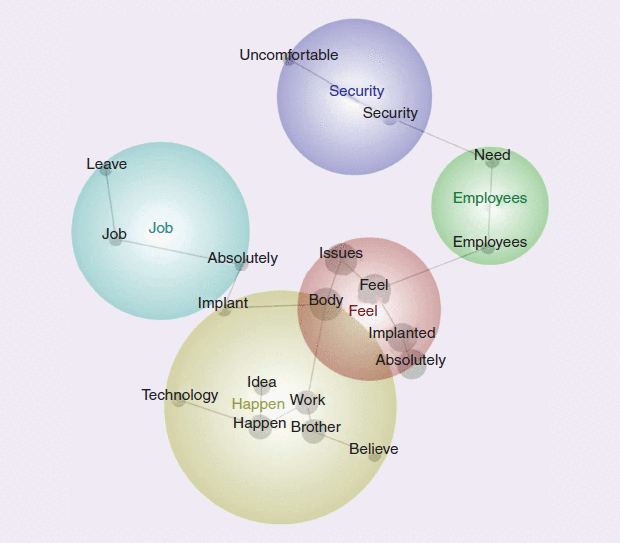
Figure 1. The concept map of relationships of terms in responses
The study employed one instrument that collected key data relative to the business profile, the currently utilized technologies for identification and access control at the organi zation, and the senior executives’ perceptions of RFID implants in humans for identification and access control in organizations. Twenty-five percent of the small business own ers that participated in the survey said they had electronic ID access to their premises. Twenty percent of small busi ness owner employee ID cards came equipped with a photo graph, and less than 5% stated they had a security breach in the 12 months preceding the study. Of the total number of respondents, 41% provided a comment to the open-ended question. These are collated and coded below thematically. A concept map was also generated using the content analysis tool Leximancer (Figure 1).
Results: Reasons for Rejection
The following are the responses expressed for rejecting the concept.
NegatIve FeelIngs
1) Disagree
2) Object
3) Hate it
4) Would not like it
5) Refuse
6) Not agree
7) Against
8) Yuk
9) Abhorrent
10) Absolutely vehemently opposed
11) Not happy
12) Not positive
13) No way in hell
14) What an unimaginably appalling idea
15) Horrified
16) I would leave the job
17) Totally against
18) I don’t think it would ever be appropriate to implant devices into the body for such a trivial thing
19) Never
20) Utterly unacceptable
21) I find the thought appalling
22) Absolutely not
23) Object strongly
24) I would detest it
25) Don’t like the idea
26) I would sooner stick pins in my eyeballs
27) I would definitely not allow any thing to be implanted in my body for any reason, let alone for work purposes. I would not do it, if I was paid or even if I was to lose my job if I refused.
28) Absolutely not! It’s insane!
29) Negative feelings
30) Way too extreme
31) I would refuse. This should be illegal.
32) Would leave my job
33) Honestly, though I wholeheartedly embrace new tech nologies and the benefits that can be gained from such, this would make me uncomfortable…it’s just creepy.
34) I would not like it and not approve of it at all
35) I think it’s an awful idea 36) Not a chance
37) I wouldn’t be. I don’t believe in it.
38) I think it’s absolutely ludicrous and I would never do it
39) I would not agree to it nor would I work for someone that did
40) Would not do it under any circumstance
41) I would never support this. Ever.
42) No, no, no
43) Only if I’m drugged and kidnapped—then wake up in a motel bathtub full of ice with my kidney removed and an RFID chip implanted in the back of my hand. Then I would be okay about it.
44) Unwarranted
45) It’s difficult for me even I myself will disagree
46) I would not do it for my company
47) I would be apprehensive about it
48) Highly doubtful
49) Ridiculous.
Inhumanity
1) Sick
2) Our shop floor employees and executives are not pets
3) This sounds hideous, and inhuman
4) This is a disgraceful suggestion. The company does not own the employees. Slavery was abolished in developed countries more than 100 years ago. How dare you even suggest such a thing? You should be ashamed.
5) I absolutely would not allow an employer to implant me like a ... dog!
6) Animals are microchipped not humans
7) Feel like an experimental animal
8) Seems very robotic
9) No way! We’re not pets.
10) Absolutely not! It’s insane!
IntrusIveness (Invasion and violatIon)— physIcally and psychologIcally
1) We have no plans to introduce this invasive procedure
2) I would never work for an organization that would require an RFID, and I sure would never expect or request my cur rent or future employees to be violated like that
3) Invasive both physically and psychologically
4) Invading my bodies privacy
5) Violated
6) I would be reticent, given that there are less intrusive options
7) Against it—too invasive 8) I am totally against this procedure because it is a violation of one’s body and privacy 9) It would be invasive.
InvasIon of prIvacy
1) Personal privacy concern
2) Feels a bit like Big Brother
3) Could be used by outside world, say police
4) I wouldn’t like it—privacy issues 5) Would feel that Big Brother is watching over me
6) I feel it would be an invasion of privacy
7) It would never happen. I think it’s a Big Brother theory and morally and culturally wrong.
8) I would not do it. I do not like that idea, too Big Brother
9) It seems too Big Brother to me
10) It will never happen—I am against this—Big Brother is here
11) I am totally against this procedure, because it is a viola tion of one’s body and privacy
12) Not at all want or like. Too Big Brother.
13) Do not want to be implanted with anything that gives away my identity so easily. I would want to be in control of when how where to disclose my identity.
14) Feels a bit like Big Brother
15) It would never happen. I think it’s a Big Brother theory and morally and culturally wrong.
Invasion of human rights
1) A total violation of human rights
2) Violation of human rights
3) I would refuse, as I would see it as an invasion of my civil liberty
4) Should not be implanted as it breaches individual rights
Rellgious Issues
1) I do not believe you should put things in your body that God did not supply you with
2) Don’t need it so wouldn’t do it. Also religious reasons.
3) I would not want it, I do believe in the mark of the beast in my religion, and that is getting a little too close to home for me
4) I would hate it! It goes against all that I believe in.
Cultural Issues
1) Too sophisticated for our community
2) I would hate it! It goes against all that I believe in.
3) There will be division between those who have implants for ID and those have who have the current technology for ID.
4) It would never happen. I think it’s a Big Brother theory and morally and culturally wrong.
Health Issues
1) Maybe there is an issue with occupational health and safety
Health Implications:
1) Do we know everything about side effects?
2) Maintenance, isn’t repairing/replacing/ upgrading a lot more impractical?
3) I would be against it. There are too many health issues that are still unaddressed when it comes to implanting a foreign object in one’s body.
4) Would not allow it. Health risks due to chronic disease. I have severe rheumatoid arthritis.
5) I would worry about possible health issues
6) It could cause health issues—it is not for everyone
7) I do not feel anything for this implant of RFID because it can harm the human body.
CosmetIc Issues
1) Wouldn’t want another scar on body
2) Personally, I won’t entertain because of the marks left on the skin.
Inconvenience
1) I would feel extremely uncomfortable with this
2) Feel that it is an imposition
3) I do not think I would be too pleased about it
4) Be bothered and uncomfortable
5) Very much complicated.
Unwarranted
1) Strongly against: there is no need for it
2) I am not against this type of device, but I would not use it simply for business security
3) Unnecessary
4) Small enterprises/offices do not need it
5) Not needed
6) Not relevant
7) Company is too small
8) I don’t see the need for it within our small organization
9) As we are only a small firm, we are familiar with all our employees
10) Not worthwhile for such a small business but would refuse
11) Not relevant for my small organization
12) There’s no need. We are too small
13) It is not needed when I am an investor only with equities
14) As the employees in my firm are part-time based, the firm is not interested in implanting the chips
15) It’s good, but the need for such high security measures is something unnecessary—again this creates more problems from the staff.
Cost Issues
1) Presently I am not ready for the same, as it will be quite expensive for organization of my size
2) Not interested as this involves cost.
Reasons for Acceptance
The following are the responses expressed for accepting the concept.
PosItIve feelIngs—Smart Idea
1) It is a smart idea
2) Very necessary
3) I think it would be a good idea
4) Never opted for that idea but surely would like to try it
5) It will be good
6) God’s gift
7) It would be good
8) Very good 9) Good innovation
10) Good
11) I think don’t have a problem in implantation
12) Very much
13) I am open to the idea of getting an implant
14) It is good technology
15) It’s good
16) It is good
17) It’s ok with me
18) So much
19) It’s new concept for me as well, but I like the concept
20) Welcome.
Neutral feelings—IndIfferent
1) Wouldn’t bother me
2) Would have no issue with the technology
3) Indifferent
4) Fine
5) I feel okay
6) Nothing special
7) No issues
8) I do not think any harm in this
9) Neutral
10) No hassle
11) Don’t care
12) No issue
13) Normal.
ConvenIence Value
1) Simple use and low cost
2) Very easy to identify employers
3) I feel it is better option to prescribe the identification method
4) I would feel absolutely in business 24×7 5) It would make it much more convenient to never lose or forget one’s ID.
Enhanced Security
1) Feel secure
2) As an owner or being in long-term association with the com pany will make me feel secure about my work and position
3) It is very secure and is very useful in our organization
4) It is safe and secure
5) This creates security with regard to business.
The Cool Factor—InnovatIveness
1) Cool
2) Proud
3) As I am the owner/sole proprietor of the organization, I am very proud to be associated in such business
4) It is good to start a new technology.
Enhanced Privacy
1) Great, I don’t have to carry a tag showing my identity to all conditionaL acceptance The following are the responses expressed for conditionally accepting the concept.
Job RetentIon
1) Would submit if it meant losing my job otherwise.
Power or Influence
1) If it is necessary, I would do it
2) If top official finds something required to upgrade the identification and security in the organization, they might implement the changes.
Business Need
1) If we felt we needed it, then no problem. Maybe: undecided The following are the responses expressed by those who were undecided about the concept.
Awareness
1) I wouldn’t mind, but I would want more information like is it safe? How is it administered? How is it removed? Where would it be put? Will it leave a scar? Are there any other complications (my personal security, tracking, glob al positioning system, and so on)?
2) Uncomfortable about it until I understood it completely and had seen it demonstrated and tested for any side effects and so on
3) I would prefer to implant but would like know in depth about the viability
4) No clue
5) No idea
6) Don’t know
7) Undecided.
Overall value—benefIts versus sacrifices
1) It is very useful, but at the time, it is also risky.
Discussion
ThematIc AnalysIs
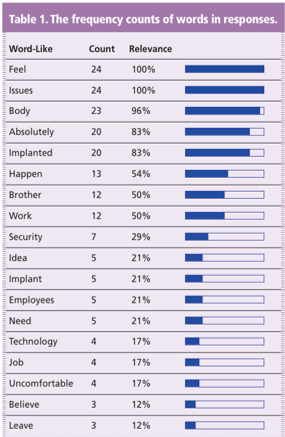

Figure 2. Thematic Content Analysis
The results presented previously have been codified into sim ilar themes. By far, there were more percthieived reasons to reject implants as electronic employee ID than to accept them. What we saw from the codification exercise was that those participants who responded to the open-ended question had a clear-cut perceived reason as to why they would accept or reject being implanted for employee ID. That reason may have been expressed in a feeling rather than an identifiable reason, but nonetheless, the respondents were absolute in their response. Only a small number of respondents, 12 in total, were truly undecided in the maybe category or would conditionally accept the concept.
This indicates, more than anything else, that microchipping people in the workforce is a divisive issue: Either an individual is vehemently opposed to the idea of being microchipped for employee ID or he or she is willing to accept the implant with some certainty. Out of the 186 responses received from the total number of respondents (N = 453), only 48 people per ceived they would accept an implant for employee ID purposes in the workplace. About 13 of those 48 people were indifferent to the type of technology instituted with respect to employee ID, stating they would not be bothered, were neutral about, or it was no hassle whether it was an implantable device.
Content AnalysIs
Table 1 provides a presentation of the words that came up frequently in the content analysis of the open-ended question, “How would you personally feel about being implanted for ease of identification with your own organization?” The terms most frequently recorded by the transnational participants in describing their response to implants in the workplace included: feel, issues, body, absolutely, happen, Big Brother, work, security, idea, implant, employees, need, technology, uncomfortable, believe, and leave. This demonstrates that, holistically, respondents were aware of the potential to implant people for identification purpos es but felt there were many issues, that is, barriers to accep tance, namely those issues related to surveillance (i.e., Big Brother). The question itself caused some people to feel uncom fortable and to consider leaving if mandatory implantation was enforced. It is important to state, however, that most proponents of implantables (e.g., Retherford of Citywatcher.com) do not believe that implantables in the workplace will ever be imposed but will be presented as one of several options and that, over time, the convenience will overcome any doubts or fears end users might be harboring personally [25].
Concept Map
The relationship between terms found frequently in the partici pant responses is presented in the concept map found in Figure 1. The most frequently used terms are represented by larger nodes, for example, body, absolutely, feel, and issues, and their proximate colocation with other terms indicate a contex tual power relationship. Reading this concept map, we can deduce that, even if RFID implants were introduced for security purposes in the workplace, employee sentiment would generally be one of feeling uncomfortable. And whether this was due to Big Brother, or other beliefs (e.g., religious, cultural, or soci etal), the absolute response would be to go so far as leaving that job and workplace.
Conclusion
This article presented and analyzed the results of a transna tional study that surveyed small business owners, asking the question: “How would you personally feel about being implanted for ease of identification with your own organization?” Perceived reasons for rejecting an employee ID implant vastly outnumbered the perceived reasons for accept ing an employee ID implant. Interestingly, only a small num ber of respondents were undecided or provided conditional acceptance, indicating that the question is very divisive and that people hold absolute personal feelings toward the pierc ing of their skin with a foreign device (e.g., a microchip). We can deduce more broadly from these results that a new digital divide is potentially forming between that smaller group who is either indifferent or feels that implanting people for ID is a smart idea. Given the study was conducted in April 2011, we also need to continue the quantitative and qualitative investigation with follow-up surveys that have been conducted in 2012 and 2013. For now, much media hype persists in one-off experiments that show people adopt ing implants mostly for physical access to assets (e.g., cars) or buildings simply as a replacement for keys or cards. Yet, these experiments are beginning to demonstrate how humans can be human-plus through body modifications, and may well be influencing citizens to experiment with new technolo gies in unprecedented ways.
References
1. M. G. Michael and K. Michael, “A note on uberveillance,” in From Dataveillance to Uberveillance and the Realpolitik of the Transparent Society, K. Michael and M. G. Michael, Eds. Wollongong, Australia : Univ. of Wollongong, 2006, pp. 9–25.
2. M. G. Michael and K. Michael, Eds., Uberveillance and the Social Implication of Microchip Implants (Advances in Human and Social Aspects of Technology). Hershey, PA : IGI Global, 2014.
3. ABC. ( 2011, Jan. 24 ). Top cop's wish list: microchipped crooks, ABC News. [Online]. Available: http://www.abc.net.au/news/2011-01-24/top-cops-wishlist-microchipped-crooksIl915814, Accessed 5 April 2017.
4. M. Calligeros. ( 2011, March 24 ). Castrate sex offenders: state MP, Brisbane Times. [Online]. Available: http://www.brisbanetimes.com.au/queensland/castrate-sex-offenders-state-mp-20110323-1c7ba, Accessed 5 April 2017.
5. Correspondent. ( 2015, March 14 ). The Express Tribute. [Online]. Available: https://tribune.com.pk/story/852977/plan-to-track-fourth-schedule-suspects-using-chip-implants-meets-scathing-criticism/, Accessed April 5, 2017.
6. R. Landau, S. Werner, G. K. Auslander, N. Shoval, and J. Heinik, “Attitudes of family and professional care-givers towards the use of GPS for tracking patients with dementia: An exploratory study,” The British Journal of Social Work, vol. 39, no. 4, 2009, pp. 670–692. [Online]. Available: https://academic.oup.com/bjsw/article-abstract/39/4/67011626512/Attitudes-of-Family-and-Professional-Care-Givers?redirectedFrom=fulltext, Accessed April 5, 2017.
7. P. Eng. ( 2002, Feb. 25 ). Implant Chip, Track People, ABC News. [Online]. Available: http://abcnews.go.com/Technology/story?id=98077&page=1, Accessed April 5, 2017.
8. A. Plesser. ( 2014, 2 Apr. ), “Implantable,” media is the next big thing, GroupM's Irwin Gotlieb. [Online]. Available: http://www.beet.tv/2014/02/implantable.html.
9. WSJ. ( 2014 ). CIO Network: Future tech will be part of us. [Online]. Available: http://www.wsj.com/video/cio-network-future-techwill-be-part-of-us/8AF11BFB-E406-492C-927B-17FDF1BB7C01.html#-8AF11BFB-E.406-492C-927B-17FDF1BB7C01.
10. E. Strickland. ( 2014, 10 June ). Medtronic wants to implant sensors in everyone, IEEE Spectrum. [Online]. Available: http://spectrum.ieee.org/tech-talk/biomedical/devices/medtronic-wants-to-implant-sensorsin-everyone.
11. P. Diamandis. ( 2014, 30 Mar. ). Why I implanted an RFID tag in my hand. [Online]. Available: http://peterdiamandis.tumblr.com/post/103473962918/why-i-implanted-an-rfid-tag-in-my-hand.
12. J. Wakefield. ( 2014, 10 Dec. ). The rise of the Swedish cyborgs, BBC. [Online]. Available: http://www.bbc.com/news/technology-30144072.
13. R. Cellan-Jones. ( 2015 ). Office puts chips under staff's skin, BBC. [Online]. Available: http://www.bbc.com/news/technology-31042477.
14. AP. ( 2017, April 3 ). A Swedish start-up has started implanting microchips into its employees, CNBC. [Online]. Available: http://www.cnbc.com/2017/04/03/start-up-epicenter-implants-employees-withmicrochips.html, Accessed April 5, 2017.
15. R. Boden. ( 2015, 28 Aug. ). Half of Brits expect to replace cash with new technologies, NFC World. [Online]. Available: http://www.nfcworld.com/2015/08/28/337345/half-of-brits-expect-to-replace-cash-with-newtechnologies/.
16. E. Estopace, ( 2015, 30 Nov. ). The next interface moment in computing could be chip implants. philstar GLOBAL [Online]. Available: http://www.philstar.com:8080/technology/2015/11/30/1527381/next-interfacemoment-computing-chip-implants.
17. H. Morris. ( 2016 ). Microchip implanted in man's hand allows him to pass through airport security. Traveller [Online]. Available: http://www.traveller.com.au/microchip-implanted-in-mans-hand-allows-himto-pass-through-airport-security-gm8xgu.
18. E. Reynolds. ( 2016 ). Australians embracing super-human microchip technology. news.com.au [Online]. Available: http://www.news.com.au/technology/gadgets/wearables/australians-embracing-superhuman-microchiptechnology/news-story/536a08003cb07cba23336f83278a5003.
19. B. Guarino. ( 2016 ). This Australian woman grew up loving Star Wars. Now implanted microchips give her Jedi powers. The Washington Post [Online]. Available: https://www.washingtonpost.com/news/morning-mix/wp/2016/08/26/this-australian-woman-grew-up-lovingstar-wars-now-implanted-microchips-give-her-jedi-powers/?utm_term=.f537849c2bd5.
20. A. Graafstra. ( 2014 ). About us, Dangerous Things. [Online]. Available: https://dangerousthings.com/about.
21. Vice. ( 2016 ). Project UKI (now VivoKey). Motherboard [Online]. Available: https://www.youtube.com/watch?v=GSv0hb0GeBQ.
22. K. Michael, “RFID/NFC implants for bitcoin transactions,” IEEE Consumer Electron. Mag., vol. 5, no. 3, 2016, pp. 103–106.
23. Vivo key. ( 2017 ). Learn more. VivoKey. [Online]. Available: http://vivokey.com/learn-more.html.
24. C. Perakslis, K. Michael, M. G. Michael, and R. Gable, “Perceived barriers for implanting microchips in humans: A transnational study,” in 2014 IEEE Conf. Norbert Wiener in the 21st Century (21CW), Boston, MA, June 24–26, 2014.
25. K. Michael, “CityWatcher.com: An Interview with Mr Gary Retherford,” in Uberveillance and the Social Implications of Microchip Implants: Emerging Technologies, IGI Global, Hershey : PA, 2014.
Authors
Faculty of Engineering and Information Sciences, University of Wollongong, New South Wales, Australia
Katina Michael (katina@uow.edu.au) is with the Faculty of Engineering and Information Sciences at the University of Wollongong, New South Wales, Australia.
College of Computer Information Technology, American University, Dubai, United Arab Emirates
Anas Aloudat (anas.aloudat@aue.ae) is with the College of Computer Information Technology of American University in the Emirates, Dubai, United Arab Emirates.
School of Computing and Information Technology, University of Wollongong, New South Wales, Australia
M.G. Michael is with the School of Computing and Information Technology at the University of Wollongong, New South Wales, Australia.
Alan Shawn Feinstein Graduate School, Johnson & Wales University, Providence, Rhode Island
Christine Perakslis (Christine.Perakslis@jwu.edu) is with the Alan Shawn Feinstein Graduate School at Johnson & Wales University Providence, Rhode Island.
Citation: K. Michael, A. Aloudat, M. G. Michael and C. Perakslis, "You Want to Do What with RFID?: Perceptions of radio-frequency identification implants for employee identification in the workplace," in IEEE Consumer Electronics Magazine, vol. 6, no. 3, pp. 111-117, July 2017, doi: 10.1109/MCE.2017.2684978.