Wearables and Lifelogging: The socioethical implications
Citations: K. Michael, "Wearables and Lifelogging: The socioethical implications," in IEEE Consumer Electronics Magazine, vol. 4, no. 2, pp. 79-81, April 2015, doi: 10.1109/MCE.2015.2392998.
In 2009, M.G. Michael and I presented the plenary article “Teaching Ethics in Wearable Computing: The Social Implications of the New ‘Veillance’” [1]. It was the first time that the terms surveillance, dataveillance, sousveillance, and überveillance were considered together at a public gathering [2]. We were pondering the intensification of a state of überveillance through increasingly pervasive technologies that can provide details from a big-picture satellite view right down to the smallest-common-denominator embedded-sensor view. Veiller means “to watch,” coming from the Latin vigilare, stemming from vigil, which means to be “watchful.” The prefixes sur, data, sous, and über alter the “watching” perspective and meaning. What does it mean to be watched by a closed-circuit television (CCTV) camera, to watch another, to watch oneself? Roger Clarke [3], Steve Mann [4], and M.G. Michael [5] have defined three “types” of watching in the sociotech literature.
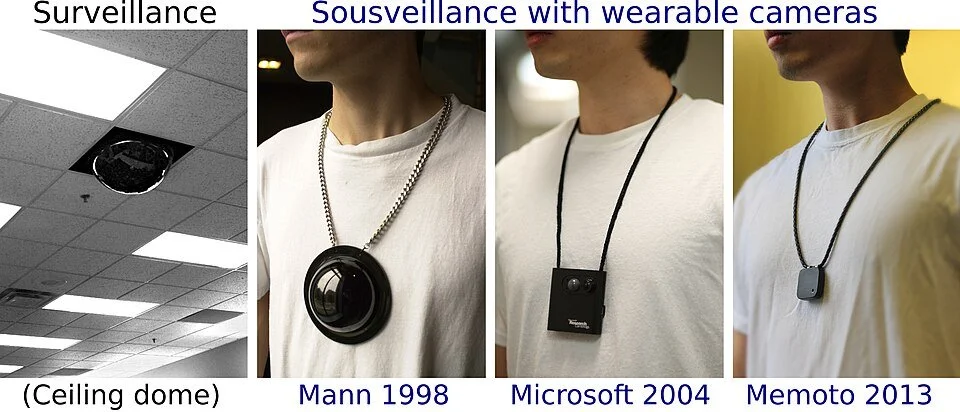
Courtesy of Steve Mann who writes on Wikimedia Commons: “Ceiling dome at MIT Coop in Kendall Square (picture I took 1994), as inspiration for my Wearable Wireless Webcam dome (camera with fisheye lens and various sensors conspicuously concealed in a camera dome, picture I took 1998), together with pictures I took of Microsoft Sensecam and Memoto, for comparison, in also photographed in Koffler Student Services Centre.” https://commons.wikimedia.org/w/index.php?search=sousveillance&title=Special%3AMediaSearch&type=image
Wearable and embedded cameras worn by any citizen carry significant and deep personal and societal implications. A photoborg is one who mounts a camera onto any aspect of the body to record the space around him-or herself [6]. Photoborgs may feel entirely free, masters of their own destiny; they may even feel safe that their point of view is being noted for prospective reuse. Indeed, the power that photoborgs have is clear when they put on the camera. It can be even more authoritative than the traditional CCTV overhead gazing in an unrestricted manner, given that sousveillance usually happens on the ground level. Photoborgs may be recording for their own lifelog but will inevitably capture another person in their field of view, and unless these fellow citizens also become photoborgs themselves, there is a power differential. Sousveillance carries with it huge socioethical, environmental, economic, political, and spiritual overtones.
The narrative that informs sousveillance is more relevant today than ever before due to the proliferation of new media. But where sousveillance grants citizens the ability to combat the powerful using their own evidentiary mechanism, it also grants other citizens the ability to put on the guise of the powerful. The pervasiveness of the camera that sees and hears everything can only be reconciled if we know the lifeworld of the wearer, the context of the event being captured, and how the data will be used by the stakeholder in command. The evidence emanating from cameras is endowed with obvious limitations, such as the potential for the impairment of the data through loss, manipulation, or misrepresentation [7]. Sousveillance happens through the gaze of the one wearing the camera, just like a first-person shooter in a video game.
Sensors now come endowed in most devices, big or small, and the discrete data collected tell us much about the spatiotemporal patterns of that which is being monitored.
In 2003, WIRED published an article written by N. Shachtman [8] on the potentiality to lifelog everything about everyone. He wrote:
The Pentagon is about to embark on a stunningly ambitious research project designed to gather every conceivable bit of information about a person's life, index all the information and make it searchable… The embryonic LifeLog program would dump everything an individual does into a giant database: every e-mail sent or received, every picture taken, every Web page surfed, every phone call made, every TV show watched, every magazine read… All of this—and more—would combine with information gleaned from a variety of sources: a GPS transmitter to keep tabs on where that person went, audio-visual sensors to capture what he or she sees or says, and biomedical monitors to keep track of the individual's health… This gigantic amalgamation of personal information could then be used to “trace the ‘threads’ of an individual's life.”
It simply goes to show how any discovery can be tailored toward any end. Lifelogging is meant to sustain the power of the individual through reflection and learning, to enable growth, maturity and development, but here, instead, it has been hijacked by the very same stakeholder from which it was created to gain protection.
Sousveillance also drags into the equation the innocent bystander who is going about his or her everyday business and just wishes to be left alone. When we asked wearable 2.0 pioneer Steve Mann in 2009 what one should do if bystanders of a recording in a public space questioned why they were being recorded without their explicit permission, he pointed us to his request for deletion Web page [9]. This is admittedly only a very small part of the solution and, for the most part, untenable. One just needs to view a few minutes of the Surveillance Camera Man Channel at http://www.liveleak.com/c/surveillancecameraman to understand that people generally do not wish to be filmed in someone else's field of view. Some key questions include:
In what context has the footage been taken?
How will it be used?
To whom will the footage belong?
How will the footage taken be validated and stored?
In “Digital Wearability Scenarios,” Deniz Gokyer and I provide plausible scenarios of the use of wearable cameras in a closed campus setting. Although the scenarios are not based on primary sources of evidence, they do provide conflicting perspectives on the pros and cons of wearables. As companies are engaged in even shorter market trialability of their products, the scenarios demonstrate what can go wrong with an approach that says “Let's unleash the product now and worry about repercussions later; they'll iron themselves out eventually—our job is to solely worry about engineering.” The pitfalls of such an approach are presented in my article “Sousveillance,” which also appears in this issue. The article demonstrates how emerging technologies have direct social implications. One of the biggest problems with introducing new products without commensurate market testing is the unexpected and asymmetric consequences that ensue. For instance, my privacy is breached by someone wearing a camera, and although no one else has been affected by the recorded evidence, my life is affected adversely. Laws and organizational policies especially need to quickly come up to speed as advancements in technologies happen.
The same can be said about the use and application of radio-frequency identification (RFID). Katherine Albrecht and Liz McIntyre remind us of the way RFID was introduced into the retail market just after the turn of the century in their article “Protect Yourself from RFID.” On the one hand, tracking items for supply-chain management can help with loss prevention on the operations side of the business. On the other hand, using RFID to surreptitiously learn more about customer behavior and habits is a breach of privacy. In his article “Protecting Yourself with RFID,” William Lumpkins does not focus on the “spychips” phenomenon but rather the key benefits of RFID to industry.
PoSR describes the overlapping network transaction spaces that people traverse synchronously and asynchronously with others to maintain and use social relationships via various apps, mobile services, sensors, platforms, technologies, and conversation spaces.
Sally A. Applin and Michael D. Fischer's article, “Toward a Multiuser Social-Augmented Reality Experience,” is next in the special section, and it describes the pivotal role that social media, geolocation information, and augmented reality play in their groundbreaking concept of polysocial reality (PoSR), a framework developed for representing complex synchronous and asynchronous messaging contexts: “PoSR describes the overlapping network transaction spaces that people traverse synchronously and asynchronously with others to maintain and use social relationships via various apps, mobile services, sensors, platforms, technologies, and conversation spaces.”
For M.G. Michael and his coauthors, the discussion on veillances transcends from item-based RFID tracking sensors on things to embedded sensors on or in people. Michael et al. point to the implications that would come from a fully fledged Web of Things and People. They paint a rather dystopian future of the changes that may happen to society at large as continuous behavioral tracking takes root in the big data realm. New technologies have social implications, and these are spelled out in “Überveillance and the Web of Things and People.”
The pitfalls of a point-of-view recording—no matter how many cameras and sensors are recording and no matter from how many perspectives and stakeholders—are the limitations of video evidence. What is a whole incident? How can we denote past provocation or historical data not available during a given scene? How can we ensure that data on a mobile transmission have not been intercepted? How can we ensure data validation? We might well be on a road similar to that of DNA as admissible evidence in a court of law in terms of “eyewitness” recording of events. The key question to ask here is whether or not we can ever achieve “omniscience” through the use of seemingly “omnipresent” new media. Sensors now come endowed in most devices, big or small, and the discrete data collected tell us much about the spatiotemporal patterns of that which is being monitored. Yet, despite all the “big data,” we still struggle to make sense of what we are watching, and with a context missing (no matter how good computers are at computing), the systems remain fallible.
References
1. K. Michael M. G. Michael Teaching ICT ethics using wearable computing: The social implications of the new ‘veillance’ Proc. Australian Point of View Technologies Conf. (AUPOV09) Proc. Australian Point of View Technologies Conf. (AUPOV09) 2009-June
2. K. Michael M. G. Michael C. Perakslis 189 206 2014 Imperial College Press Be vigilant: There are limits to veillance
3. R. Clarke Information technology and dataveillance Commun. ACM 31 5 498 512 1988
4. S. Mann Sousveillance: inverse surveillance in multimedia imaging 12th Annu. ACM Int. Conf. Multimedia 12th Annu. ACM Int. Conf. Multimedia 2004
5. M. G. Michael K. Michael Uberveillance 29th Int. Conf. Data Protection and Privacy Commissioners, Privacy Horizons: Terra Incognita, Location Based Tracking Workshop, Montreal 29th Int. Conf. Data Protection and Privacy Commissioners, Privacy Horizons: Terra Incognita, Location Based Tracking Workshop, Montreal 2007
6. K. Michael M. G. Michael Commentary on: Mann, Steve (2012): Wearable Computing Encyclopedia of Human-Computer Interaction 2012 https://www.interaction-design.org/encyclopedia/wearable_computing.html
7. K. Michael Keynote: The final cut—Tampering with direct evidence from wearable computers Proc. 5th Int. Conf. Multimedia Information Networking and Security (MINES) 11 12 Proc. 5th Int. Conf. Multimedia Information Networking and Security (MINES) 2013
8. N. Shactman A Spy Machine of DARPA's Dreams Wired. 20 May 2003 http://archive.wired.com/techbiz/media/news/2003/05/58909?currentPage=all
9. S. Mann The request for deletion (RFD) Wearcam.org. 2009 http://wearcam.org/rfd.htm
Author
University of Wollongong, Wollongong, NSW, AU
Katina Michael (katina@uow.edu.au) is the editor-in-chief of IEEE Technology and Society Magazine and a senior editor of IEEE Consumer Electronics Magazine. She is the associate dean international of the Faculty of Engineering and Information Sciences at the University of Wollongong, New South Wales, Australia, where she specializes in the socioethical implications of emerging technologies. Since 2006, she has been responsible for the annual workshop on the Social Implications of National Security and has program chaired the International Symposium on Technology and Society in 2010 and 2013 on the respective topics of implantable technologies and wearable technologies. Her most recent book, coedited with M.G. Michael, is Uberveillance and the Social Implications of Microchip Implants: Emerging Technologies. She holds a Ph.D. degree on automatic identification and location-based services, a master's degree in transnational crime prevention from the University of Wollongong, and a bachelor of information technology from the University of Technology, Sydney.
Citations: K. Michael, "Wearables and Lifelogging: The socioethical implications," in IEEE Consumer Electronics Magazine, vol. 4, no. 2, pp. 79-81, April 2015, doi: 10.1109/MCE.2015.2392998.