Synthetic Faces, Fragile Trust: GenAI and the Future of Biometric Integrity
Abstract:
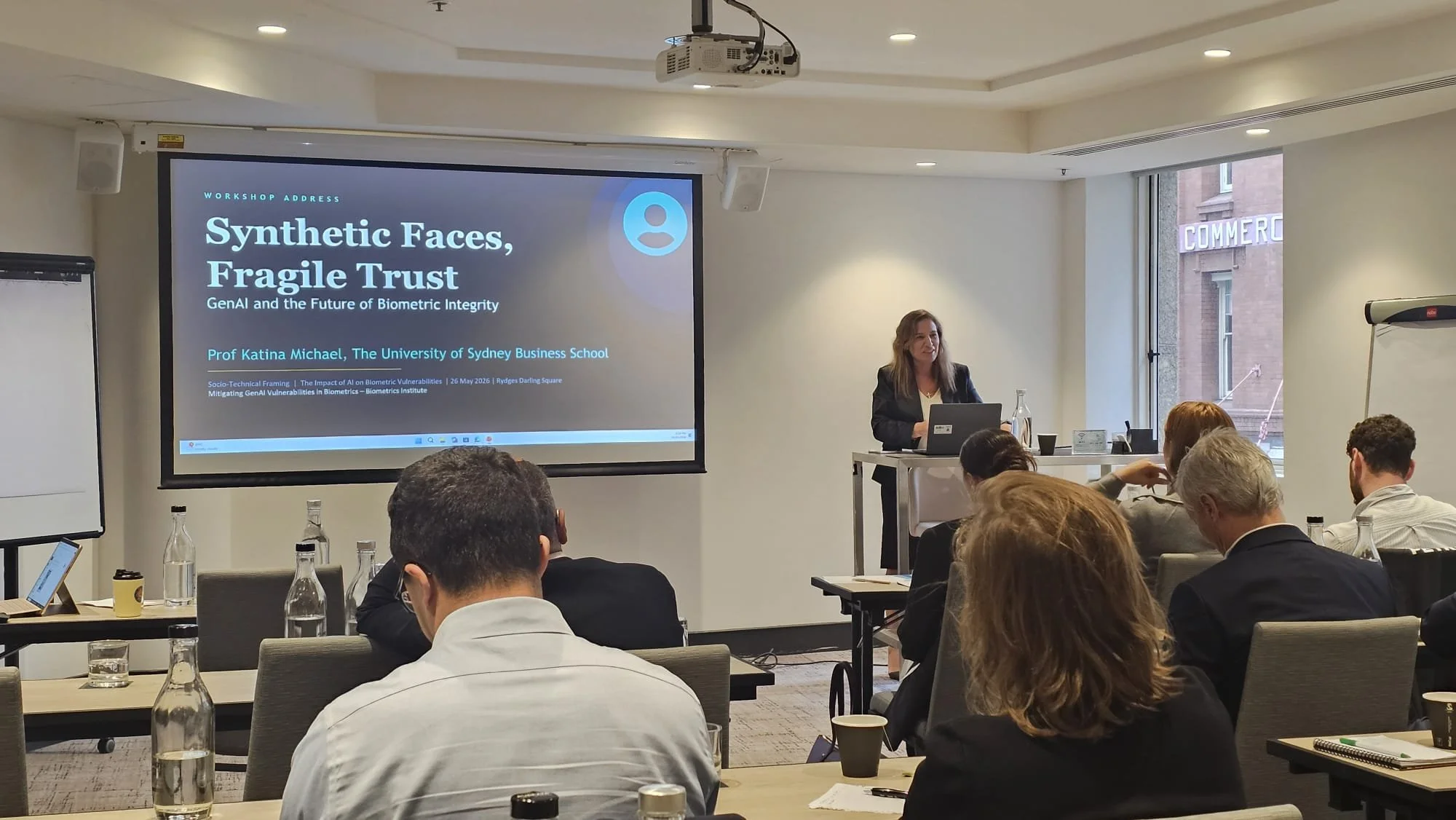
Photo credit: Simon Relph
Biometric systems have historically relied on the assumption that the human body is unique, scarce, and difficult to replicate. Generative artificial intelligence challenges each of these assumptions. Contemporary image and voice models developed by organisations such as OpenAI and Stability AI can now produce hyper-realistic synthetic faces, voices, and identities at scale. What happens to biometric integrity when faces become infinitely generatable? This presentation explores the transition from identity scarcity to synthetic abundance. It examines how the proliferation of fictitious biometric artefacts, including deepfakes and AI-generated personas, affects authentication systems, open datasets, and societal trust. As synthetic images flood the internet, biometric datasets risk contamination, trust signals are diluted, and the evidentiary value of visual media is destabilised. At the same time, regulatory frameworks such as the European Union’s Artificial Intelligence Act attempt to address synthetic media risks, yet enforcement and technical verification remain complex. Beyond technical vulnerabilities, this presentation interrogates broader societal implications: the erosion of epistemic stability, the industrialisation of identity fraud, the emergence of AI-versus-AI detection arms races, and the ethical reconfiguration of personhood in digital environments. The talk concludes by proposing a socio-technical framework for biometric resilience that integrates technical safeguards, governance mechanisms, provenance infrastructure, and renewed ethical commitments to human identity. In an era where seeing is no longer believing, safeguarding biometric integrity becomes central not only to security systems but to the preservation of societal trust itself.
Citation: Katina Michael, 26 May 2026, “Synthetic Faces, Fragile Trust: GenAI and the Future of Biometric Integrity”, Mitigating GenAI Vulnerabilities in Biometrics Workshop, https://www.biometricsinstitute.org/event/mitigating-genai-vulnerabilities-in-biometrics-workshop/
Other Panelists
Arun Ross is the Martin J. Vanderploeg Endowed Professor at Michigan State University and Site Director of the NSF Center for Identification Technology and Research. He is the recipient of the IAPR Young Biometrics Investigator Award (2013) and the JK Aggarwal Prize (2014), and was named a Kavli Fellow by virtue of his presentation at the 2006 Kavli Frontiers of Science Symposia. He testified on the topic of biometrics before the U.S. House Science, Space, and Technology Committee in 2022 and the United Nations Counter-Terrorism Committee in 2013. He is the co-author of the monograph “Handbook of Multibiometrics” and the textbook “Introduction to Biometrics.”
Associate Professor Dr Amy Dawel is a clinical and cognitive psychologist at The Australian National University, where she leads the ANU Emotions and Faces Lab. Her research investigates emotion regulation and face perception, with a focus on how these processes support human connection and wellbeing. A current research priority involves understanding how people perceive and interact with AI-generated personas, including the detection of deepfake faces and the potential for human-machine collaboration to improve AI detection capabilities. This work has been featured in outlets such as The New York Times and National Geographic. Amy is also investigating relationships between AI chatbot use and children’s wellbeing. Her research program is supported by the Australian Research Council and Australian Rotary Health, and has been recognised by the 2022 ACT Tall Poppy and 2024 McMichael Awards.
Michael King, Professor, Department of Electrical Engineering and Computer Science, Harris Institute for Assured Information – Identity Lab, Florida Institute of Technology (USA). He is also a Distinguished Lecturer for the IEEE Biometrics Council. Dr. King previously served over a decade in the U.S. Intelligence Community, where he led research programs in biometrics, identity, and computational imaging, including IARPA’s BEST Program. He has briefed national leaders and served on a National Academies of Sciences, Engineering, and Medicine committee on face recognition governance. His research spans biometrics, cyber identity, artificial intelligence, and computational psychology.
Katina Michael is Professor and Program Director, MBA (Technology and Digital Strategy) at University of Sydney Business School. Katina Michael is the inaugural program director of the MBA (Technology and Digital Strategy) at The University of Sydney Business School. She is professor of Strategy, Innovation and Technology. She connects technical, policy, and public audiences, raising awareness of sociotechnical challenges and how to address them through human-centered systems design. Katina has advised governments and industry worldwide on responsible innovation. Her research helps guide professionals through the complex impacts of AI, automation, and digital transformation.
The course is highly interactive and participants will be encouraged to bring to bear their own experiences and areas of expertise during the discussion sessions.
About the Workshop
For the first time we are bringing this workshop to Australia, taking place alongside the annual Asia-Pacific Conference in Sydney. This afternoon workshop will dive into the considerations required to navigate the evolving landscape of AI, deepfakes and biometric security and discuss ways in which AI — specifically, Generative AI (GenAI) — is impacting the field of biometrics.
Speakers will address the following questions:
What are the pros and cons of utilising synthetic biometric data, such as face images, to train and test biometric systems?
Can face examiners detect altered or synthetic faces such as face morphs and deepfakes?
Is Generative AI impacting society’s trust in biometrics?
How can AI be harnessed for enhancing the security and privacy of biometric users?