Social Impact of the Internet of Medical Things
Citation: Y. Liu et al., "Guest Editorial Special Issue on the Social Impact of the Internet of Medical Things: From Body Wearables to Brain Implants," in IEEE Journal on Flexible Electronics, vol. 5, no. 6, pp. 187-188, June 2026, doi: 10.1109/JFLEX.2026.3704807.
Guest Editorial - Special Issue on the Social Impact of the Internet of Medical Things: From Body Wearables to Brain Implants
AS THE demand for the Internet of Medical Things (IoMT), wearable health monitoring, and neural interface continues to grow, there is an increasing need not only for flexible form factors but also for system-level design, energy-efficient operation, and artificial intelligence integration. Meeting these requirements calls for coordinated progress across the entire stack, from materials and devices to circuits, algorithms, and packaging. The articles in this Special Issue present several innovations that address the inherent technical bottlenecks of flexible electronics, from body wearables to brain implants, while engaging with these broader social implications [A1], [A2], [A3], [A4], and [A5].
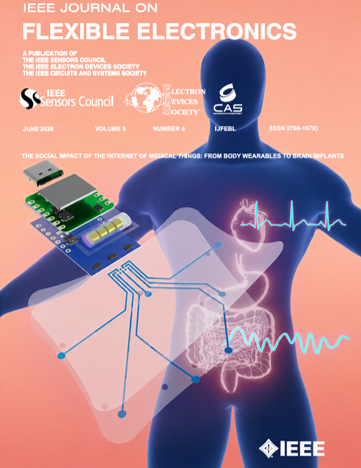
These innovations span five complementary levels of development. At the device level, Mehrolia et al. [A1] perform a comprehensive stability analysis of a fully transparent, low-power amorphous indium–gallium–zinc–oxide (a-IGZO) thin-film transistor (TFT) for flexible backplanes. At the packaging and integration level, Bai et al. [A2] introduce a high-density mini-pedestal connector for soft neural interfaces. At the wearable system level, Xing et al. [A3] demonstrate a skin-conformal multichannel platform for ambulatory electrogastrography (EGG) and electrocardiography. At the algorithmic level, Ding et al. [A4] propose an explainable foundation model for electroencephalography (EEG) decoding under real-world montage variability. Finally, at the therapeutic application level, Fan et al. [A5] review flexible wearable technologies for drug delivery. Together, these five articles contribute to the advancement of socially and clinically aware IoMT systems.
This Special Issue also reflects a unique collaboration among IEEE JOURNAL ON FLEXIBLE ELECTRONICS (IEEE J-FLEX), the IEEE Society on Social Implications of Technology (SSIT), and IEEE Brain. It was initially conceived as a joint issue with IEEE Technology and Society Magazine (TSM), broadening the discussion to the social and ethical implications of IoMT and neurotechnology, including adoption, implementation, and inequities linked to socioeconomic access, insurance coverage, and local technology infrastructure. We are pleased that related scholarship appears across the broader IEEE ecosystem, including companion opinion, commentary, and peer-reviewed articles in TSM and IEEE Spectrum articles examining human centered uses of emerging medical technologies and barriers to access.
A high-level summary of these articles is described below. Mehrolia et al. [A1] present a comprehensive sta bility analysis of a fully transparent, low-power a IGZO TFT employing a ZrO2 high-k gate dielectric and indium–zinc–oxide electrodes on a flexible polyethylene terephthalate (PET) substrate, and achieved a small thresh old voltage of 0.21, mobility of ∼8.37 cm2/V · s, and an ON-/OFF-ratio of ∼106. The authors systematically probe how active-layer thickness, dielectric thickness, and fixed charge density govern positive-bias-stress instability, and identify combinations of layer thicknesses that yield only minute threshold-voltage shifts across stress dura tions. This work provides design guidance for robust, low-voltage, and stable TFTs for future flexible IoMT applications.
Bai et al. [A2] introduce E-Link, a 256-channel mini pedestal connector for high-density polymer-based neural interfaces that addresses the persistent soft–hard packaging bottleneck of chronic neural recording. By replacing con ventional rigid pin connectors with an alignment-tolerant, insertion-free elastomeric conductive interposer compressed by a threaded cap, the system achieves uniform contact stress across a 16 × 16 array, contact impedances of 0.3–0.4 kΩ, an rms noise floor of 2.68 ± 0.46 µV, and a connection yield exceeding 97% across 100 mating cycles. The detachable architecture reduces chronic head-mounted mass from 6.6 to 2.8 g while maintaining safe thermal operation under 20-kHz sampling, and the design analysis points toward 1024-channel integration within the same 25-mm footprint, demonstrating a scalable and modular path for next-generation brain–computer interfaces.
Xing et al. [A3] report FlexEGG, a skin-conformal flex ible electronic system for high-fidelity multichannel EGG with simultaneous electrocardiogram (ECG) acquisition. The authors develop a hybrid stretchable conductor composed of poly 3,4-ethylenedioxythiophene (PEDOT):poly styrene sulfonate (PSS), silver nanowires, waterborne polyurethane, ionic liquid, and dimethyl sulfoxide (DMSO) that achieves stable skin contact, low interfacial impedance, and mechani cal robustness under physiological strain. FlexEGG supports continuous multichannel EGG recordings over 12-h windows during routine daily activities. Beyond gastrointestinal motility disorders, the platform opens a path toward integrated, non invasive monitoring of gut–heart and gut–brain interactions in real-world environments.
Ding et al. [A4] propose ST-CoG-XAI, a unified and explainable foundation model for EEG decoding that is designed for the nonstationary conditions of wearable and clinical EEG, with varying electrode geometries, intermit tent channel loss, and biomarker drift across spectral and spatial dimensions. The model combines a dual-stream encoder, in which an asymmetric convolutional network tokenizes time-domain patches and a graph neural net work tokenizes frequency-band connectomes, with a uni fied spectral-spatial–temporal synergy criss-cross transformer whose attention heads are decomposed into spatial, tempo ral, and spectral groups. A self-supervised spectro–temporal contrastive generation pretraining scheme aligns temporal and spectral representations, while DeepLIFT-guided reattention during supervised fine-tuning yields intrinsic, clinically meaningful interpretability. Evaluated on seven clinical benchmarks spanning Alzheimer’s-related diagnosis, seizure detection, sleep staging, depression, mental stress, abnormality detection, and event-type classification, the model matches or exceeds the state of the art.
Fan et al. [A5] contribute a timely review of flex ible wearable technologies for drug delivery, organizing the field along three complementary axes: the user–device interface (direct diffusion, microneedle puncture, and elec trotransdermal delivery); the device-integration considerations that shape system design (drug-loading media and reser voirs, including cell- and bacteria-based “living pharmacies,” release modalities ranging from concentration-driven dif fusion to electro-, thermo-, photo-, magneto-, ultrasound-, and chemo-responsive triggers, and energy supplied through flexible batteries, wireless powering, or nanogenerator-based self-powering); and applications across neurological, dental, ocular, dermal, and oncological disease. The review highlights the promise of closed-loop and personalized therapy while clearly flagging the open challenges of drug-loading capac ity, long-term biocompatibility, miniaturization, and clinical translation.
Collectively, these five articles highlight the progress toward clinically deployable IoMT systems through advances in low power flexible transistors, scalable high-density packaging for soft neural interfaces, conformal multimodal wearable bioelectronics, generalizable and explainable decoding algo rithms, and integrated wearable therapeutics. The Guest Editors would like to thank the authors for their valuable contributions and the reviewers for their careful evalu ations that helped maintain the high standards of this journal. We also express our appreciation to the edito rial board for their support in making this Special Issue possible.
Appendix: Related Articles
[A1] M. S. Mehrolia, A. Verma, and A. K. Singh, “Comprehensive stability analysis of fully transparent low-power thin-film transistors: Role of device design and electrical parameters,” IEEE J. Flexible Electron., vol. 5, no. 6, pp. 189–195, Jun. 2026, doi: 10.1109/JFLEX.2025.3611884.
[A2] T. Bai, G. Li, Y. Qi, and H. Fang, “E-link: A 256-ch mini-pedestal connector for high-density soft neural interfaces,” IEEE J. Flexible Electron., vol. 5, no. 6, pp. 196–208, Jun. 2026, doi: 10.1109/ JFLEX.2026.3692102.
[A3] L. Xing, Y. Cai, Y. Zhang, V. Mottini, L. Heller, and J. Li, “Skin conformal electronics for wearable electrogastrography monitoring,” IEEE J. Flexible Electron., vol. 5, no. 6, pp. 209–216, Jun. 2026, doi: 10.1109/JFLEX.2025.3623601.
[A4] J. Ding, H. Wang, C. Wu, and Y. Yang, “ST-CoG-XAI: A spectro temporal contrastive generation foundation model for explainable EEG decoding,” IEEE J. Flexible Electron., vol. 5, no. 6, pp. 217–228, Jun. 2026, doi: 10.1109/JFLEX.2025.3620380.
[A5] Y. Fan, R. Bai, X. Chen, Z. Huang, N. Du, and K. Nan, “Advances in flexible wearable technologies for drug delivery,” IEEE J. Flexible Electron., vol. 5, no. 6, pp. 229–287, Jun. 2026, doi: 10.1109/JFLEX.2025.3592866
Authors
National University of Singapore, Queenstown, Singapore
The Ohio State University, Columbus, OH, USA
Tampere University, Tampere, Finland
Northwestern University, Evanston, IL, USA
National University of Singapore, Queenstown, Singapore
University of Bath, Bath, U.K.
The University of Sydney, Sydney, NSW, Australia
Concordia University, Montreal, QC, Canada
Citation: Y. Liu et al., "Guest Editorial Special Issue on the Social Impact of the Internet of Medical Things: From Body Wearables to Brain Implants," in IEEE Journal on Flexible Electronics, vol. 5, no. 6, pp. 187-188, June 2026, doi: 10.1109/JFLEX.2026.3704807.