DARPA’s ADAPTER Program: Applying the ELSI Approach to Humancentric Implantables
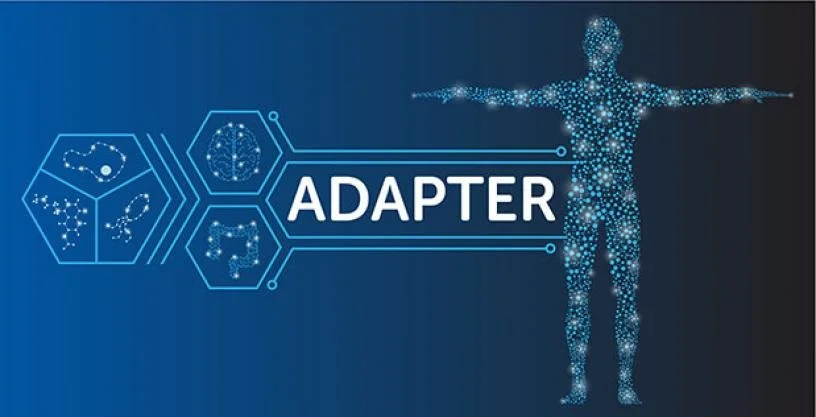
Photo source is public domain: https://www.darpa.mil/news/2020/travel-adapter-human-body
The ADvanced Acclimation and Protection Tool for Environmental Readiness (ADAPTER) program is located within the Defense Advanced Research Project Agency (DARPA) Biological Technologies Office (DARPA/BTO). ADAPTER aims to develop a travel adapter for the human body, an implantable or ingestible bioelectronic carrier that contains cellular factories and compounds (therapies) to be released upon secure external activation. Imagine a soldier on deployment having the command and control to trigger a release of therapies to prevent particular conditions in their own body. The system is designed to either entrain the sleep cycle, halving the time to reestablish normal sleep after a disruption (e.g., jet lag), or to eliminate the top 5 bacterial sources of traveler’s diarrhea. Consider it a remote control capability to wellness and recovery. ADAPTER is a way to physically interface with the human body, a type of wireless “living pharmacy”, via an implantable device that attempts to control the body’s circadian clock, aiding to regulate cycles by providing accurate diagnostics and response mechanisms. This session is dedicated to exploring the Ethical, Legal and Social Implications/Aspects (ELSI/ELSA) of ADAPTER. The panel is made up of transdisciplinary scholars with differing strengths in ethics, law and social implications of advanced biomedical implantable devices. Using a normative approach, the panel will ask the main question: “Is it desirable for warfighters in the US Armed Forces to bear an implantable device for the goal of better sleep cycles and less prevalence of traveler’s diarrhea?”
The DARPA Mission and Perspective and the Role of ELSI
Since its inception, DARPA has had a singular mission: to make pivotal investments in breakthrough technologies for national security. Working with innovators inside and outside of Government, DARPA has repeatedly transformed revolutionary concepts into practical capabilities, pushing critical frontiers ahead of the Nation’s adversaries. DARPA’s leadership and team members understand that this pursuit of cutting edge technologies will at times raise ethical, legal, security, or policy questions that cannot and should not go unanswered. Therefore, DARPA is committed to addressing the broader societal questions raised by its work and engaging those in relevant communities of expertise to provide context and perspective for consideration. DARPA works rigorously within the law and regulations and with appropriate organizations where legal and policy frameworks already exist. In new and uncharted territory, the Agency engages a variety of experts and stakeholders with varying points of view—both to hear what they and their professional communities of practice have to say and to help convey to those communities DARPA’s insights about what technology can and cannot do.
Relevance to Bioengineering Track:
This panel addresses the technological trajectory of next generation technologies, especially focused on embedded devices (in vivo) for the treatment of two non-critical health conditions: jet lag and traveler’s diarrhea. Using an ethical, legal and social implications (ELSI) framework the panel will address an open discussion into future systems of care and how they may me desirable (or not), permissible (or not), to the broader community, beyond the military.
Raising Public Awareness about the Technological Potentials:
This panel introduces the potential for a ‘living pharmacy’ to be embedded in the human body to aid warfighters. Semi-autonomous to fully autonomous drug delivery has long been touted as a way for patients to better manage their health conditions ensuring better and more improved outcomes, as therapies are released predictably as required. The biomedical domain has seen a spate of innovations in the last two decades of fully implantable solutions, related to the heart and brain to better regulate a patient’s health. We are now considering uberveillant devices for preventative care based on real-time diagnostics, rather than care based on prosthesis. This is more about strengthening a warfighter, than recovering a lost function. But are there alternatives? Could less technical solutions aid in supporting warfighters for the two scenarios posed- jet lag and traveler’s diarrhea? It is incredibly important to reach the public with this panel for the main reason that military-industrial relationships are well known. The potential for a spin-off commercial venture from the ADAPTER Program are real, even if not a single warfighter ever receives an ADAPTER implantable. ELSI discussions are paramount at the nascent stages of any new biotechnological innovation. The importance of raising public awareness about potential socio-technical imaginaries is also important as it is a form of education.
Keywords: biomedical engineering, ethics, global and public health, nanotechnology, pharmacology and toxicology, science and technology studies, and science and values
Title: Socio-technical Design for Complex Systems
Talk Description: Professor Michael will discuss the socio-technical design process for complex systems like implantable or ingestible technologies, drawing upon concepts in ELSA and socio-technical systems.
Bio: Dr. Michael is a Professor in the School for the Future of Innovation in Society and School of Computing and Augmented Intelligence at Arizona State University. She researches the socio-ethical implications of emerging technologies, including implantable devices.
Title: Legal and Ethical Issues of MedTech in the Military
Talk Description: Professor Gerke will discuss privacy laws in the U.S. and Europe that are relevant when developing cutting-edge new medical technologies for the military. She will also explore ethical issues raised by such technologies and solutions on how to protect the privacy of individuals adequately.
Bio: Ms. Gerke is an Assistant Professor of Law at Penn State Dickinson Law. She researches ethical and legal challenges of artificial intelligence and digital health topics, including ingestible electronic sensors.
Title: Risks and benefits of ADAPTER
Talk Description: This presentation will address the benefits, risks and harms of the ADAPTER Program. It will address prevention versus enhancement of military personnel and suggest an ethical framework for deployment.
Bio: Mr. Mehlman is Professor of Law and Bioethics at Case Western Reserve University Schools of Law and Medicine. He is interested in the bioethics of military medicine and military performance enhancement.
Title: Ethical and Practical Challenges in Working on Military Medical Research
Talk Description: Dr. Wynia will explore some ethical and practical challenges in working on military medical research that could be construed as ‘dual use’ (i.e., research that might enhance both defensive and offensive capabilities), including how to communicate about such research with the public and our allies and adversaries.
Bio: Dr. Wynia is an internal medicine and infectious diseases physician and Director of the Center for Bioethics and Humanities at the University of Colorado. He is interested in how clinicians manage ethical issues and uncertainty in emerging and innovative biomedical technologies.
Source: Katina Michael, Sara Gerke, Maxwell Mehlman, Matthew Wynia, 2022, “DARPA’s ADAPTER Program: Applying the ELSI Approach to Humancentric Implantables”, Session #1 - Track 9, in Ken Foster Bioengineering, International Symposium on Technology and Society, ISTAS22, https://www.istas22.org/program/track-9/