Novel NFC Applications to Enrich Our Connections
Citation: K. Michael, "Novel NFC Applications to Enrich Our Connections: The NFC Forum Innovation Awards," in IEEE Consumer Electronics Magazine, vol. 6, no. 3, pp. 118-121, July 2017, doi: 10.1109/MCE.2017.2684979.
One of the greatest judging experiences I have had the good fortune of being a part of was for the Near-Field Communication (NFC) Forum Innovation Award in its inaugural year [1]. (I was representing the IEEE Council on Radio-Frequency Identification.) The NFC Forum’s (www.nfc-forum.org) mission is to advance the use of NFC tech nology by developing specifications, ensuring interoperability among devices and services, and educating the market about NFC technology.
The forum’s global member companies are current ly developing specifications for a modular NFC device architecture and protocols for interoperable data exchange and device-independent service delivery, device discovery, and device capability. Unsurprisingly, sponsors of the NFC Forum are tech giants like Apple, Broadcom Corporation, Dai Nippon Printing Co., Ltd., Google, Intel, MasterCard World wide, NXP Semiconductors, Qualcomm, Samsung, Sony Cor poration, STMicroelectronics, and Visa. NFC is being viewed as a key piece of the Internet of Things puzzle. Versatile and easy to implement, estimates are that it will be a US$21.8 bil lion industry by 2020, on the conservative side [2], with expo nential growth expected by 2050 into an industry worth trillions of dollars.
The forum had a large contingent of international entrants for a variety of categories, including “Most Innovative NFC Product, Service, or Implementation,” “Best Mobile App,” and “Best NFC Startup” (see “The NFC Forum Innovation Award Winners by Category”). There were nine judges in all, including Allied Business Intelligence Senior Analyst Phil Sealy, Groupe Speciale Mobile (GSM) Association Termi nals Director Paul Gosden, and The Smart Card Alliance Executive Director Randy Vanderhoof, and we all went through several rounds of judging.
Top honors went to Speech Code’s “Talking Labels,” Khushi Baby’s “Mobile Medical App,” and Dimple’s “Cus tomizable Mobile Button Stickers” at the NFC Forum awards ceremony in Las Vegas, Nevada, on 14 March 2017. Entries were judged on their innovation, commercial potential, and usability as well as on the quality of design and implementa tion. The beauty of this competition from a judge’s eyes was that every entrant was so different in aim and objectives, design, implementation, and final product. In most cases, NFC was being described as a part of a larger process, a sin gle component of a system acting as the key enabler.
There were entrants touting NFC in novel agricultural applications, factory or manufacturing automation, or ser vices driven with consumer information access as the pri mary goal. Submissions ranged across a broad set of industries from the connected home, smart health, smart consumer, and automotive to Internet of Things, gaming, connected retail, and transportation. In one case study, an entrant pointed to the tens of thou sands of end users of its implementation in the transportation industry, demonstrating not only that take-up has been well estab lished but that NFC has been around for longer than people might think. The value in such competitions is that they pull members of the economic knowledge infrastructure closer together toward collaborative opportunities and common standardization that should see an emerging technolo gy with enough support mecha nisms to reach its full potential in the market [3]. According to the chair of the NFC Forum, Koichi Taga wa, “In today’s increasingly connected world, NFC of fers a tap-based experience that simplifies, enriches, and improves our daily lives. Since it is easy to implement, develop ers and product designers are turning to NFC to enable the Internet of Things and deliver compelling, personalized user expe riences.” This does beg the question whether or not there are any limits to NFC development and deployment. It is such a versatile technology and integratable to just about anything. I have, though, been the first to question its application in certain market segments, including the finan cial sector, given the lack of emphasis being applied by the credit card industry at large to security of current tap-and-go solutions plaguing some local merchants. Yet, it is a sign of the times, perhaps, when embeddable NFC in humans for Bitcoin transactions is a legitimate registered entrant in a competition such as this one. We should be ready to witness anything imaginable to the free mind to enter the market. End users seem to like the ease of conducting transactions with NFC, even if they do not fully understand the implications of doing so.
MOST INNOVATIVE NFC PRODUCT, SERVICE, OR IMPLEMENTATION
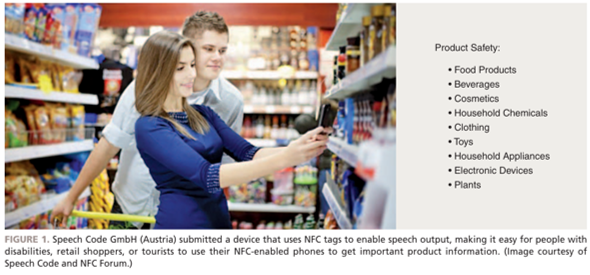
The first-place winner in the “Most Innovative NFC Product, Service, or Implementation” category was Speech Code GmbH (Austria) (Figure 1) for its NFC talking labels, which enable up to 30 min of recorded speech in over 40 languages from stickers adhered to signage, food and beverage packag ing, and retail products. Using NFC tags to enable speech output, the talking labels make it easy for people with dis abilities, retail shoppers, or tourists to use their NFC-enabled phones to get important product information, such as food allergy and nutrition facts, as well as identification informa tion for the visually impaired. This Austria-based company has won a string of past awards and has a vibrant female chief executive officer, Barbara Operschall, who is passionate about the tourism sector.
BEST MOBILE APP
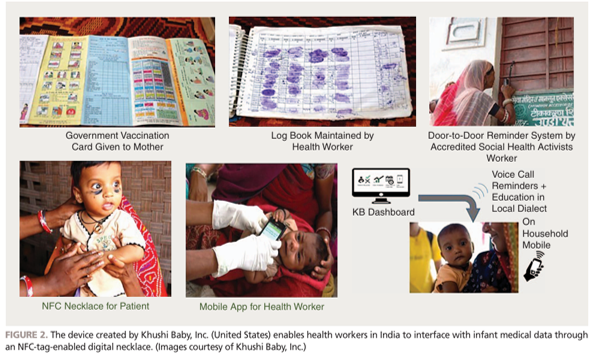
The first-place winner in the “Best Mobile App” category was Khushi Baby, Inc. (United States) for its NFC wearable health mobile application, which uses NFC mobile technolo gy to enable health workers in India to interface with infant medical data through an NFC-tag-enabled digital necklace (Figure 2). Unlike paper immunization records that are diffi cult to maintain and access, clinicians can use NFC-enabled mobile devices and the Khushi Baby, or happy baby, mobile app to read the infant’s wearable necklace, identify which vaccinations are needed, upload the vaccine data into the cloud, and monitor the infant in real time. Modeled after amulet necklaces frequently worn by babies in this region, the waterproof, battery-free, digital necklace is ideal for use in rural communities, using low-power wireless technology for its operation.
It is easy to see how this mobile app might well be imple mented for MedicAlert-style bracelets of various types in different kinds of markets. But underlying care applications are always the dominant factor of control. Stringent guide lines must ensure that the data gathered by the wearable device are not used retrospectively in nonmedical contexts. There also need to be regulatory guidelines introduced on how long the device is worn by infants and how the gathered data will be archived and who has access to the information and for how long.
If the Aadhaar multimodal biometric system is anything to judge by, emerging technologies in India are often deployed before the commensurate consumer protections are put in place. Of course, Khushi Baby has the best interests of children at heart, their care and hope for a better life, sup porting health workers in their aims, but it is amazing how scope creep can easily pervade emerging technologies. Placing chips in bracelets or just about any other common fash ion item can be a temptation for product developers who see potential for even greater functional applications [4]. Still, I am inspired by how daring Indian innovators are in pushing next-generation cell phone applications out to the public. Having traveled through India several times in the last few years, I have seen the vibrant tech sector, which is definitely thinking outside the box. But I am admittedly cautious with any application of technology that can be used to sort groups of people, independent of age, gender, and market. I would much prefer to see Indian innovators create their own mobile applications for their own communities in the longer term.
The NFC Forum Innovation Award Semifinalists by Category
MOST INNOVATIVE NFC PRODUCT, SERVICE, OR IMPLEMENTATION
▼ Blulog (Poland)—NFC-enabled data loggers for customizing and monitoring temperatures within isothermal packaging used in shipping and storage. (http://blulog.eu/en/)
▼ East Japan Railway Company (Japan)—NFC-based mobile wallet service, Suica, which enables local and nonlocal riders to add and check balances, purchase commuter passes, and secure passage across the high-speed rail anywhere, anytime. (https://www.nfcworld.com/tag/east-japan railway-company/)
▼ Speech Code GmbH (Austria)—NFC-tag-based stickers that contain 30 min of speech output in over 40 languages. (https://www.speechcode.eu/) BEST MOBILE APP
▼ Apps4Android, Inc., an IDEAL Group company (United States)—NFC-based talking label maker and reader application to assist people with disabilities. (https:// www.speechcode.eu/)
▼ Khushi Baby, Inc. (United States)—NFC-enabled wearable health mobile application that allows health workers to interface with patients through a digital necklace. (http://www.khushibaby.org/)
▼ Nestech Corp. (Taiwan)—NFC-based smart key application that allows home owners and small hotel managers manage their properties remotely. (http://nestech. en.taiwantrade.com/product/nfc-host-app-1040801.html) BEST NFC STARTUP
▼ Dimple Inc. (Latvia)—NFC tag-based programmable buttons for adding tap-and-go functionality to a mobile device. (https://dimple.io/)
▼ Kuvée, Inc. (United States)—NFC-enabled, connected wine dispensing system that allows users to view tasting notes, rate wines, and make purchases that are shipped right to their door. (https://www.kuvee.com/)
▼ Talkin’ Things LLC (Poland)—NFC-based global smart packaging system that provides an innovative product communication platform and effective protection against brand-related threats. (http://talkinthings.com/)
BEST NFC STARTUP
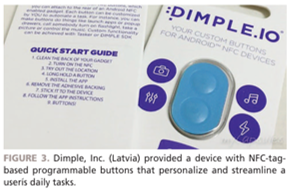
The first-place winner in the “Best NFC Startup” category was Dimple, Inc. (Latvia) for its NFC-tag-based programma ble buttons that personalize and streamline a user’s daily tasks (Figure 3). The highly customizable NFC sticker comes with two or four shortcut buttons that can be adhered to the back of an NFC-enabled device. From speed dialing, launch ing a flashlight, or other most-used apps, to creating an extra play button or controlling smart home controls, Dimple offers endless personalized options using the phone’s own energy. Now, that is innovative stuff! Let’s try and make next year’s competition even bigger, better, and stronger. I urge more companies to enter into as many categories as they are eligible. Do not rush the process or rehash your ready-made marketing materials, but spend time to address the various NFC Forum criteria. The entrants who were clearly ahead of the game were those that had a fully functional system/app with real end users and could con vey the social benefits with tangible evidence. I was personal ly struck by the effort of startups to get going in this growing market. Many hundreds of hours of energy were exerted, and the passion came through. Keep up the great work, and remember to remain customer focused. The returns will fol low with time. Congratulations to all those who participated in the competition.
ABOUT THE AUTHOR
Katina Michael (katina@uow.edu.au) is with the Faculty of Engineering and Information Sciences at University of Wol longong, New South Wales, Australia.
REFERENCES
[1] NFC Forum. (2016, Dec. 14). NFC industry, customer experience and product design leaders share 2017 outlook and predictions on NFC technol ogy. [Online]. Available: http://nfc-forum.org/nfc-industry-customer-experi ence-and-product-design-leaders-share-2017-outlook-and-predic tions-on-nfc-technology/
[2] Markets and Markets. (2017, Mar. 14). Near field communication market worth 21.84 billion USD by 2020. [Online]. Available: http://www. marketsandmarkets.com/PressReleases/near-field-communication.asp
[3] K. Michael and M. G. Michael, Innovative Automatic Identification and Location-Based Services: From Bar Codes to Chip Implants. Hershey, PA: IGI Global, 2009.
[4] Leen. (2014, July 21). Back to Undithal, Khushi Baby. [Online]. Avail able: http://khushi-baby.blogspot.com.au/2014/07/back-to-undithal.html, Accessed April 5, 2017
Citation: K. Michael, "Novel NFC Applications to Enrich Our Connections: The NFC Forum Innovation Awards," in IEEE Consumer Electronics Magazine, vol. 6, no. 3, pp. 118-121, July 2017, doi: 10.1109/MCE.2017.2684979.