GenAI, Ingenuity, the Law, and Unintended Consequences
Citation: K. Michael, J. R. Carvalko, C. J. Andrews and L. Batley, "In the Special Issues: GenAI, Ingenuity, the Law, and Unintended Consequences," in IEEE Transactions on Technology and Society, vol. 5, no. 2, pp. 149-155, June 2024, doi: 10.1109/TTS.2024.3413268.
SECTION I.
Introduction
The June issue incorporates a double special issue bringing together the areas of Generative AI, ingenuity and the law; and separately the unintended consequences of emerging technologies aligned to artificial intelligence and subset areas, such as biometrics. The first special issue is led by Joseph Carvalko Jr., Chairperson, Technology and Ethics, Yale Interdisciplinary Center for Bioethics, Institution for Public and Social Policy Studies [1]; and the second special issue is led by Clinton Andrews of the Edward J. Bloustein School of Planning and Public Policy at Rutgers University and previously the President of the IEEE Society on Social Implications of Technology [2]. In this guest editorial we provide a brief Introduction to the special issues and an overview of each of the accepted papers. We also invite Lucy Batley of Traction Industries located in Newcastle on the Tyne in England to join us, as the inspiration behind the cover design of this issue [3].
SECTION II.
Special Issue One: Generative AI, Ingenuity and the Law
The first paper [A1] is sole authored by Joseph R. Carvalko of Yale University and Quinnipiac University. In this peer-reviewed paper that frames the entire special issue, Carvalko explores the interplay between Generative AI (GenAI), creativity and the law. The three papers that follow Carvalko’s piece, delve deeper into different aspects presented in his framing: the data, the regulation of large language models (LLMs) and responsible AI, and the ethics and trustworthiness of AI in the context of reinforcement learning.
Carvalko highlights the potential revolutionary impact that AI can have on society at large, offering breakthroughs in a range of disciplines, and life in general. However, Carvalko who is both an engineer and patent attorney, emphasizes the need for policymakers and experts to join together to regulate against the possible harms and implications of the emerging technology. Carvalko acknowledges the regulatory advancements that have occurred in the European Union, but is critical of the United States’ hesitant position on meaningful regulation. These policies will have repercussions on institutional and daily life. As an end-to-end piece the author thoroughly describes the various techno-legal impacts, with societal implications.
The second paper [A2] is by Kean Birch and Guilherme Cavalcante Silva of York University, and Sarah Marquis of the University of Ottawa. The work was supported in part by the Social Sciences and Humanities Council (SSHRC) of Canada under Grant 435-2018-1136. It presents a view on data assets and has been incorporated into the special issue predominantly because GenAI relies on data as fuel. Of course, when data is amassed by any entity, the value of the data reflects its multiplicity of uses. Birch and their coauthors emphasize that data is a key asset that drives the digital economy. They ask the fundamental question surrounding the value of data and how its collection, use and valuation should be considered by policymakers, regulators and stakeholders.
Birch et al. acknowledge the potential for privacy loss, data breaches, even declining market competition while acknowledging the social and economic benefits in a data-driven economy. They postulate that if data is an asset, then it must have a value and that value is the allure for Big Tech firms that rely on its control to influence the market. The paper follows a qualitative financial documentary materials analysis in a single case study, that of Google, and its approach to data value which focuses on monetizing users. When we examine this article from the perspective of GenAI, Google appears to be trailing despite recent declarations of transforming its page rank algorithm into an advanced search tool. This notice heightens consciousness about the potential to enhance user monetization via their stimuli and corresponding ‘dialogues’ in GenAI sessions.
The third paper [A3] is written by Jose Berengueres of KTH, Royal Institute of Technology Stockholm. This paper identifies four touchpoints where ethical safeguards can be applied in order to achieve responsible AI in the context of LLMs. Each of these perspectives is then evaluated between a cost and effectiveness trade-off. The key finding of the paper is that applying safeguards upstream aligns with established engineering practices of addressing issues at the source. In his paper the author (1) conducts a review of codes of ethics, (2) an assessment of ethics awareness, and (3) an identification of safeguard application points. Berengueres cleverly compares the evolution of changing attitudes in vehicular safety from the 1950-1970s with AI today, and points to a “regulatory reaction time” of both users and providers over time.
The fourth paper [A4], written by Theodore McCullough, an Adobe Inc. employee who is an attorney with several qualifications in the Arts, Computer Science and the Law, hones in on reinforcement learning (RL) and explains and explores ethical and trustworthy AI. McCullough begins with stating the monkey paw problem, which in lay terms can be described as getting what you asked for from the RL, and not what you should have asked for, or not what you intended. McCullough uses an evaluative feedback process in RL to help the reader better understand the monkey paw problem, using a policy gradient method in an attempt to find an optimal policy. He also notes that part of the ethical challenge of RL is that proximal policy optimization may not offer a complete solution. He provides evidence as to why this is the case particularly because RL is not immune to bias.
McCullough cites the case of the Sama employee who asked OpenAI how they should label a piece of distasteful content, asking an earnest question as a labeler, without recourse. This open-ended example serves to demonstrate the complexity of societal norms that differ across the globe, demanding the need to implement the European Union AI Act (EU AIA), as well as the need for human oversight to attempt to control the monkey paw problem. McCullough points to International Covenant on Civil and Political Rights (ICCPR) and the International Covenant on Economic, Social and Cultural Rights (ICESCR), emphasizing the role of people and corporations to uphold human rights through international laws.
SECTION III.
Special Issue Two: Unintended Consequences of Innovations
Spearheaded under the leadership of Clinton J. Andrews, a second special issue, which although connected to the first, rightfully commands its own set of viewers captivated by the topic of unexpected results stemming from innovation. Andrews’ work is neither situated solely on GenAI, nor on the broader topic of emerging technologies (Fig. 1), which so often preoccupies our attention in this space [4], [5], [6], but on innovation per se. In fact, Carvalko and Andrews both concur that there are positive and negative unintended consequences of innovation.

Fig. 1. Unintended Consequences of Technology Special Issue in IEEE Technology and Society Magazine vol. 35, no. 4, 2016 led by Ramona Pringle et al. Artwork by Katina Michael.
Andrews begins by asking the age-old question: “If people want the benefits of innovations, must they simply accept the unintended adverse consequences” [A5]? He implies that there are certain tools and techniques that could assist designers in addressing challenges before they take root, so that the challenges may be easily preventable before diffusion of an innovation into the market. And yet there is a full realization that not all businesses adopt such preventive strategies toward what he terms “spillover effects”. He is a realist in so far as summing up the present situation- deploy first, worry about teething problems later. In this reactive mode, Andrews states, jurisprudence is busy remediating the blatant wrongs. And while it might well look like an ethical problem at its root, the development of poor digital applications or services may well be more about an organization’s competencies or incentives in their workforce. Andrews brings to light various methodologies and tools that can be employed to anticipate the unintended consequences of innovation. His fundamental proposition emphasizes that it is crucial to address any potential challenges prior to or soon after the introduction of a new invention, thus alleviating harm to stakeholders before the core features become firmly established. Just as Carvalko’s paper frames his special issue, Andrews’ peer reviewed paper does likewise in introducing three additional papers with a mixture of positive and negative social implications.
[A6] is composed of authors from two institutions: Gabriella Pangelinan and Michael King herald from Florida Institute of Technology; and Aman Bhatta, Haiyu Wu and Kevin Bowyer from the University of Notre Dame. In [A6], we learn about the current concerns related to the proliferation of automated facial recognition for the prevention or solving of crimes. This paper analyzes the accuracy of 1-to-N face identification across demographic groups applying the presence of a blur to simulate the typical reduction in resolution of a probe image, as might have been captured on CCTV. The number of wrongful arrests by police that have been reported by the media have continued to grow, increasing the timeliness of this research. This paper offers important insights including: (1) the accuracy of 1-to-many facial identification varies across demographics; (2) how frequently 1-to-N matching is used is an unknown; and (3) before conducting a 1-to-N search, the probe image quality must be considered
[A7] studies the ethics of employing automated AI in military operations. The paper is written by an international research team inclusive of Wolfgang Koch of Fraunhofer-Institut fur Kommunikation Informationsverarbeitung und Ergonomie; Dierk Spreen of Hochschule fur Wirtschaft und Recht Berlin Fachbereich; Kairi Talves of Kaitseministeerium; Wolfgang Wagner of Tartu Ulikool Psuhholoogia instituut; Eleri Lillemäe of Kaitsevae Akadeemia, Matthias Klaus of the University of Cambridge; Auli Viidalepp of Tartu Ulikool filosoofia ja semiootika instituut; Camilla Cooper of Forsvarsstaben and Janar Pekarev of Kaitsevae Akadeemia. This paper focusses on the ethical dilemma inherent in automated weapon systems. On the one hand it could be argued that all weapons are unethical. The authors are not engaging in a dispute over the morality of weaponry. Instead, they are advocating for the optimized and advantageous usage of weapons within a legally defined structure, given a intrinsic set of restrictions. According to the authors, the human takes center stage in the control and use of the technology. In the context of the special issue, the authors call for developments in the military space to be accompanied by “politically supported open discourse, involving as many stakeholders from diverse backgrounds as possible” in order to “both manage the risks of these new technologies and prevent exaggerated risk avoidance impeding necessary development”. The content of the paper may initiate disputes because its first and substantial claim assumes the ethical nature of weapons, and focusses instead on the potential ethical dilemmas in their deployment.
The final paper of this special issue [A8] is written by Victor Stroele, Lorenza Leão Oliveira Moreno, Thalita Thamires de Oliveira Silva, and Jairo Francisco de Souza from Federal University of Juiz de Fora in Brazil; Jorão Gomes Jr. from Vienna University of Economics and Business; and Enayat Rajabi from Cape Breton University in Canada. Despite the backlash social media has faced concerning suitable digital mediums for children, it is critical to acknowledge the influential capacity of social media influencers. Possessing an expansive audience base, these individuals hold the power to assist in locating missing individuals simply through the sheer number of followers they boast and their expansive communication reach. The sooner individuals can be found after they have been declared missing, the greater the chance they can be found before they may succumb to natural or other elements.
A challenging factor in locating missing individuals lies in the reality that emergency service organizations often lack sufficient resources. They struggle to track down persons who go absent due to diverse reasons such as illness, cognitive issues, fear, and more. Furthermore, these institutions face problems in effectively communicating pertinent alerts. This paper demonstrates an unintended positive application of social media in the effective dissemination of information to raise awareness within the community as a whole of a missing person during a crucial timeframe.
The paper’s novelty is considered in three ways: (1) a new method to identify location-aware influencers on the X platform; (2) an analysis of the dissemination of information using publicly available missing person data collected from Brazilian non-governmental organizations (NGOs), and (3) the development of a new missing person dataset that can support further research into the future. It is important to mention that there were no direct human participants in the study. The experimental study used datasets containing only publicly available data and the research project was protected by the Resolution 510 of the Brazilian National Research Ethics Commission. This paper, more than any other in both special issues, points to what Birch et al. noted as the “value of data”. Of course, when there is a life that depends on the use of available data (publicly or privately held) it is proportional to make it available if it would be used to save a life. It all comes down to trust in how the collected data will be used. Digital trails of evidence can support someone who is lost or has been forcibly taken, and the same platform can be used to reach people within a sphere of geographic expanse. This is beneficial technology, but not necessarily one that was intended when social media such as Facebook and Instagram were created to bring family and friends closer together. In this instance, the social media is meant to bring strangers together for the purposes of finding a living human.
SECTION IV.
Enter the Bears: Toward Discovery
A. The ‘Bear’ Experiment
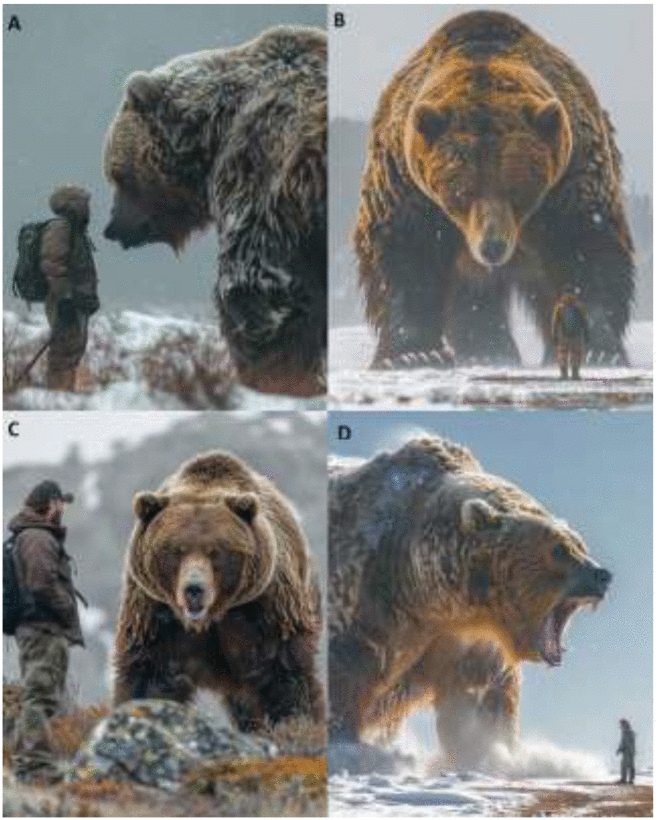
Fig. 2. Generative AI Used: Midjourney 6.0. PROMPT: award-winning professional photography of a 40 foot grizzly bear rearing up against a tiny Japanese man, cinematic background, phenomenal attention to detail, shot with Lecia SL2 using Leica 50mm f/1.4 Lensar 4:5 --v 6.0 --style raw --s 645.
To every cover there is a story. Enter the bear… And then the bears. Lucy Batley of Traction Industries posted one of the outcomes of a Midjourney creation prompt (Fig. 2) on LinkedIn. Having recently made her acquaintance the day before, Katina asked Lucy if the “bear was hers”. Lucy clearly had marked the image with GenAI labelling, taking credit for the concept and noting the generated image was created using software. Little did she know that the bear was so symbolic of the manner in which some people view GenAI. In asking her for a high-resolution image, Lucy reciprocated with the bear, and then a quad-tile of bears. Katina immediately was struck on the fit of the tile and sent it to managing editor AndreAnna McLean for her opinion. It was decided that the single bear would grace the cover, and the quad-tile the guest editorial. Thus, began the search for interpretation: what meaning did the bears have, and why had Lucy chosen the prompt that she had? It was all a mystery.
B. Stimuli Intervention: Lucy’s Explanation
Katina asked Lucy what motivated her to write the prompt that she had in Midjourney (Fig. 2)? Lucy’s reply follows in full. She said: My inspiration for creating this AI-generated image stemmed from an article I read about the increasing bear attacks in Japan, driven by climate change and shrinking habitats. My love for nature and bears fueled my desire to capture their fierceness and the emotional intensity of such encounters. Using Midjourney 6.0, I crafted a prompt that depicted a “40-foot grizzly bear rearing up against a tiny Japanese man” to evoke a David and Goliath analogy, reflecting the tension between Big Tech and small businesses. This approach highlights the scale and fear intrinsic to both natural and societal struggles.
Katina then asked Lucy what the depiction of the quad-tile of bears and the human in the image output speak to her of? How did she interpret the four images of the bears? Lucy elucidated. In the quad generated by Midjourney, the three images I rejected were:
Too cute and cuddly, lacking the intended terror.
A front on view of the bear, where the tiny man was lost in the composition.
The man was proportionate to the bear and appeared unafraid with his hands in his pockets.
The chosen image stood out because of its detailed depiction of the bear’s fur, its open, growling mouth showcasing an aggressive snarl, and the blowing snow, which added a sense of harsh climate. This image vividly conveys the roar and terror I wanted to encapsulate. The tiny man, motionless and seemingly paralyzed by fear, accentuates the sheer scale and ferocity of the bear. Through this image, I aim for viewers to viscerally feel the fear and awe that such a confrontation would elicit. My intention is that this image will raise awareness about climate change, whilst simultaneously illustrating the power of Generative AI to bring ideas to life.
C. The Bear as Symbolism by Joseph Carvalko Jr.
Next it was time to speak to Joseph Carvalko about the impending special issue. At the conclusion of that Zoom call, I posited to him a slightly different question. “Joe,” I said, “I met Lucy Batley, and she used GenAI to create an image, and that image is now our cover, and here let me show you the quad-tile of bears.” And he interpreted the bears in the following way.
Symbols, such as a flag, cross, or bear, hold profound socio-psychological implications, often reflecting a culture’s core identity and values. Their significance transcends visual representation—they influence our understanding of our existence and world context. A symbol could mean a wide array of things to an individual or something of paramount importance to a particular group.
Historically, humans have associated various symbols with their wants, needs, fears, and dreams, yet none has consistently and as cogently served this purpose as the bear.
This majestic creature has come to encapsulate the awesomeness of nature, the supremacy of a constitutional rule, and the stern resilience necessary to achieve lofty aspirations.
The ancients were the first to name the Big Dipper arrangement of stars, Ursa Major, known globally as the Great Bear constellation. In Russia, the bear symbolizes the nation’s rugged beauty and the resilience of its people, while in the U.S. it commemorates California’s struggle for independence from Mexico.
These emblematic instances underscore the symbolic labyrinth within social domains while throwing light on individual psychology. The bear, when symbolically tied to artificial intelligence (AI), reflects an untamed wildness—a realm vast, diverse, waiting to be tamed and fully understood for humanity’s collective benefit. AI holds promise to transform our future by enriching our communicative abilities and expanding our vision of what’s possible. Like the bear, AI is an influential entity—divergent in its composition yet bearing a logical parallelism to an intellectual framework born out of Western, Eastern, Indian, and Islamic logicians’ collective wisdom. Within AI lies a permanent logic, malleable yet capable of transforming humanity’s trajectory. Nevertheless, as we interweave AI into every aspect of our existence, we must respect it for its robustness yet approach it cautiously, for like the bear, it lacks the instincts or emotions that distinguish us from most other species and the mechanics of our inventions.
D. The Four Faces of AI by Katina Michael
Katina had begun to formulate her ideas by the time she had communicated with Joseph, and she had remained fixed on the idea of the four faces of AI. She wrote: in Fig. 2, tile A reminded me of the way in which I greet my Husky-Malamute every morning when she awakes, in close proximity eyes-to-eyes; tile B provided for me greater perspective on the exaggerated size of the bear in all its enormity and stealth... the size of its claws did not go unnoticed either; tile C somewhat brought the human back into view and in control, not as a face-off any longer, but one where the human was within earshot of the bear and seemingly granting it instruction... here the bear was depicted as a helper in my eyes, an aid to the human; and lastly tile D showed the full force of the roar of the bear, unmatched and unrivaled... it is king and in control, and the human can only bow down to its power or risk being swept away by the wind. In this quad-tile, we could analogize the four guises of AI: A and D depict the typical binary “friend or foe” scenario, while B and particularly C show us the potential to provide AI with clear instruction toward supportive action... where AI is neither friend or foe but an aid to a given determination by the human. B and D show us that the human has the ability to tame the beast, instead of being overcome and overwhelmed.
The following week during an MBA class at the University of Wollongong, Katina showed the bears and asked the class to ponder on what the bears meant to them. Former broadcast worker Martin Keyes immediately observed that tile D was not an angry bear but a bear that was protecting the human. The bear’s gaze he noted was not aimed at the little human below, but far out, in protection of the human against a seemingly “just as big” beast. Might this well be the bad bear come to harm the human? But that roar, with jaw open wide and sharp teeth showing, is a reminder of the power of AI- it could break us if it wanted to, and if as Clinton Andrews warns in his own paper, the innovation is not kept in check from the outset [A5]. Another student, Richie Clarke, inspired by the bears, wrote to Katina personally after the class. The four images tell a story of companionship between the man and the bear, from varying degrees of their relationship building including positivity (face-to-face contact with the bear), argument, distance, and culminating in the final image of the bear aggressively defending the human. The fourth image at the bottom right could not be considered aggressive as the posture of the bear is defensive given the movement of the snow at its feet, the snarl and its back is up; given the bear is significantly larger in size and dimension compared to the human it is possible the bear has seen an imminent threat in the distance and is attempting to defend the human.
E. Supersizing the Threats by Clinton Andrews
Clinton Andrews was the last to learn about the bears. Katina sent him the image and asked him to reflect. She did not provide any backdrop whatsoever, nor mention that the bears had been generated by an AI. She asked him to reflect on what the images in the quad-tile meant. He wrote as follows. Few people ever directly experience the primal fear invoked by a close encounter in the wild with an adult grizzly bear, so our storytellers super-size them to add excitement. Fifty years ago, I would have looked at these images and concluded that the portrayals of the human and the bear are both accurate, while their juxtaposition in a single image is terrifying but implausible. Two human generations after the first Star Wars movie normalized computer-generated imagery in popular culture, more of us are likely to accept the scalar mismatch as plausible, at least for advancing a narrative. I wonder if we are doing the same thing in our studies of the social implications of technology—super-sizing threats to make the story more interesting to an uncritical public. The exaggeration entertains but may dis-empower people and may obscure both the significance and manageability of emerging adverse consequences of technology.
SECTION V.
Reflection
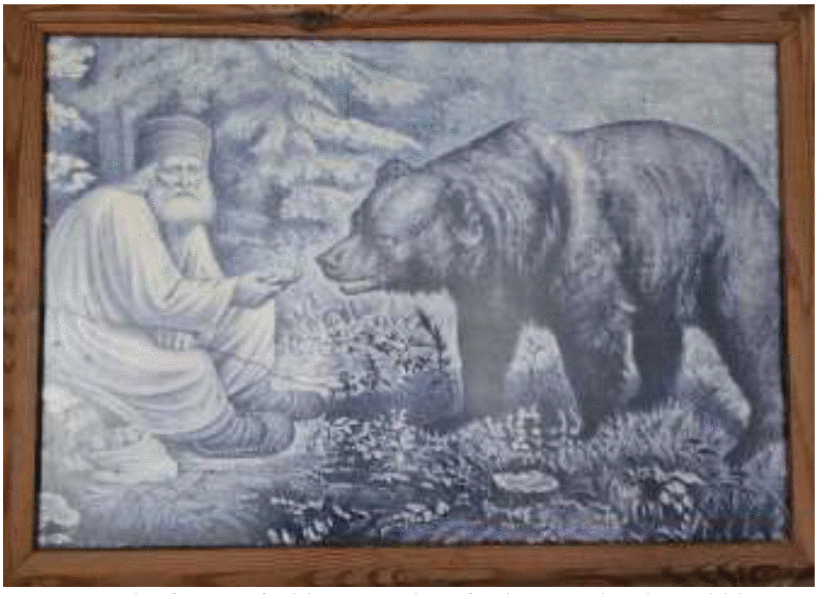
Fig. 3. The frame of Elder Seraphim feeding Misha the wild bear in Sarov that has hung in Katina’s office since 1994.
On a recent Zoom call with four people, Katina shared with Lucy that since 1994, she had hung in her office, artwork of a bear that had been tamed by the Elder Seraphim of Sarov (1754-1833). She had bought the artwork with husband Michael, the year she began her degree at the University of Technology, Sydney. What did this all mean she wondered? She had seen that bear somewhere deep within all those decades ago, but it was not until she actually spoke to Lucy she made the connection with the prompt. In searching for a depiction of that artwork to include in this editorial, Katina came across an icon that named the bear as Misha (i.e., Michael). Katina’s dog is named Mishka (the female version of Misha). The artwork depicts Seraphim feeding a piece of bread to the bear, apparently tamed and obedient to Seraphim’s commands. The depiction is one of peace without fear. The bear is of nature, and the AI is digital and artificial. Perhaps like Seraphim who could tame a mighty bear with all its unpredictability, surely we could tame AI, without fear.
SECTION VI.
Implications
Whatever the story we tell ourselves about AI, we are certain we cannot dismiss it altogether. Doing so would be foolish. Equally, not caring about its social implications would be detrimental both for its beneficial uses and dealing with its negative unintended consequences. AI is here to stay in one guise or another, even if some Big Tech firms are beginning to depreciate certain forms of AI. The majority of innovative creations that shaped the zeitgeist of the Twentieth Century often emerged without prior societal evaluation. Changes to law and the technology itself followed the harms visited upon individuals after-the-fact. The vital role of interdisciplinary collaboration cannot be understated in the realm of exhaustive technology analysis. Determining the ethical parameters, safety measures, and effectiveness of pioneering technology, like AI, calls for the consolidated insights of a diverse group of experts. Each expert, ranging from ethicists, engineers, scientists, to legal authorities and stakeholders imparts their unique viewpoints, fostering well-rounded decisions that advocate the greater good of the society. Simply put, it is a creative intersection of ideas that underpins well-balanced societal progress. We can begin by asking how will the law step in, as markets expand across the globe? Will AI be exploited, for the greater welfare of society, or for the gain of those in power? Might we ever be able to control a particular form of AI, so it does no harm, or will it have its own technological trajectory, creating unintended negative consequences along the way? How might users find uses for it for the public benefit? Or will it only serve the interests of those who have developed it?
SECTION VII.
Conclusion: The ‘Bare’ Truth

Katina and Mishka at home
In conclusion, it is essential to note that GenAI is sparking the creation of unheard-of methodologies. These have profound implications not only for legal frameworks and innovation but also for the way we direct our discoveries. Our ambition should lie in harnessing these tools for positive applications only, thus creating favorable environments that perpetually inspire further exploration for both sound regulations and stakeholder safety and utility throughout the world. A simple experiment observed in the writing of this paper, demonstrated how much GenAI can serve to fuel deeper analysis, critical reflective thinking, and diverse thematic interpretation across disciplines. GenAI should not only be considered “output” but uniquely generative of varying forms of consensus sentiment. Importantly, what is lacking is the acknowledgement of the data GenAI relies on, and this can be addressed by blockchain strategies for original creators and contributors, as one among several ways to address remuneration, recognition and reward. In this piece, Batley’s bears served to propel a whole new round of outputs, creating an unexpected ripple effect filled with meaning, for which the authors of this editorial are appreciative for the connection. The bears echoed example human positionality, replaying the North, South, East and West perspectives, as a mirror of the times in which we live.
ACKNOWLEDGMENT
In this issue we also welcome our new senior editors, associate editors, and reviewers [A9]. Your expertise will take IEEE TTS to another level. We thank all those who provided years of service to the IEEE Transactions on Technology and Society, especially our former Co-Editor-in-Chief, Dr. Roba Abbas of the University of Wollongong who celebrated her tenth-year volunteering in SSIT publications. Dr. Abbas is the newly elected Ex-Com Chair of IEEE SSIT Technical Activities and we wish her every success with her charter.
Appendix: Related Articles
J. R. Carvalko Jr., “Generative AI, ingenuity, and law,”IEEE Trans. Technol. Soc., vol. 5, no. 2, pp. 169–182, Jun. 2024, doi: 10.1109/TTS.2024.3413591.
K. Birch, S. Marquis, and G. C. Silva, “Understanding data valuation: Valuing Google’s data assets,” IEEE Trans. Technol. Soc., vol. 5, no. 2, pp. 183–190, Jun. 2024, doi: 10.1109/TTS.2024.3398400.
J. Berengueres, “How to Regulate large language models for responsible AI,” IEEE Trans. Technol. Soc., vol. 5, no. 2, pp. 191–197, Jun. 2024, doi: 10.1109/TTS.2024.3403681.
T. C. McCullough, “Explaining and exploring ethical and trustworthy AI in the context of reinforcement learning,” IEEE Trans. Technol. Soc., vol. 5, no. 2, pp. 198–204, Jun. 2024, doi: 10.1109/TTS.2024.3406513.
C. J. Andrews, “Better anticipating unintended consequences,” IEEE Trans. Technol. Soc., vol. 5, no. 2, pp. 205–216, Jun. 2024, doi: 10.1109/TTS.2024.3403412.
G. Pangelina, A. Bhatta, H. Wu, M. C. King, and K. W. Bowyer, “Analyzing the impact of demographic and operational variables on 1-to-many face ID search,” IEEE Trans. Technol. Soc., vol. 5, no. 2, pp. 217–230, Jun. 2024, doi: 10.1109/TTS.2024.3416344.
W. Koch et al., “On the ethics of employing artificial intelligent automation in military operational contexts,” IEEE Trans. Technol. Soc., vol. 5, no. 2, pp. 231–241, Jun. 2024, doi: 10.1109/TTS.2024.3405309.
V. Stroele, L. L. O. Moreno, J. Gomes, T. T. d. O. Silva, E. Rajabi, and J. F. de Souza, “Who is going to help? Detecting social media influencers to spread information about missing persons,” IEEE Trans. Technol. Soc., vol. 5, no. 2, pp. 242–251, Jun. 2024, doi: 10.1109/TTS.2024.3395175.
[A9] K. Michael, “IEEE Transactions on Technology and Society Editorial Board Profiles,” IEEE Trans. Technol. Soc., vol. 5, no. 2, pp. 119–148, Jun. 2024, doi: 10.1109/TTS.2024.3423208.
References
Yale Interdisciplinary Center for Bioethics, Yale University, “Technology and Ethics,” 2024. [Online]. Available: https://bioethics.yale.edu/technology-and-ethics
Rutgers University, Edward J. Bloustein School of Planning and Public Policy, “Andrews,” 2024. [Online]. Available: https://bloustein.rutgers.edu/people/andrews/
Traction Industries, “About,” 2024. [Online]. Available: https://www.tractionindustries.com/
R. Pringle, K. Michael, and M. G. Michael, “Unintended consequences: The paradox of technological potential,” IEEE Potentials, vol. 35, no. 5, pp. 7–10, Sep./Oct. 2016.
R. Pringle, K. Michael, and M. G. Michael, “Unintended consequences of living with AI: The paradox of technological potential? Part II,” IEEE Technology and Society Magazine, vol. 35, no. 4, pp. 17–21, Dec. 2016, doi: 10.1109/MTS.2016.2632978.
K. Michael, What Are the Unintended Consequences of Technology?, University of Wollongong, Mar. 21, 2017. [Online Video]. Available: https://www.youtube.com/watch?v=UzsSVUTuiE0
Authors
Arizona State University, Tempe, AZ, USA
Katina Michael (Senior Member, IEEE) is a joint Professor with the School for the Future of Innovation in Society and the School of Computing and Augmented Intelligence, Arizona State University. She is also the Director of the Society Policy Engineering Collective and a Senior Global Futures Scientist with the Global Futures Laboratory. She was previously employed as a Senior Network Engineer with Nortel Networks and also worked as a Systems Analyst with Andersen Consulting and OTIS Elevator Company. She is an Honorary Professor with the School of Business, University of Wollongong.
Yale University, New Haven, CT, USA
Joseph R. Carvalko Jr. is a technologist, an academic, and a patent lawyer, who devotes his attention to and writes about the intersection of law and technology. He chairs the Technology and Ethics Working Research Group, Interdisciplinary Center for Bioethics, Yale University. He is an Adjunct Professor and a Course Creator of Law, Science, and Technology with Quinnipiac University School of Law. In 2018, he was a Faculty Member with the Sherwin B. Nuland Summer Institute in Bioethics, Interdisciplinary Center for Bioethics, Yale University. In 2020, he served as a Consultant to NATO Headquarters, Supreme Allied Commander Transformation, Innovation Hub, and Warfighting 2040 Study; a former member of ABA, Section of Science and Technology Law (former editorial board of SciTech Lawyer; former Chair of Behavioral Sciences Committee); a member of Society on Social Implications of Technology; a member of the Publications Board of IEEE Transactions on Technology and Society (currently, an Associate Editor of IEEE Society and Technology Magazine); and a member of Yale Community Bioethics Forum on Biomedical Ethics, Yale School of Medicine.
Rutgers University, New Brunswick, NJ, USA
Clinton J. Andrews (Senior Life Member, IEEE) is a Distinguished Professor, a Center Director, and the Associate Dean for Research with the Edward J. Bloustein School of Planning and Public Policy, Rutgers University. He was educated at Brown University and Massachusetts Institute of Technology in engineering and planning, and he worked previously in the private sector and at Princeton University. He teaches urban planning and public informatics courses, and he performs research on how people use the built environment. His work addresses how technological and environmental changes affect urban life, with a focus on climate change mitigation and adaptation. He has current projects on the energy transition, low-income housing, urban heat stress, and coastal hazards. He publishes both scholarly and popular articles and his books include Humble Analysis: The Practice of Joint Fact-Finding, Regulating Regional Power Systems, and Industrial Ecology and Global Change. He recently completed service as the Co-Editor of the Journal of Planning Education and Research, and he remains a member of the editorial board of the Journal of Industrial Ecology.
Traction Industries, Dudley, U.K.
Lucy Batley has 30 years of tech experience spanning designing for the digital world, her talent recognized at the outset of her career by winning EMAP’s Best Young Designer. She built a strong foundation at the dawn of the digital era to bring products to the then-burgeoning online marketplace, working with renowned brands and artists, including Audi, MaxMara, Samsonite, Vespa, Fila Sport, and The Manic Street Preachers. She also designed the digital interface to launch the Euro into the U.K. to Barclays Bank SME Division. She has since founded digital design agencies and established Traction Industries, providing solutions incorporating artificial intelligence and emerging technologies to drive innovation. A thought leader and visionary designer, she is passionate about how AI can work with humans and is a sought-after speaker, AI expert, and a broker.
Citation: K. Michael, J. R. Carvalko, C. J. Andrews and L. Batley, "In the Special Issues: GenAI, Ingenuity, the Law, and Unintended Consequences," in IEEE Transactions on Technology and Society, vol. 5, no. 2, pp. 149-155, June 2024, doi: 10.1109/TTS.2024.3413268.