COVID-19 Contact Trace App Deployments
Citation: R. Abbas and K. Michael, "COVID-19 Contact Trace App Deployments: Learnings From Australia and Singapore," in IEEE Consumer Electronics Magazine, vol. 9, no. 5, pp. 65-70, 1 Sept. 2020, doi: 10.1109/MCE.2020.3002490.
Image by Elchinator from Pixabay
As the COVID-19 pandemic has gripped nation states around the world, technological fixes based on smartphone solutions have been proposed as a means to mitigate the risk posed to humans, prevent further economic loss, and overcome societal and business challenges. If health authorities and government agencies can track and trace the movement of the citizen at the most granular level, verify with whom they have had contact over a given period, then they can respond immediately by placing confirmed cases and suspected contacts in quarantine. By doing so, it is theoretically possible to minimize the level of exposure to the disease, particularly in high-density areas, before a potential outbreak happens, limiting the spread of a virus.[1]
THERE IS AN APP FOR THAT
The location-based technologies proposed in response to COVID-19 are built primarily on the foundations of mobile commerce, encompassing a range of applications that can potentially utilize proximity details, identity, location data, and other condition information in the provision of value-added services to the end-user.[2] These technologies leverage a range of telecommunication standards, protocols, and features depending on the required functionality. That is, the technologies at work depend on the specific application or context within which they are implemented. For instance, location services can be instituted at varying levels of detail across the mobile value chain[3]: at the network level (determined by the mobile network provider), at the device level (edge device like a FitBit[4]), at the operating system level (Android or iOS), at the app level (deployed by the local health authority or government agency).
Furthermore, these technological solutions or apps generally make use of a variety of sensors and capabilities on the smartphone: everything from location sensors, to beacons that use Bluetooth to ask the question “is there any other phone nearby, and if there is, are you willing to share information?” Importantly, these kinds of apps are generally not mandatory and work on an opt-in basis. Some apps are location-based (track and monitor); others are physical social network-based (contact and trace); and there are also hybrid solutions (geofencing and control).[5]
The COVID-19 pandemic has by its very nature, rapidly caused confusion and fear within society, particularly with up to the minute reporting through the advent of online social networking that has raised awareness about personal struggles and COVID-19-related deaths. This fear has resulted in the call for technological and location-based solutions in response to the pandemic, which allows for contact tracing efforts to be automated. For instance, internationally, contact tracing is being explored as a key means of containing the spread of COVID-19. The World Health Organization identifies three basic steps to this form of tracing, which include contact identification, contact listing, and follow-up.[6] Contact identification records the mobile phone number and a random anonymized user ID. Contact listing includes a record of users who have come into close contact with a confirmed case, and notifies them of next steps, such as quarantine. Finally, follow-up entails frequent communication with contacts to monitor the emergence of any symptoms and test accordingly to confirm.
SINGAPORE'S TRACETOGETHER
One of the first contact tracing implementations was in Singapore, known as TraceTogether, which employs Bluetooth technology to sense users within close proximity.[7] This is principally presented as a tool to “protect” individuals, families, and society at large through a data-driven community-based approach for the common good, where proximity and duration details are shared between devices that have the TraceTogether app installed.[8] Participation in Singapore's initial rollout was estimated at about 17% of the total population, where about one in five adults have downloaded TraceTogether.[9] In an effort to preserve privacy, the app's developers claim it retains proximity and duration details for 21 days, after which the oldest day's record is deleted and the latest day's data are added, avoiding the collection of location data. But proximity and duration information alongside timestamps can reveal a great deal about a user's relative distance (and therefore relative location), time and duration of contact. A Bluetooth-based app may not know where you are on the Earth's surface using a coordinate projection system (longitude and latitude), but it can accurately infer your location when bringing a variety of non-Earth unit-based data together, thus revealing your absolute location. This contact tracing model has some known weaknesses, for example, that it is centralized and places a government authority (as opposed to an independent entity) in control of the transfer of valuable contact and connection details once there is a confirmed case.[10]
AUSTRALIA'S COVIDSAFE
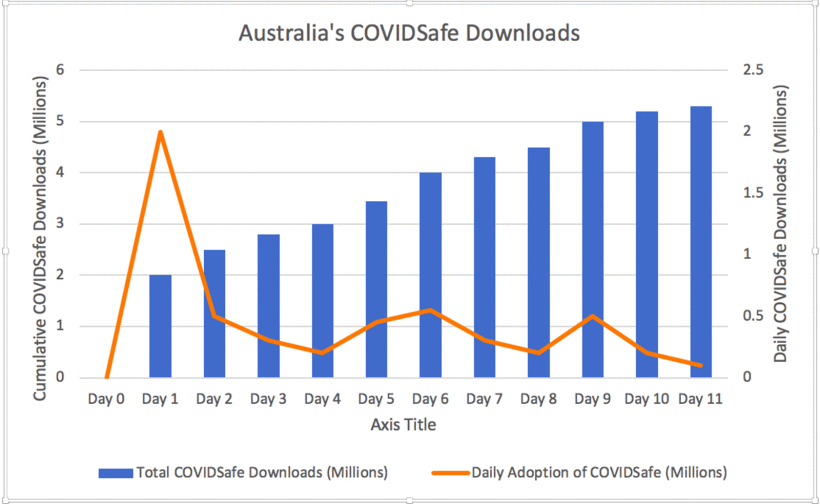
Figure 1. Australia's COVIDSafe Downloads in the first 11 Days.
Australia's contact and trace app, known as COVIDSafe was based on Singapore's TraceTogether app and adapted for local requirements,[11] costing 1.5 million AU to build. It too logs participating individual contacts, allowing for health authorities to alert other community members who have come into proximity of a confirmed case. As soon as a General Practitioner confirms a positive test, the confirmed case grants consent for the encrypted data on their handset to be sent to Amazon Web Services servers to allow for automated mobile alerts to be delivered to the patient's physical social network of the last 14 days. While the app is voluntary, the Australian Government hoped for a 40% take up,[12] but after considerable initial interest, the app's participation figure after 11 days is at about 5.3 million downloads, approximately 1 in 4 adults (see Figure 1). The Australian Government, encouraging more active downloads before relaxing self-isolation orders on May 3, 2020, SMS-ed its citizens requesting further consideration, if COVIDSafe had not as yet been downloaded by them (see Figure 2). Some citizens saw this in an unfavorable light and a form of political coercion, particularly given that there was an initial indication that the app would be mandatory,[13] a decision later revoked by the Australian Prime Minister given the public backlash[14] with the app requiring consent during the registration process (see Figure 3). Interestingly, Singapore has similarly noted to its citizens given a recent and considerable increase in COVID-19 cases, that the app would need to be downloaded and installed by “everyone” to enable effective contact tracing.[15]
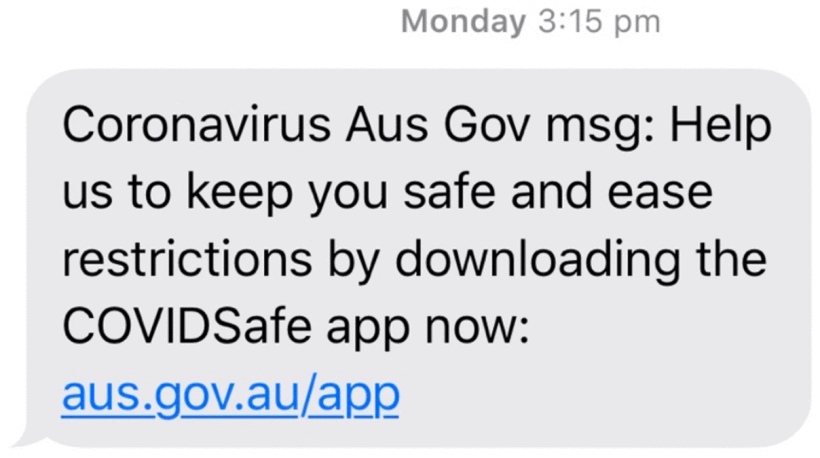
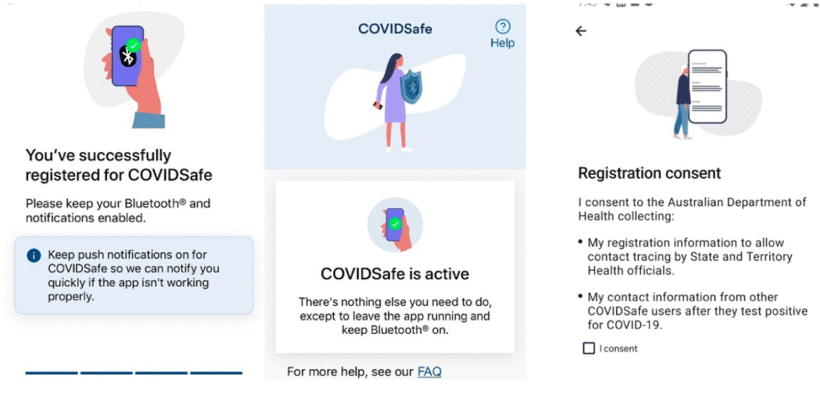
Figure 2. Coronavirus Australian Government Download Message. Figure 3. Registering for COVIDSafe after Download
REASONS WHY THE APPS HAVE BEEN UNSUCCESSFUL
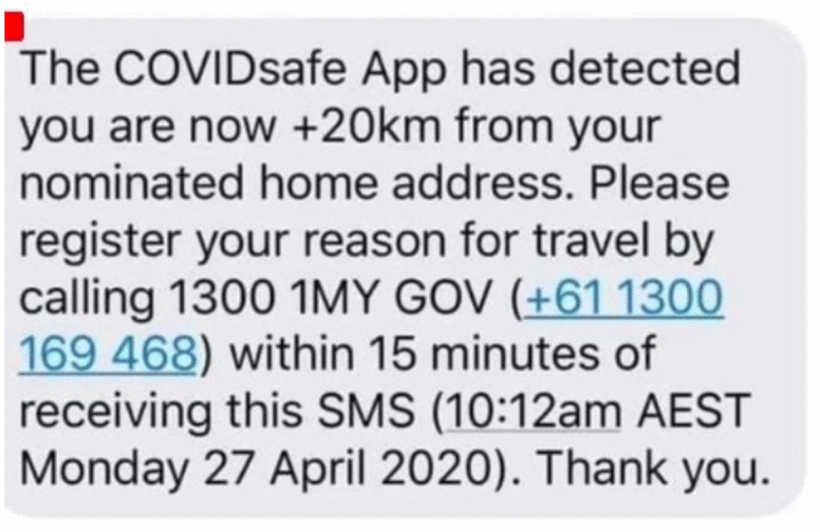
Figure 4. COVIDsafe Hoax Message.
In the case of TraceTogether and COVIDSafe, there have been numerous reasons[16] why the app has not been downloaded by more citizens, and these considerations must be explored from a socioethical lens.[17] For instance, the proposed model does not account for accessibility by vulnerable individuals, who may not own or be able to operate a smartphone, potentially including the elderly, children, migrants and others unable to speak English, or those living with cognitive impairment. Additionally, there has been a spate of iPhone iOS issues (roughly half the market in Australia), primarily, that the design of the app requires it to remain open, active and running in the foreground of the device with light emitting, whereas other apps are closed, thereby impacting battery performance. There have also been substantial issues with over 1 million older phones that are unable to download the app.[18] There was additionally a user interface issue inadvertently notifying individual users that “You have tested positive for COVID-19,”[19] and additional hoax applications, fake SMS-es and more (see Figure 4). More recently, it has been reported by users that the app has issues “connecting” to other phones with the app installed, sometimes taking hours for “communications” between the two devices to occur, rather than conforming to the suggested short intervals of 15 min cycles. The app also prohibits installation by those who are citizens working abroad and who may be using a roaming plan, accepting exclusively an Australian phone number for registration purposes. It has also come to light that there are significant electromagnetic interference issues for those individuals who are diabetic and are using glucose monitoring apps[20] or individuals using other implantables that have a remote programmer device. At times, obstruction will also mean that a reading between the two devices cannot happen; although Bluetooth is a nonline of sight technology, it does not work well when metal, marble, concrete, or water (in humans) form a barrier.[21]
Those critical of technology responses to COVID-19 based on smartphones, have noted that the technology alone does not act to prevent the coronavirus, and that the spread of the virus can only be potentially contained if there is a significant level of participation by members of society. It is also ineffective for those individuals who are asymptomatic and continue to roam without realizing they are carriers, and are possibly transmitting the virus to others. Schneier,[22] noted in one of his recent blogs, “I can't see how this sort of app is valuable.” But some of the gravest challenges for these contact tracing apps remains the law, in particular, privacy protections, metadata laws, and laws pertaining to cloud servers with respect to intelligence gathering. While many privacy and security practitioners remained hopeful at the very beginning of the contact tracing journey, as time has passed, it is becoming apparent that the proposed solutions do not work without the relevant regulatory and sociotechnical structures in place. A subset of these structures includes conducting field data testing for a variety of operational scenarios, which has not been completed to date; providing technical and design specifications that are accessible to a wide range of stakeholders; and offering open source code to the technical community in a timely fashion.
DATA OWNERSHIP, TRUST, AND CONTROL
Some computer scientists have noted that the contact tracing app is just that, an app that semiautomates the existing, manual health surveillance process of “contact tracing.” They point to more proactive approaches that might utilize location intelligence[23] in a preemptive fashion, and using responsible artificial intelligence to determine how an outbreak might play out, and respond with enhanced preparedness. Others have argued, if we are all self-isolating then what is the point of using this kind of technology? What do we gain from it unless we are harboring notions of digital certification of immunity and allowing some people to roam while others do not?[24] The confusion also comes about in regards to the value of such just-in-time Apps, when the following questions are posed: Who owns the data? Who is driving the deployment of the app in the first place? And who are the companies behind its creation? A pandemic-tracing app would need to have a limited lifetime, even if the user forgets to uninstall the COVID-19 app after victory has been declared over the pandemic. It must not become the de facto operational scenario, as this would have major societal ramifications.[25]–[28] Already, it is suspected that this has been the first of many litmus tests to come with respect to how far a government can push before manufactured consent is instilled,[29] and there is a deliberate move toward mobile government and digital transformation. In Hong Kong, for example, despite the political unrest of recent time, citizens have accepted the use of electronic bracelets when in quarantine, as a “health comes first” initiative.[30]
In the end it might well come down to trust.[31] Do we trust our data in the hands of government? The answer might well be “no,” but do we have any other choice? Do we trust our data in the hands of corporations who have previously been fined for massive location data breaches? Who will be held accountable and by which oversight body, for the potential misuse of location and social networking information when COVID-19 runs its course? And who will recover our fundamental civil liberties after the new status quo sets in as a de facto “risk-based” rhetoric? Thus, we need to maintain a finite emergency declaration period within existing laws and regulations, and introduce specific rules beyond biosecurity acts. The deeper questions may well be about how we harness the power of transformative digital technologies for our medical supply chains and underlying health infrastructures to better coordinate our efforts in response to disasters and emergencies;[32] not so much about the shiny new app that is supposed to save the world. No one fears “tech for good.” But when we relax those fundamental requirements of privacy and security, particularly strategies for maintaining anonymity and the encryption of data, and the access of personal information by corporations, we need to ask ourselves, can't we do any better[33]? A measured approach to design of these systems is necessary,[34] as is community consultation, which without it must be underscored, the apps may prove to be yet another example of IT project failures.
References
1. A. Vaughan, Apr. 17, 2020, “There are many reasons why covid-19 contact tracing apps may not work,” New Scientist, Accessed: May 9, 2020, [Online]. Available. https://www.newscientist.com/article/2241041-there-are-many-reasons-why-covid-19-contact-tracing-apps-may-not-work/#ixzz6JtJYzqXw
2. K. Michael and M. G. Michael, Innovative Automatic Identification and Location-Based Services: From Bar Codes to Chip Implants, Hershey: Information Science Reference, 2009.
3. A. Aloudat, K. Michael, and R. Abbas, “Location-based services for emergency management: A multi-stakeholder perspective,” in Proc. 8th Int. Conf. Mobile Bus., Jun. 2009. doi: 10.1109/ICMB.2009.32.
4. J. Ralls, Apr. 14, 2020.“Fitbit collaborates with Scripps research and Stanford medicine to study the role of wearables to detect, track and contain infectious diseases like COVID-19,” FitBit. Accessed: May 9, 2020. [Online]. Available. https://investor.fitbit.com/press/press-releases/press-release-details/2020/Fitbit-Collaborates-with-Scripps-Research-and-Stanford-Medicine-to-Study-the-Role-of-Wearables-to-Detect-Track-and-Contain-Infectious-Diseases-like-COVID-19/default.aspx
5. K. Michael, “Location-based services: A vehicle for IT&T convergence, in Advances in e-Engineering and Digital Enterprise Technology. eds., K. Cheng, D. Webb, and R. Marsh, London, U.K. : Professional Engineering Publishing, 2004, pp. 467–478.
6. WHO, “Contact tracing,” World Health Organisation, May 2017. Accessed: May 9, 2020. [Online]. Available: https://www.who.int/news-room/q-a-detail/contact-tracing
7. SingGov, “TraceTogether, safer together,” Singaporean Government Agency, May 2020, Accessed: May 9, 2020. [Online]. Available: https://www.tracetogether.gov.sg/
8. TraceTogether, “How does TraceTogether work? ” Team Trace Together, Apr. 2020, Accessed: May 9, 2020. [Online]. Available: https://tracetogether.zendesk.com/hc/en-sg/articles/360043543473-How-does-TraceTogether-work-
9. A. Aravindan and S. Phartiyal, “Bluetooth phone apps for tracking COVID-19 show modest early results,” Reuters, Apr. 2020. Accessed: May 9, 2020. [Online]. Available: https://www.reuters.com/article/us-health-coronavirus-apps/bluetooth-phone-apps-for-tracking-covid-19-show-modest-early-results-idUSKCN2232A0
10. D. Sadler, “Contact tracing tech is a mixed bag,” InnovationAus, Apr. 2020. Accessed: May 9, 2020. [Online]. Available: https://www.innovationaus.com/contact-tracing-tech-is-a-mixed-bag/
11. D. Crowe, Apr. 14, 2020. “Mobile tracing is next step in virus battle in bid to stop outbreaks,” Sydney Morning Herald. Accessed: May 9, 2020. [Online]. Available: https://www.smh.com.au/politics/federal/mobile-tracing-is-next-step-in-virus-battle-in-bid-to-stop-outbreaks-20200414-p54jsd.html
12. A. Probyn, Apr. 25, 2020. “Coronavirus lockdowns could end in months if Australians are willing to have their movements monitored,” ABC. [Online]. Available. https://www.abc.net.au/news/2020-04-14/coronavirus-app-government-wants-australians-to-download/12148210, Last Accessed: 9 May 2020.
13. SBS News, Apr. 17, 2020. “Coronavirus mobile tracking app may be mandatory if not enough people sign up, Scott Morrison says,” SBS News. Accessed: May 9, 2020. [Online]. Available: https://www.sbs.com.au/news/coronavirus-mobile-tracking-app-may-be-mandatory-if-not-enough-people-sign-up-scott-morrison-says
14. J. Hayne and G. Hitch, Apr. 18, 2020. “Coronavirus app will not be forced upon Australians, Scott Morrison says,” ABC News, Accessed: May 11, 2020. [Online]. Available: https://www.abc.net.au/news/2020-04-18/prime-minister-rules-out-making-coronavirus-app-mandatory/12161126
15. M. Hui, Apr. 21, 2020. “Singapore wants all its citizens to download contact tracing apps to fight the coronavirus,” Quartz, Accessed: May 9, 2020. [Online]. Available: https://qz.com/1842200/singapore-wants-everyone-to-download-covid-19-contact-tracing-apps/
16. J. Gramenz, May 1, 2020. “Reasons we're not downloading app,” The Queensland Times. Accessed: May 9, 2020. [Online]. Available: https://www.qt.com.au/news/reasons-were-not-downloading-app/4006827/
17. A. Aloudat and K. Michael, “The socio-ethical considerations surrounding government mandated location-based services during emergencies: An Australian case study,” in ICT Ethics and Security in the 21st Century: New Developments and Applications. Ed., M. Quigley, Hershey, PA, USA : IGI Global, 2011, pp. 129–154.
18. J. Dudley-Nicholson, May 6, 2020. “Experts call for government to upgrade COVIDSafe app due to software issues,” The Daily Telegraph, [Online]. Available: https://www.dailytelegraph.com.au/coronavirus/experts-call-for-government-to-upgrade-covidsafe-app-due-to-software-issues/news-story/bd302f747dc979bfa2a0e8ce2402eced
19. J. Dudley-Nicholson and C. Armstrong, May 5, 2020. “COVIDSafe app: Issues preventing registrations as Federal Government calls for more downloads ”, The Daily Telegraph. [Online]. Available. https://www.dailytelegraph.com.au/coronavirus/easy-explainer-how-the-covidsafe-app-works/news-story/3ce225cfc42c22186e1d9d341990df8b
20. T. Biggs, May 1, 2020. “COVIDSafe may interfere with diabetes-monitoring apps,” Sydney Morning Herald. Accessed: May 11, 2020. [Online]. Available: https://www.smh.com.au/technology/covidsafe-may-interfere-with-diabetes-monitoring-apps-20200501-p54oyd.html
21. J. Boyd, May 6, 2020, “Australia's contact-tracing COVIDSafe app off to a fast start,” IEEE Spectrum. Accessed: May 9, 2020. [Online]. Available: https://spectrum.ieee.org/tech-talk/computing/software/australias-contact-tracing-covidsafe-app
22. B. Schneier, “Contact tracing COVID-19 infections via smartphone apps,” Apr. 15, 2020. Accessed: May 9, 2020. [Online]. Available: https://www.schneier.com/blog/archives/2020/04/contact_tracing.html
23. K. Michael, B. Stroh, O. Berry, A. Muhlhauber, and T. Nicholls, “The AVIAN flu tracker––A location service proof of concept,” Recent Advances in Security Technology: Proceedings of the 2006 RNSA Security Technology Conference, Australian Homeland Security Research Centre, Sep. 2006, Accessed: May 9, 2020. [Online]. Available: https://ro.uow.edu.au/infopapers/387/
24. A. Holmes, Apr. 12, 2020. “Fauci says the government is considering giving out COVID-19 ‘immunity cards’ as part of push to reopen the economy,” Business Insider. Accessed: May 9, 2020. [Online]. Available: https://www.businessinsider.com.au/the-government-is-considering-covid-19-immunity-cards-2020-4?r=US&IR=T
25. A. Aloudat, K. Michael, X. Chen, and M. A.-D. Mutaz, “Social acceptance of location-based mobile government services for emergency management,” Telematics Informat., vol. 31, no. 1, pp. 153–171, Feb. 2014.
26. M. G. Michael, S. J. Fusco, and K. Michael, “A research note on ethics in the emerging age of Überveillance,” Comput. Commun., vol. 31, pp. 1192–1199, 2008.
27. K. Michael and R. Clarke, “Location and tracking of mobile devices: Überveillance stalks the streets,” Comput. Law Secur. Rev., vol. 29, no. 3, pp. 216–228, Jun. 2013.
28. K. Michael and M. G. Michael, “The social and behavioural implications of location-based services,” J. Location Based Services, vol. 5, no. 3/4, pp. 121–137, 2011.
29. E. S. Herman and N. Chomsky, Manufacturing Consent: The Political Economy of the Mass Media, New York, NY, USA : Pantheon Books, 1988.
30. BBC, Apr. 24, 2020. “Coronavirus: People-tracking wristbands tested to enforce lockdown,” BBC News: Technology, [Online]. Available: https://www.bbc.com/news/technology-52409893#
31. A. Salleh, Jun. 11, 2010. “Tracking apps could ‘undermine trust’,” ABC Science. Accessed: May 9, 2020. [Online]. Available: http://www.abc.net.au/science/articles/2010/06/11/2922784.htm
32. A. Aloudat and K. Michael, “Toward the regulation of ubiquitous mobile government: A case study on location-based emergency services in Australia,” Electron. Commerce Res., vol. 11, no. 1, pp. 31–74, 2011.
33. L. Perusco and K. Michael, “Control, trust, privacy, and security: Evaluating location-based services,” IEEE Technol. Soc. Mag., vol. 26, no. 1, pp. 4–16, Spring 2007.
34. R. Abbas, K. Michael, and M. G. Michael, “Using a social-ethical framework to evaluate location-based services in an internet of things world,” Int. Rev. Inf. Ethics, vol. 22, pp. 43–73, Dec. 2014. [Online]. Available. http://www.i-r-i-e.net/inhalt/022/IRIE-Abbas-Michael-Michael.pdf
Authors
University of Wollongong
Arizona State University
Citation: R. Abbas and K. Michael, "COVID-19 Contact Trace App Deployments: Learnings From Australia and Singapore," in IEEE Consumer Electronics Magazine, vol. 9, no. 5, pp. 65-70, 1 Sept. 2020, doi: 10.1109/MCE.2020.3002490.