Consumer Technology-Based Solutions for COVID-19
Citation: H. Thapliyal, K. Michael, S. P. Mohanty, M. B. Srinivas and M. K. Ganapathiraju, "Consumer Technology-Based Solutions for COVID-19," in IEEE Consumer Electronics Magazine, vol. 10, no. 2, pp. 64-65, 1 March 2021, doi: 10.1109/MCE.2020.3040513.
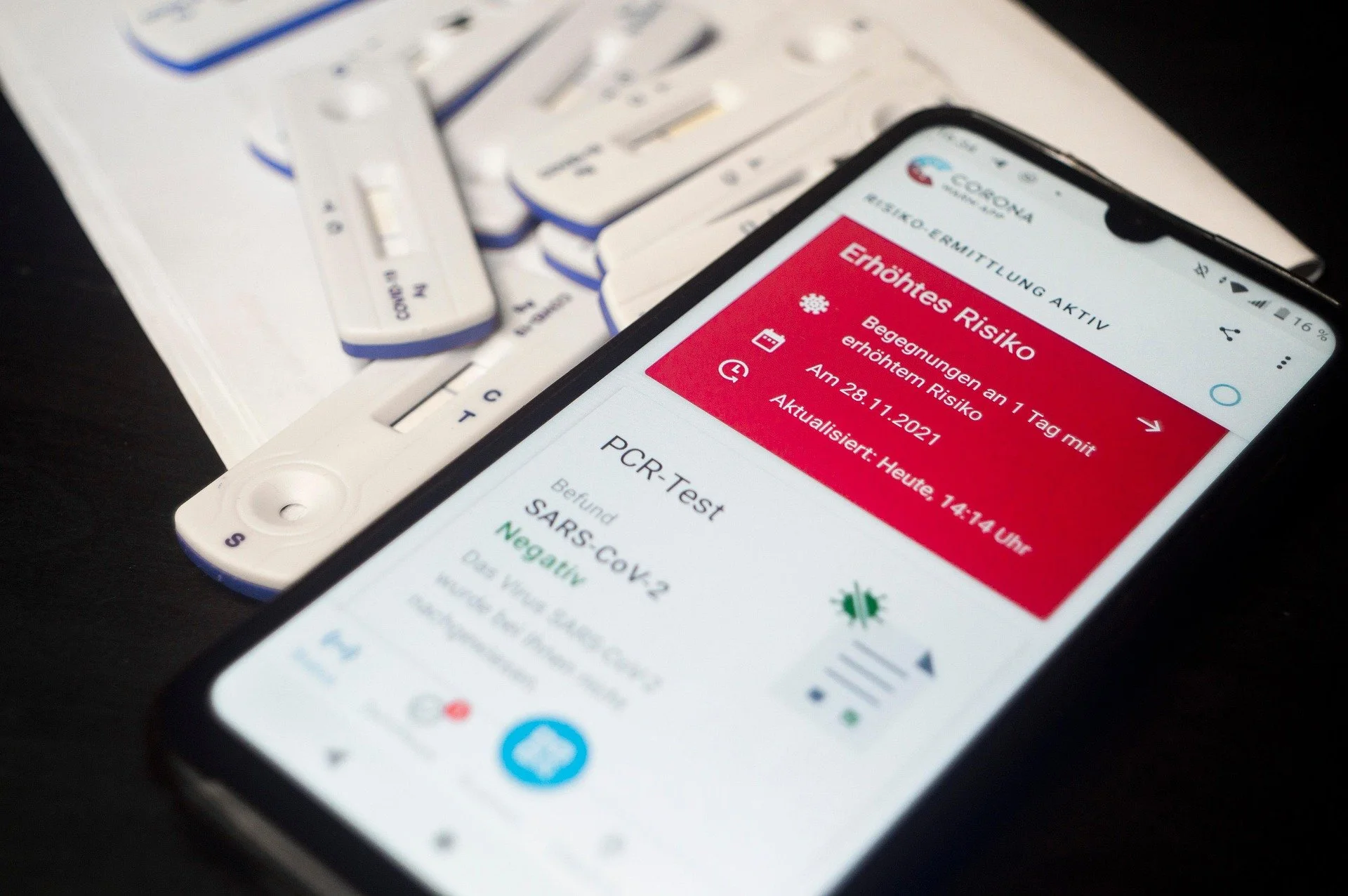
Image by SamuelFJohanns from Pixabay
This special section presents leading research addressing COVID-19 Consumer Technology solutions. Consumer technologies need to be developed for health and wellbeing during COVID-19 pandemic, that are closely tied to the ground realities, with interdisciplinary expertise of academicians and industry professionals including scientists, engineers, medical professionals, sociologists, and front-line workers. We believe that there are some major thrust areas that broadly relate to consumer electronics, which require significant attention, including the following.
Diagnosis, and Prevention of COVID-19 Through Consumer Technology
A few possible research directions are: i) novel sensors that can provide potential solutions, ii) wearable technologies-based solutions, iii) leveraging machine learning and AI computational methods, and iv) Internet-of-Things (IoT) and smart home technologies.
Improving the Health and Well-Being of the COVID-19 Patients, Family, and Caregivers
A few research directions are: i) utilizing consumer technologies for quarantine management and self-care, ii) wearable, edge-computing, IoT-based approaches for effective contact tracing, iii) consumer technology solutions for social/business interactions during physical distancing.
Security, Privacy, and Ethical Issues That Arise in Public Interest Technologies for COVID-19
With the above criteria in mind, we invited prospective authors to contribute to the current Special Section that will provide a comprehensive review of fundamentals, the current state-of-the-art, and future technology solutions to COVID-19. We briefly introduce the accepted articles in the following.
“Can IoMT help to prevent the spreading of new coronavirus?” introduces a wrist-worn device that does not physically disturb the person to track the health conditions of the person and detects the symptoms of COVID-19 at the early stages. The article titled “A Smart Mask for Active Defense Against Coronaviruses and Other Airborne Pathogens” presents a new “active mask” paradigm in which the wearable device is equipped with smart sensors and actuators to both detect the presence of airborne pathogens in real time and take appropriate action to mitigate the threat.
“Novel MEC based Approaches for Smart Hospitals to Combat COVID-19 Pandemic” considers multi-access edge computing (MEC) flavor of the edge paradigms for realizing the contactless approaches that assist the mediation of COVID-19 and the future of healthcare.
The article titled “Crowd Size using CommSense Instrument for COVID-19 Echo Period” proposes and evaluates a nonintrusive, passive, and cost-effective solution for crowd size estimation in an outdoor environment. The following paper presents the development of large area pressure sensors and demonstrates a proof of concept prototype to counter the social distancing issue in areas with a high density. It is titled: “Large Area Pressure Sensor for Smart Floor Sensor Applications - An Occupancy Limiting Technology to Combat Social Distancing.”
“Efficient and Privacy-Preserving Medical Research Support Platform Against COVID-19: A Blockchain-Based Approach” presents a blockchain-based medical research support platform, which can provide efficient and privacy-preserving data sharing against COVID-19. A second paper on privacy preserving practices is presented using a novel technique based on call data record analysis (CDRA) and contact tracing is proposed that can effectively control the coronavirus outbreak. The paper, “A Privacy Preserved and Cost-Efficient Control Scheme for Coronavirus Outbreak Using Call Data Record and Contact Tracing,” demonstrates how a positive coronavirus patient can be traced through CDRA and contact tracing.
As concluding remarks, mechanisms like hand sanitization, the wearing of certified masks, and the practice of social distancing are being explored to mitigate the spread of the transmission (actively or passively) and to reduce COVID-19 infections. Physical distancing between humans can be verified using technologies that aid in the notification of large gatherings, indoor or outdoor. Similarly, test, trace, and isolate/quarantine of COVID-19 suspects can be achieved through IoT based technologies. Independent of the technology deployment, the privacy of users, and security of the data are of utmost importance.
The guest editors would like to thank all the authors for their contributions, and the reviewers for their expert assistance in reviewing the manuscripts.
Authors
University of Kentucky
Himanshu Thapliyal is an Associate Professor and Endowed Robley D. Evans Faculty Fellow with the Department of Electrical and Computer Engineering, University of Kentucky, Lexington, KY, USA. Contact him at hthapliyal@uky.edu.
Arizona State University
Katina Michael is a Professor with the School for the Future of Innovation in Society, School of Computing, Informatics and Decision Systems Engineering, Arizona State University, Tempe, AZ, USA. Contact her at katina.michael@asu.edu.
University of North Texas
Saraju P. Mohanty is a Professor with the Department of Computer Science and Engineering, University of North Texas, Denton, TX, USA. Contact him at saraju.mohanty@unt.edu.
BITS Pilani, Hyderabad
M.B. Srinivas is a Professor with the Department of Electrical Engineering, BITS Pilani, Hyderabad, India. Contact him at mbs@hyderabad.bits-pilani.ac.in.
University of Pittsburgh
Madhavi K. Ganapathiraju is an Associate Professor with the Department of Biomedical Informatics, School of Medicine, and in the Intelligent Systems Program of School of Computing and Innovation, University of Pittsburgh. Contact her at madhavi@pitt.edu.
Citation: H. Thapliyal, K. Michael, S. P. Mohanty, M. B. Srinivas and M. K. Ganapathiraju, "Consumer Technology-Based Solutions for COVID-19," in IEEE Consumer Electronics Magazine, vol. 10, no. 2, pp. 64-65, 1 March 2021, doi: 10.1109/MCE.2020.3040513.