Celebrating the First Four Years of IEEE TTS
Citation: K. Michael, R. Abbas and G. Roussos, "Celebrating the First Four Years of IEEE TTS," in IEEE Transactions on Technology and Society, vol. 4, no. 4, pp. 280-290, Dec. 2023, doi: 10.1109/TTS.2024.3360830.
SECTION I.
Introduction
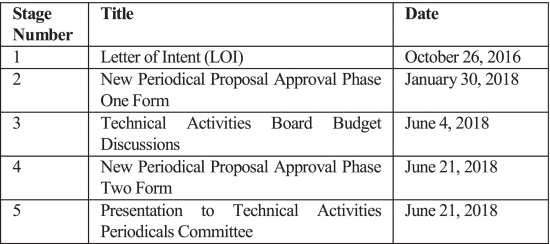
TABLE I IEEETTS Proposal Stages
It was not long after the search had begun for a new Editor-in-Chief of the IEEE Technology and Society Magazine (TSM) in 2016 that discussions commenced in the Board of Governors (BOG) about the possibility of a transactions-level publication in the IEEE Society on the Social Implications of Technology (IEEE SSIT). Since 2014, it had been the hope of Professor Emeritus John Impagliazzo of Hofstra University, IEEE SSIT’s Vice President of Publications, that a periodical would be introduced to showcase the depth and breadth of research in the multi-, inter- and trans- disciplinary space of technology and society. Other board members agreed that so long as SSIT did not have a transactions-level publication, that the Society would have fallen short in its mission, presenting a visible gap in supporting the global outreach of research relevant to its pillars and membership. It was expressed that such a transactions-level publication should be representative, evidence-based, and strive for demonstrated excellence.
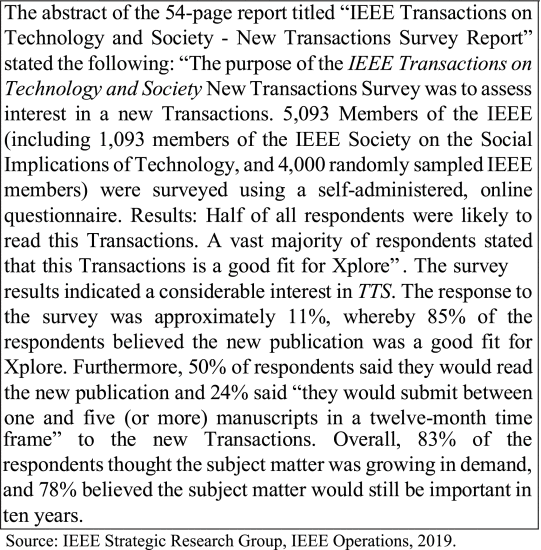
TABLE II IEEETTS - New Transactions Survey Report 2018
The decision to proceed with an SSIT-backed transactions had financial implications for the small society with direct impacts on human resources. In 2016, after two years of BOG discussions about the possibility of a Transactions, SSIT VP tasked the then Editor-in-Chief of the IEEE TSM, Professor Katina Michael, to lead the development of a full-length proposal to the Technical Activities Board (TAB) Periodicals Committee, to be submitted at the IEEE headquarters in Piscataway, New Jersey. There were five steps in the process (see Table I) prior to the approval of the Transactions. This was followed by a market survey, conducted in 2018, which is a requirement for a new periodical at the IEEE. The aim of a market survey is to gather quantitative evidence to support the qualitative data being presented by a given Society. SSIT commissioned the survey of the IEEE readership through the IEEE Strategic Research group at the IEEE Operations Center (see Table II). Upon approval, the first issue of the publication launched in March 2020.
This paper presents fundamental outcomes to date and additional background information that can provide readers, prospective authors and (guest) editors with details regarding the Transactions’ scope, coverage, contributions to interdisciplinarity and interdisciplinary fields, and its global-to-local real-world application. Furthermore, this Editorial is dedicated to celebrating the first 4 years of the IEEE TTS as it has reached several milestones. The first milestone is that the publication outlet has experienced an increase in submissions requiring an expansion of its editorial board. This has resulted in the approval of a second Editor-in-Chief, as of May 9, 2023, and the establishment of a Co-Editors-in-Chief (Co-EICs) model within SSIT [1]. It is also exemplified in the recent call for up to 7 Senior Editors and 30 Associate Editors [2]. The journal has additionally undergone significant and sustained accelerated growth since the beginning of 2022, as demonstrated by IEEE Xplore Analytics, in terms of monthly HTML views and full-text PDF downloads [3]. The second milestone is that the TTS has participated in its first full Periodicals Review and Advisory Committee (PRAC) evaluation, a mandatory assessment mechanism for all IEEE periodicals.
The remainder of this Editorial provides further background information in Section II, details pertaining to scope and coverage of TTS in Section III, an overview of papers published since the launch of the journal in Section IV, with our TTS vision presented in summary in Section V. In Section VI we present an afterward incorporating TTS’ foundational pillars. Finally, the papers in the December 2023 issue of the Transactions are identified and summarized in Section VII.
SECTION II.
Background: About IEEE TTS
Fig. 1. IEEE TSM Covers 2013–2017 [10].
In 2016, SSIT began discussion around the introduction of a periodical to complement the award-winning IEEE Technology and Society Magazine (TSM)[5], published since January of 1982 (see Fig. 1 for the quarterly covers of IEEE TSM published between 2013–2017), and the long-standing IEEE SSIT Newsletter[6]. Following the success of IEEE TSM in the prestigious FOLIO Awards [7], [8], it was felt necessary to expand the SSIT publications portfolio with a view to host highly developed research that would make major contributions to theory and practice in the social implications of technology.
The intention was that a transactions-level publication would grow over time to become SSIT’s flagship technical publication appealing to both IEEE members and constituents, and external stakeholders, given the deliberate interdisciplinary focus and desire to support truly transdisciplinary projects and outcomes. The new periodical would also seek to be the catalyst in addressing the historical tensions associated with publishing high quality and impactful interdisciplinary and transdisciplinary work [9]. For instance, there are limitations and constraints that are commonly experienced by interdisciplinary scholars and stakeholders, both individually and collectively, as they navigate academic pressures.
SECTION III.
The Established Scope and Fields of Interest of TTS
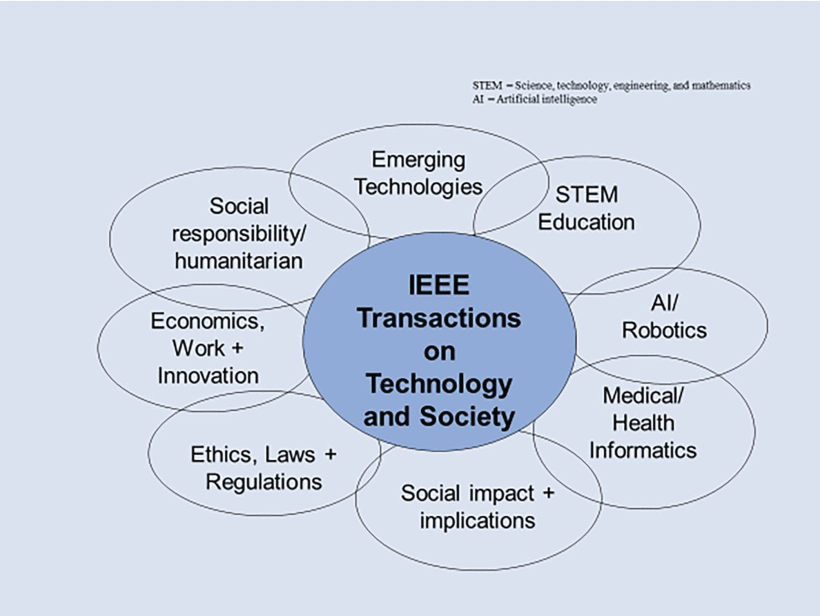
Fig. 2. IEEE TTS Scope
IEEE TTS[11] publishes research papers on the interactions between technology and society, and the impact of such interactions at the individual (micro), organizational (meso) and societal (macro) levels. The focus also extends to ethical, professional, and social responsibility in the practice of science, technology, engineering and mathematics, creating and sustaining a forum for open discussion of resultant issues (Fig. 2).
Within this scope, the Transactions covers a broad range of topics in such areas as information and communication technology; the social implications of emerging technologies and innovations; Science, Technology, Engineering, Arts and Mathematics (STEAM) education; health and safety; life sciences; energy; economic issues; and environmental implications. TTS also addresses issues surrounding professional practice and responsibility; law and regulation; public policy and organizational policy; technology and the future of work; philosophy of technology; bioengineering and sustainability. The Transactions communicates with a wide array of readers from multiple disciplines involved in the societal implications of technology.
The periodical is interdisciplinary with joint perspectives from individuals such as engineers, scientists, technologists, ethicists, informaticians, public policy experts, lawyers, health practitioners, economists, science and technology studies experts, psychologists, political scientists, sociologists, and anthropologists. Papers published in TTS are in-depth papers of original work targeted at technically knowledgeable readers who are not necessarily specialists in the subjects being treated but have an interdisciplinary background in one or more fields of interest. At IEEE TTS our emphasis is on high quality research and empirical studies, applications and technological issues, theoretical arguments supported by evidence or proof, and conceptual framework development, where we generally publish research that:
is empirical and or demonstrates interdisciplinary novelty;
bridges theory and practice;
merges technology and society considerations in a seamless manner;
is methodologically sound;
is potentially supported by additional content in the form of code, original qualitative research, and other media files;
ideally covers inter-/ trans-sectoral partnerships/ stakeholder perspectives; and/or
is globally appealing to both a general, socio-technical and technical audience.
The concept map for the inaugural issue of IEEE TTS can be found in Fig. 3, indicative of our scope, fields and areas of interest and what we publish (see also, [12]). For example, in volume 1, issue 1, the general papers submitted were concerned with issues of design and development of technology, data and processes, and how humans use technology and the corresponding impact and risks to the public. Some of the main social and technical issues that were presented by authors related to access to information and privacy risks, technological exposure and vulnerability, cons of systems and services to users, and citizen health and wellbeing, inclusive of mental health. The ethical use of AI featured prominently in several papers, as well as research into facial recognition and its accuracy among given populations. Appendix A in the supplementary material includes a complete list of concept maps for every issue in the first 4 years of TTS. This can be used as a guide for the kind of content that is received and the socio-technical themes addressed.
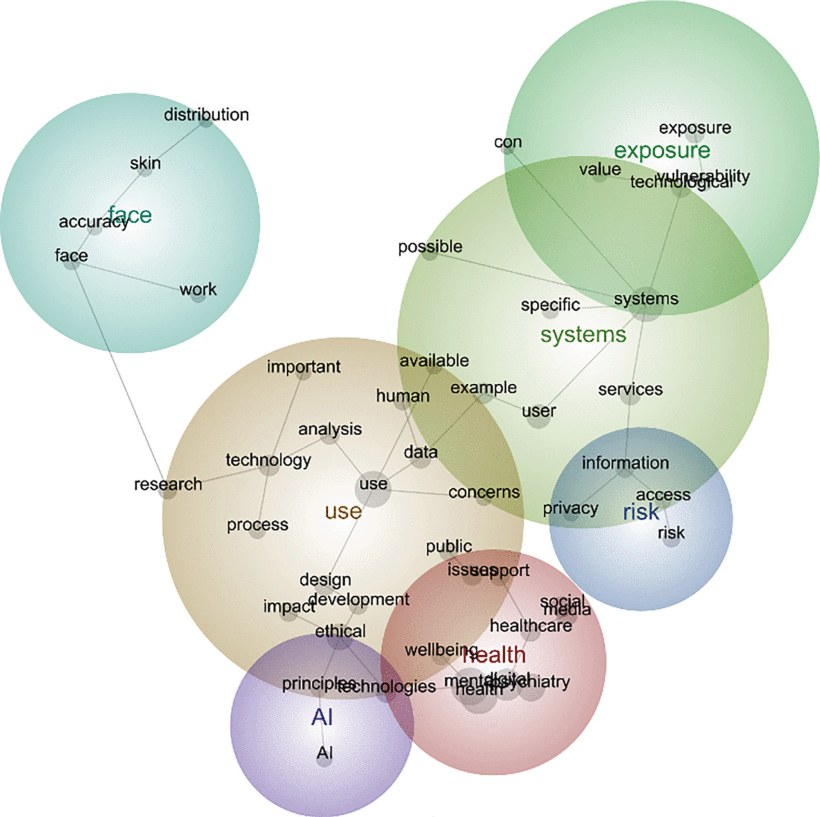
Fig. 3. Concept Map of the inaugural IEEE TTS March 2020 Vol. 1/ No. 1 issue.
SECTION IV.
Celebrating the First Four Years: Papers Published From 2020–2023
Fig. 4. IEEE TTS Covers 2020–2023.
Since its launch, TTS has undergone significant growth, where sixteen full issues have been published (see Fig. 4). In the first year, 192 pages were budgeted, and that number has increased to 352 pages in 2023. In the period since the creation of IEEE TTS, the periodical has incorporated 112 articles into 4 volumes in 1,092 total pages [see Appendix B in the supplementary material]. The total number of papers have included EIC/Co-EIC/Co-Editor editorials, special calls, special issue guest editorials, and original research pieces. The journal has additionally had 325 different affiliations registered for the articles that have appeared in its corpus [refer to Appendices C and D in the supplementary material].
A. Citations and Downloads Snapshot
Table III presents the top 25 most cited articles in the IEEE TTS according to Scopus cited works, current as of January 2024. For a complete listing of citations per paper, see Appendix F in the supplementary material for Scopus listings, and Appendix G in the supplementary material for Google Scholar listings. Table IV presents the top 25 most downloaded/viewed articles in the IEEE TTS corpus according to IEEE Xplore. For a complete listing of most downloaded/viewed articles see Appendix H in the supplementary material. In terms of thematic coverage, the two most cited works according to Scopus pertain to themes of biometrics, [AI/algorithmic] bias, and facial recognition, while the top three cited articles in IEEE Xplore focus on artificial intelligence.
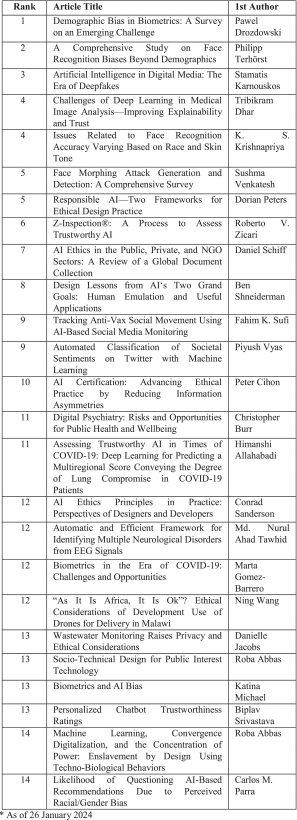
TABLE III The Top 25 Most Cited Articles in IEEETTS 2020–23 According to IEEE/Scopus Listings
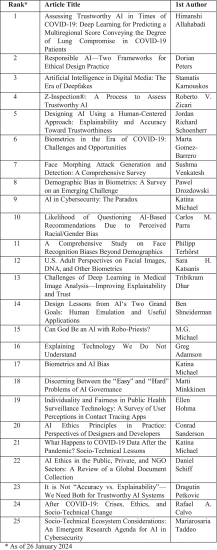
TABLE IV The Top 25 Most PDF Downloads/Viewed Articles in IEEETTS 2020–2023 According to IEEE Xplore
B. Semantics, Concept Maps and Usage
The main themes addressed in the IEEE TTS corpus are illustrated in Fig. 5. The top 10 semantic terms are: information, technology, system, data, research, example, con, work, development, and process. Much can be summated about the kinds of articles submitted to IEEE TTS from this high-level semantic word cloud; for example, there is a notable emphasis on the ‘con’ or undesirable consequences of technology and the corresponding link with systems, data, development environments and processes embedded within a real-world context or explored through a representative example.
Fig. 5. Main Themes Covered in IEEE TTS 2020–2023.
Furthermore, the top 100 words appearing in articles published in IEEE TTS are shown in Fig. 6, and include social, human, public, people, need, work, time, use, impact, ethical, privacy, potential, con, AI, analysis, design and development, among other terms. This is a direct call to authors who research in this space to contribute work related to the main or auxiliary terms shown in this word cloud.
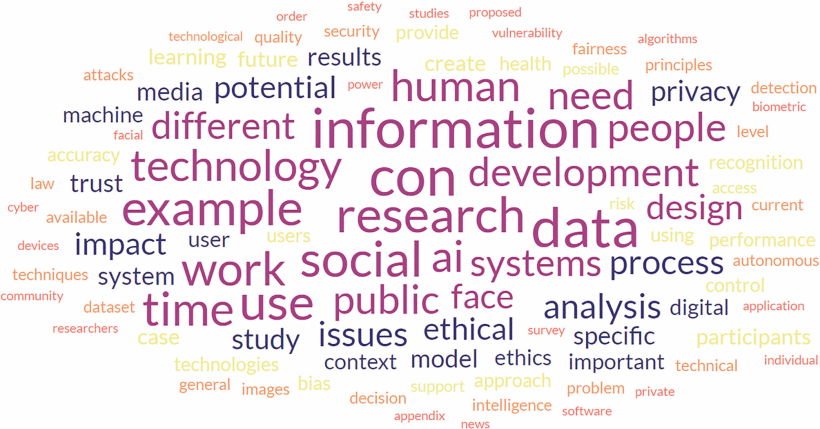
Fig. 6. Top 100 IEEE TTS 2020–23 Articles Word Cloud.
According to the IEEE Xplore generated thesaurus, 322 prominent terms feature in IEEE TTS articles (Table V). For example, the term “ethics” featured in 37 articles, “AI” in 36 articles, “law” in 18 articles, “social networking” in 14 articles, “COVID-19” in 12 articles, “stakeholders” in 12 articles, “government” in 12 articles, “privacy” in 11 articles, “facial recognition” in 10 articles, “medical services” in 10 articles, “technological innovation” in 10 articles, and “machine learning” in 10 articles. The breadth and depth of the terms featured in Appendix I in the supplementary material further confirms the motivation behind the need to create IEEE TTS as an outlet publishing high-quality interdisciplinary research.
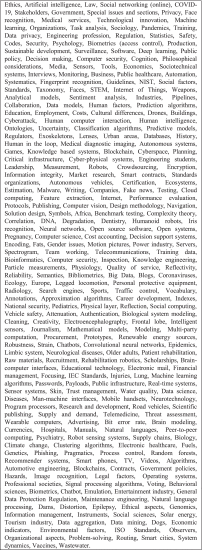
TABLE V IEEE Generated Thesaurus on IEEETTS 2020–23
Fig. 7 depicts the steady growth of IEEE TTS in terms of readership, representing accelerated growth since 2022 resulting from increased international exposure and recognition of the periodical by the IEEE, the broader academic community and beyond. Supplementary to growth statistics, Fig. 8 highlights global reach, relative usage, and article access.
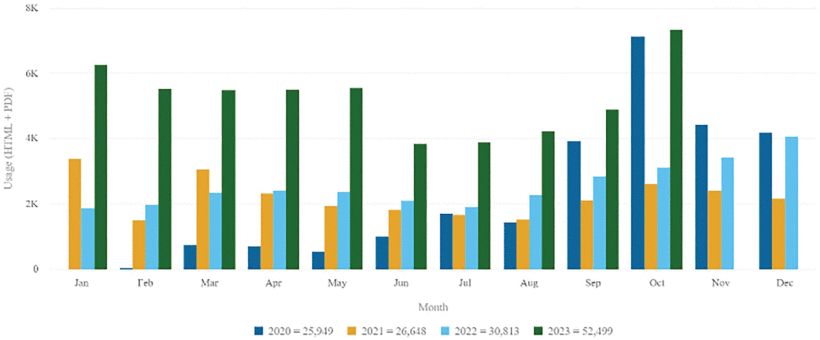
Fig. 7. Total Usage Statistics 2020–x2023.
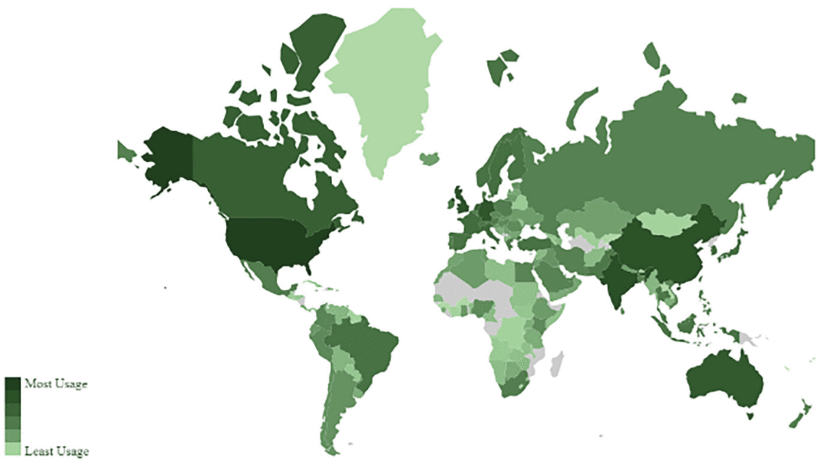
Fig. 8. Global Usage of IEEE TTS Articles 2020–2023.
The top 24 countries with more than 1,000 downloads of TTS articles, in order of count, include: United States, India, China, United Kingdom, Germany, Australia, Canada, Netherlands, Italy, Taiwan, Province of China, Republic of Korea, France, Japan, Sweden, Hong Kong, Brazil, Turkey, Norway, Spain, Finland, Singapore, Switzerland, and Indonesia. One can derive from this list that “technology and society” issues are pertinent areas of discussion internationally, and that the truly global nature of the publication in authorship and readership was well anticipated. IEEE TTS is a focal point drawing studies from across the globe to participate in the presentation of key works on the social implications of technology.
For a complete listing of papers published in the first 4 volumes of IEEE TTS and a detailed overview of peer-reviewed paper summaries, see Appendix J in the supplementary material. End-to-end index subjects covered, and individual author/co-author listings are also available for each volume [13], [14], [15], [16].
C. Special Issues 2020–2023
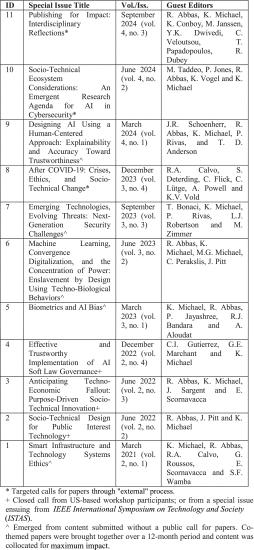
TABLE VI Special Issues Published in IEEE TTS Since 2020
Since 2020, 11 special issues have been published (Table VI) in IEEE TTS, including collections stemming from international projects, conferences, and workshops (e.g., with The Alan Turing Institute/ Oxford Internet Institute/ U.K. National Cyber Security Centre, among other entities). It is also important to note that members of the Senior Editor team have led special issues, thereby setting a standard and benchmark for desired special issues within the Transactions and aiding in the establishment of a global TTS network, increased exposure and the amalgamation of disparate communities (e.g., Rafael A. Calvo of Imperial College London led a guest edited issue “After COVID-19: Crises, Ethics, and Socio-Technical Change” in volume 3, issue 3). Example special issues contributed to by the Senior Editor team included: volume 2, issue 1 on “Smart Infrastructure and Technology Systems Ethics” and volume 2, issue 3 on “Anticipating Techno-Economic Fallout: Purpose-Driven Socio-Technical Innovation,” in addition to other issues. The following Associate Editors also contributed to guest edited issues and accompanying editorials: Jordan Richard Schoenherr, Pablo Rivas, Theresa D. Anderson, Anas Aloudat, Tamara Bonaci, Lindsay J. Robertson, Michael Zimmer, and Jason Sargent. The TTS Editorial Board is also proactively seeking special issue proposals [17].
SECTION V.
Celebrating and Supporting Impactful Interdisciplinary Work: Our Vision
IEEE TTS is emerging as a leading interdisciplinary outlet globally, demonstrated in the quality, breadth, and representation of published manuscripts. That there is an interdisciplinary transactions-level periodical in a technical institute such as the IEEE, supported by an established society such as SSIT, is certainly worth celebrating. Through initiatives and outlets such as TTS, the IEEE can point to advancing humanity through the careful consideration of ethical, legal and social implications of technology. IEEE TTS therefore fills a gap in facilitating dialogue between disparate fields relevant to technology and society.
As we continue to strive for excellence, a range of innovations and processes will be instituted relating to our policies and procedures, Editorial Board and internal network, community outreach, training opportunities for diverse stakeholders, industry engagement, impact-related projects, and support of academic and other stakeholders in the public interest and through an interdisciplinary emphasis. Our vision is for continued development toward a globally recognized interdisciplinary publication outlet that both supports and celebrates truly interdisciplinary work. The research community has enthusiastically responded to our vision, and the first four years have provided ample validation for this initiative. Thus, we invite you to join us in this endeavor and in celebrating the first four years of IEEE TTS.
SECTION VI.
Afterward
We send our appreciation to those on the inaugural IEEE TTS editorial board, steering committee, publications board, co-editors, reviewers, administrator and managing editor for their dedicated collaboration in the establishment of a reputable outlet that aligns with multi-stakeholder perspectives [18]. We also thank the authors who supported IEEE TTS from its inception, believing in its mission and vision, and sharing in our hopes for a future where real-world problems could be addressed through sustainable solutions [19]. Your papers are meaningful, within and beyond academia. They can change the world and begin dialogues afresh. They can inspire a future generation. We can never underestimate the power of the word to ignite action.
As we reflect on our journey to date, we have remained faithful to the history of SSIT, established more than 50 years ago by conscientious and diligent engineers who dealt with criticism despite their pioneering efforts to introduce ethics into the profession to ensure the health and safety of citizenry. This history also includes 42 volumes of IEEE TSM carefully curated by eleven editors-in-chief [see Appendix K in the supplementary material], that showcased technological controversies and potentials that are still being discussed today and propelled further through technological convergence and a multiplicity of global tensions. Additionally, consecrated by annual SSIT sponsored international conferences (e.g., the International Symposium on Technology and Society (ISTAS) since 1989 [refer to Appendix L in the supplementary material]), SSIT members have provided a suitable forum for people to discuss both their hopes and fears with respect to the social implications of technology, and potential ways forward. These gatherings remind us that we are not alone, that there is a community of interdisciplinary thinkers that seek to better design systems for users, indeed every human being, and every facet of life for generations to come, mitigating the risks that so often are a byproduct of technological innovation.
And, if we have learnt anything at SSIT, it is that humans have agency and that we must be considered an integral part of any system. We are not at the mercy of our technological breakthroughs. We are able to shape how we use the tools we invent, and in what we invest our time and money. Additionally, we are accountable for the technologies we design, develop and implement and must therefore adhere to the highest ethical standards and assume responsibility for these technologies. To be sure, we come to an awareness of our strengths, individually and collectively empowered through public interest technology initiatives [20], as our shared voice manifests through culture, grassroots narratives, beliefs and experiences. A monthly IEEE SSIT Newsletter now exists which continues to share news with thousands of subscribers worldwide, consistently containing notable outcomes, announcements, and opportunities for event participation and other calls. The Society’s web site https://www.technologyandsociety.org has also provided access to freely available content pertaining to technology and society and is synced with social media accounts that have enjoyed a growing subscriber base. Each of these are SSIT assets and we need to cultivate their continued development, and ensure succession planning within the membership and throughout all IEEE regions [21], to have the greatest impact globally, though all change is local and driven by context. While our tools have commercial value, we would rather shift the emphasis to our greatest assets: our people and the places within which they reside. This is what we leave behind as a legacy to future generations. And in this article, we celebrate the beginnings of our latest conception: IEEE TTS.
A. Foundational Pillars
When we established IEEE TTS, a number of us came together to discuss what our foundational pillars for the Transactions would be and how these would form a schema. We had known one another for decades, and worked together on a number of projects that interfaced on the boundaries of disciplines, where new discoveries are found. We had deep respect for each other’s intellect, experience, and application in academia, industry, not-for-profits, non-government agencies, and other community/professional services. We knew that decisions in the real-world were never made by a single entity and we sought to collaborate to infuse the academic research process with our learnings and lifeworlds from within and outside academia. We thus chose to build our Transactions on ten pillars that have served till today as the fundamental basis for the kinds of manuscripts we have attracted and continue to publish.
1) Human Responsibility:
When confronted with an idea for an innovation, engineers typically think of the question: “Can we do this?” Additional questions may also include: “Should we do this?” and if so, “How should we go about this to get the most beneficial outcome for all?” These added research dimensions are distinct in the technology and society interdisciplinary space. Technologists are increasingly concerned with de-risking and how they can get the best product to market in the shortest amount of time and within budget. Good technology requires adequate time and funding; it also requires humans to adequately manage technology and execute on their responsibility in a given role, with commensurate succession planning and hand-off. Humans are ultimately responsible for the products and processes that are diffused into the market.
2) Multi-Stakeholder Decision-Making:
Decisions about technology often do not incorporate stakeholder perspectives. This research space is where technical decisions and human values intertwine. Papers in the Transactions should feature that interplay wherever relevant. Business and government entities should strive to incorporate different voices to ensure better decisions are made for all with long-term positive impacts.
3) Scholarship and Advocacy:
Many existing publications allow for advocates to write persuasive pieces of journalism on themes related to issues of technology and society, but very few require claims to be supported with academic rigor using primary sources of evidence. The Transactions emphasizes scholarship and welcomes advocacy supported by primary evidence. Already IEEE TTS has published works from STEM-qualified independent researchers working in their local municipalities representing citizens with respect to emerging technologies in their geographic locale.
4) Interdisciplinarity:
The Transactions addresses the effect of technology on society and how society shapes technology. TTS explores ways in which societal needs are driving technological developments, and industry is diffusing technology into the market with government agency oversight. The research analysis by its very nature is typically interdisciplinary: it can be multi-dimensional, multi-paradigmatic, trans-sectoral, and transdisciplinary. By bringing researchers from differing disciplines, organizations and institutions together, a variety of theories and methodologies may be explored to address a given problem in a novel way.
5) Funded Grant Projects, Non-Funded Initiatives and Real-World Case Examples:
The Transactions will typically present strategies for responsible development in projects and real-world case examples. These projects will study socio-technical systems, their elements, and new design spaces. Projects that assemble more than one stakeholder to investigate a real-world case example(s) are publishable in IEEE TTS so long as they follow a rigorous research process. We also encourage project oversight by an independent third party that can ensure that these processes are followed accordingly. These projects can demonstrate the benefits of technology on society, and provide lessons learned going forward for other stakeholders and grant bodies, as well as how to overcome challenges and prevent pitfalls.
6) Insights:
The Transactions offers insights into emerging technologies by providing primary evidence through field observations, usability testing, industry perspectives, governmental positions, and analysis of social phenomena affected by technology. These insights can be presented at any stage of the innovation process: invention, commercialization (e.g., market testing, pilot, policy sandbox), as well as widespread diffusion. Patents, product lifecycle management (PLM), in addition to maintenance and product recalls (e.g., hazards, warnings, and safety related information), provide insight about current future innovations and innovation processes.
7) Theory:
Transactions articles must incorporate theory, theoretical frameworks, theoretical extensions, and/or new applications of theory. This is fundamentally what distinguishes the Transactions from the Magazine. Theory development goes beyond the amalgamation of one or more theories but requires comprehensive definitions with adequate historical antecedents of terminology, testing, validation and end-to-end proofs.
8) Methodologies:
The Transactions publishes works on socio-technical systems that adopt a research process using one or more methodologies applicable to the research phenomenon being studied in the technology and society space. These may include but are not limited to: case studies, interviews, focus groups, observations, ethnographies, surveys, questionnaires, Delphi studies, improved algorithmic approaches, experiments, the development of products and artefacts. Participatory action research, and participatory research methods, innovative new data collection and analysis techniques are encouraged (e.g., video analytics and sentiment analysis); as are traditional multi-method and mixed-method approaches (regression analysis, content analysis). Human research ethics/ internal review board approvals must be acknowledged by the institution or organization of the researcher(s).
9) Evidence:
The Transactions encourages evidence-based research using primary sources. This evidence may be gathered directly from humans or non-humans through direct interaction. Indirect interaction may occur when a human or animal carries or wears/ bears a machine that collects data from the human/ animal subject (or proxy) and also gathers data from the environmental context. Data may emanate from confined short-term projects or even longitudinal studies; conducted at varying units of analysis. Algorithms, simulations, raw data sets (qualitative or quantitative) are welcome to be presented in the form of additional media files published in IEEE Xplore or through IEEE’s Data Port [22] or Code Ocean [23]. This data should have been collected with informed consent, and be anonymized prior to being deposited so that no identifying information is contained within the file. Other researchers should be able to gain access to the data set, and incorporate it into their own studies or further research by citing the respective DOI. Secondary sources of evidence are welcome, but their storage is subject to ethical guidelines and/or copyright notices. Open source intelligence (OSI) or public sector information (PSI) may be used in studies but the chief investigators of the project need to have informed the community of stakeholders (e.g., on a microblogging service). IEEE TTS does not condone web scraping or unauthorized surveillance of private communities.
10) Clear Outcomes:
Transactions papers should provide clear outcomes that are actionable, such as design improvements, new tools for science and technology, community engagement, technology impact assessments and other evaluative assessments, and policy recommendations. We are thus moving from a model where papers are the only outcomes that matter, to one where individual data sets that can be shared with the rest of the research community and built upon may be considered outcomes. We are furthermore exploring other forms of impact derived from respective project outcomes and specifically from open data sharing practices across a range of project and geographical contexts, where feasible.
We hope that you might consider the adoption of these foundational pillars in your research, your research teams, and respective institutions and organizations, and contribute your outcomes to IEEE TTS.
SECTION VII.
In This Issue
The December 2023 issue is a general issue and as is custom in our editorials, we present a succinct summary of each of the papers. The first paper [1] is written by Alex John London and Motahhare Eslami from Carnegie Mellon University, Yosef S. Razin and Jason Borenstein from Georgia Institute of Technology, and Russell Perkins and Paul Robinette from the University of Massachusetts, USA. The work was supported by a National Science Foundation Grant IIS-2112633. The paper investigates the ethical issues pertaining to smart assistants for older adults as they experience cognitive decline, and how these technologies can act to mediate social interactions that may result in prosocial behaviors between other members in a social setting or support networks. The work considers whether these kinds of interventions may offer caregivers more utility and grant older adults greater autonomy and independence.
The second paper [2] is written by three researchers at Virginia Tech, Timothy R. Pote, Nicole V. Asbeck and Alan T. Asbeck. The work was supported by the National Science Foundation under Grant 1718801. The paper explores how exoskeletons are being used in industrial workplaces and whether an employers’ mandate in order to mitigate worker injuries raises any ethical concerns given the power asymmetry between employer and employee. The paper explores whether exoskeletons can be fitted to all employees for reasons of body shape and size, whether workers may have privacy concerns given exoskeletons require to be fitted to measure appropriately, and whether or not it is right to add additional work tasks given the exoskeleton perceived advantage. Two frameworks are used to examine these issues and others inclusive of ways to overcome fundamental challenges of exoskeletons in the workplace.
The third paper [3] is written by Claas Digmayer of Rheinisch-Westfalische Technische Hochschule Aachen and Gregory P. Pogue of The University of Texas at Austin. The article is supported by an interdisciplinary research project ‘DC Socio-Economics: Niche Readiness and Market Diffusion of DC Technologies’ and is funded by the Federal Ministry of Education and Research (BMBF, FKZ 03SF0592), Flexible Electrical Networks (FEN) Research Campus. This paper uses interviews to identify community values and governance preferences with respect to the use of sustainable energy technologies. What do citizens want to happen? What are the underlying values of citizens toward energy use and how might this knowledge be harnessed demonstrator projects that might raise awareness further? The results of the study show that there are five values that influence perceptions of energy use in communities and these are: (1) growth, (2) independence, (3) sustainability, (4) affordable living, and (5) mobility.
The fourth paper [4] is co-authored by an international team led by K. Ahmad of Jeonbuk National University in South Korea. The co-authors include: M.A. Ayub and Nasir Ahmad from the University of Engineering and Technology, Peshawar, Pakistan; K. Ahmad with Munster Technological University, Cork, Ireland; J. Khan with AJOU University, Suwon, South Korea and A. Al-Fuqaha with Khalifa University, Doha, Qatar. The work was supported by the National Priorities Research Program (NPRP) under grant 13s-0206–200273 from the Qatar National Research Fund and focuses on an important environmental challenge that potentially affects every human being. The paper explores how we address the challenge of water quality by analyzing social media sources to be harnessed as an immediate feedback loop.
The fifth paper [5] is written by three authors from the Universidade de Vigo, in Luis A. Lopez-Valcarcel, Manuel Garcia Sanchez, and Enrique Costa-Montenegro. The work was supported by the Life Program of the European Union (Project Life16 Env/ES/000559, LifeTEC). The article is a case study of how locative communications technology, specifically geolocation data can assist emergency services in the field, even if network coverage is unavailable. The work presents a successful pilot of the proof of concept with first responders in the fire department and successfully validates the deployment of the LifeTEC application where the location of assets (human, machine and fixed or mobile infrastructure) can be presented on a visual map that can assist operations coordinators who are deployed in the field to make better and more timely decisions given extreme weather conditions. The case study demonstrates the utility of the platform outdoors, especially where there is limited or no alternative mobile coverage.
The sixth paper [6] is written by lawyer Michael Anthony C. Dizon of Curtin University in Australia (our only sole-authored article for the December issue). The work was supported by the New Zealand Law Foundation under Grant 2017/ILP/10 and the University of Waikato through the ENCRYPT and DECIPHER Research Project. The paper studies encryption from the viewpoint of technology, law and policy and emphasizes the importance of ensuring information security and data privacy but also acknowledges that encryption can also be used for nefarious purposes. Dizon conducts primary research into the importance of trust in security and examines the problem from three stakeholder types, inclusive of the general public, business and government entities. In particular, four direct objects of trust are studied with respect to encryption including: the technology, particular persons of interest, institutions, and other stakeholders who are involved in encryption. The article’s contribution is in emphasizing the need for regulation around encryption itself.
The seventh paper [7] has four authors led by Dirk van der Linden Northumbria University, U.K. and is co-authored by Brittany I. Davidson of the University of Bath, U.K.; Orit Hirsch-Matsioulas and Anna Zamansky from the University of Haifa is Israel. In a highly illustrative piece, the work supports more than just textual descriptions, and incorporates both qualitative and quantitative data to provide evidence of how digital technologies help people take care of their dogs. This piece speaks of the opposing technological forces at play toward dystopian and utopian visions of the future by using the human-dog bond as a metaphor. It poses the question whether technology will take on the human’s role and negatively impact the human-dog bond, or rather will it augment human abilities in support of the human-dog bond. The thematic analysis has potentially far-reaching applications and implications. The underlying premise is one where the reader must consider how technology can support us in becoming better and more informed caregivers rather than a destructive fatalistic scenario where the human-dog relationship is utterly disentangled.
ACKNOWLEDGMENT
To every volunteer and IEEE staff member who has supported the charter of IEEE TTS through their expertise since its proposal, approval, development and distribution, we extend a warm thank you for your dedication to the cause of interdisciplinarity.
Appendix: Related Articles
A. J. London, Y. S. Razin, J. Borenstein, M. Eslami, R. Perkins, and P. Robinette, “Ethical issues in near-future socially supportive smart assistants for older adults,” IEEE Trans. Technol. Soc., early access, Jan. 16, 2023, doi: 10.1109/TTS.2023.3237124.
T. R. Pote, N. V. Asbeck, and A. T. Asbeck, “The ethics of mandatory exoskeleton use in commercial and industrial settings,” IEEE Trans. Technol. Soc., early access, Apr. 5, 2023, doi: 10.1109/TTS.2023.3264807.
C. Digmayer and G. P. Pogue, “Using community values and governance preferences to facilitate transitions towards sustainable energies,” IEEE Trans. Technol. Soc., early access, Jan. 26, 2024, doi: 10.1109/TTS.2024.3358984.
K. Ahmad, M. A. Ayub, K. Ahmad, J. Khan, N. Ahmad, and A. Al-Fuqaha, “Social media as an instant source of feedback on water quality,” IEEE Trans. Technol. Soc., early access, Jul. 8, 2022, doi: 10.1109/TTS.2022.3189568.
L. A. López-Valcárcel, M. G. Sánchez, and E. Costa-Montenegro, “LifeTEC: A compact and economic system for in-the-field management of firefighting services through TETRA,” IEEE Trans. Technol. Soc., early access, Nov. 28, 2023, doi: 10.1109/TTS.2023.3336963.
M. A. C. Dizon, “The value of trust in encryption: Impact and implications on technology law and policy,” IEEE Trans. Technol. Soc., early access, Jan. 18, 2023, doi: 10.1109/TTS.2023.3237987.
D. V. D. Linden, B. I. Davidson, O. Hirsch-Matsioulas, and A. Zamansky, “On the role of technology in human-dog relationships: A future of nightmares or dreams?” IEEE Trans. Technol. Soc., early access, Sep. 20, 2022, doi: 10.1109/TTS.2022.3207991.
References
1. T. Bookman, “Roba Abbas appointed new co-editor-in-chief of IEEE Transactions on Technology and Society,” IEEE Transactions on Technology and Society, vol. 4, no. 2, pp. 110–111, Jun. 2023, doi: 10.1109/TTS.2023.3280757.
2. K. Michael and R. Abbas, “Call for senior editors and associate editors of the IEEE Transactions on Technology and Society,” IEEE Transactions on Technology and Society, vol. 4, no. 3, pp. 196–198, Sep. 2023, doi: 10.1109/TTS.2023.3313449.
3. IEEE, “Xplore Analytics,” Jan. 26, 2024. [Online]. Available: https://xploreanalytics.ieee.org/
4. Clarivate, Journal Citation Reports, 2023. [Online]. Available: https://clarivate.com/products/scientific-and-academic-research/research-analytics-evaluation-and-management-solutions/journal-citation-reports/
5. IEEE Xplore, “IEEE Technology and Society Magazine,” [Online]. Available: https://ieeexplore.ieee.org/xpl/RecentIssue.jsp?punumber=44
6. IEEE Society on Social Implications of Technology (SSIT), “SSIT Newsletter,” Jan. 26, 2024. [Online]. Available: https://technologyandsociety.org/ssit-newsletter-2/
7. T. Bookman, “T&S Magazine Wins STC Award,” IEEE Society on Social Implications of Technology, 2016. [Online]. Available: https://technologyandsociety.org/ts-magazine-wins-stc-award/
8. FOLIO:, “2024 Eddie & Ozzie Awards,” Jan. 26, 2024. [Online]. Available: https://www.eddie-ozzie.com/
9. R. Abbas et al., “Publishing for impact: Interdisciplinary reflections,” IEEE Transactions on Technology and Society, vol. 4, no. 3, pp. 201–217, Sep. 2023, doi: 10.1109/TTS.2023.3318396.
10. IEEE Xplore, “IEEE Technology and Society Magazine,” [Online]. Available: https://ieeexplore.ieee.org/xpl/RecentIssue.jsp?punumber=44. (Duplicate of Ref. 5.)
11. IEEE Xplore, “IEEE Transactions on Technology and Society,” [Online]. Available: https://ieeexplore.ieee.org/xpl/RecentIssue.jsp?punumber=8566059
12. K. Michael and R. Abbas, “Call for senior editors and associate editors of the IEEE Transactions on Technology and Society,” IEEE Transactions on Technology and Society, vol. 4, no. 3, pp. 196–198, Sep. 2023, doi: 10.1109/TTS.2023.3313449. (Duplicate of Ref. 2.)
13. “2020 Index IEEE Transactions on Technology and Society, vol. 1,” IEEE Transactions on Technology and Society, vol. 1, no. 4, pp. 193–196, Dec. 2020. [Online]. Available: https://ieeexplore.ieee.org/stamp/stamp.jsp?tp=&arnumber=9359906
14. “2021 Index IEEE Transactions on Technology and Society, vol. 2,” IEEE Transactions on Technology and Society, vol. 2, no. 4, pp. 217–221, Dec. 2021. [Online]. Available: https://ieeexplore.ieee.org/stamp/stamp.jsp?tp=&arnumber=9639886
15. “2022 Index IEEE Transactions on Technology and Society, vol. 3,” IEEE Transactions on Technology and Society, vol. 3, no. 4, 2022. [Online]. Available: https://ieeexplore.ieee.org/stamp/stamp.jsp?tp=&arnumber=10004495
16. “2023 Index IEEE Transactions on Technology and Society, vol. 4,” IEEE Transactions on Technology and Society, vol. 4, no. 4, 2023.
17. K. Michael and R. Abbas, “IEEE Transactions on Technology and Society call for special issue proposals,” IEEE Transactions on Technology and Society, vol. 4, no. 3, pp. 199–200, Sep. 2023, doi: 10.1109/TTS.2023.3315029.
18. “Masthead,” IEEE Transactions on Technology and Society, vol. 4, no. 3. [Online]. Available: https://ieeexplore.ieee.org/stamp/stamp.jsp?tp=&arnumber=10298649
19. National Academy of Engineering, “NAE Grand Challenges for Engineering,” 2024. [Online]. Available: https://www.engineeringchallenges.org/challenges.aspx
20. R. Abbas, J. Pitt, and K. Michael, “Socio-technical design for public interest technology,” IEEE Transactions on Technology and Society, vol. 2, no. 2, pp. 55–61, Jun. 2021, doi: 10.1109/TTS.2021.3086260.
21. IEEE, “IEEE Membership,” 2023. [Online]. Available: https://www.ieee.org/membership-catalog/productdetail/showProductDetailPage.html?product=MEMIEEE500
22. IEEE, “IEEE DataPort,” Jan. 26, 2024. [Online]. Available: https://ieeedataport.org/
23. IEEE, “IEEE Code Ocean,” Jan. 26, 2024. [Online]. Available: https://innovate.ieee.org/ieee-code-ocean/
Supplemental Items
Description - Facts and Figures
DOI: https://ieeexplore.ieee.org/ielx7/8566059/10475509/10475510/tts-3360830-mm.zip?arnumber=10475510
Authors
School for the Future of Innovation in Society, Arizona State University, Tempe, AZ, USA
School of Computing and Augmented Intelligence, Arizona State University, Tempe, AZ, USA
School of Business Faculty of Business and Law, University of Wollongong, Wollongong, NSW, Australia
School of Computing and Mathematical Sciences Birkbeck College, University of London, London, U.K.
Citation: K. Michael, R. Abbas and G. Roussos, "Celebrating the First Four Years of IEEE TTS," in IEEE Transactions on Technology and Society, vol. 4, no. 4, pp. 280-290, Dec. 2023, doi: 10.1109/TTS.2024.3360830.