Capitalism and the Enchanted Screen: Myths and Allegories in the Digital Age
Citation: M. G. Michael and K. Michael, "Capitalism and the Enchanted Screen: Myths and Allegories in the Digital Age—Aleks Wansbrough (London, U.K.: Bloomsbury Publishing, 2021, 232 pp.)," in IEEE Technology and Society Magazine, vol. 41, no. 2, pp. 10-13, June 2022, doi: 10.1109/MTS.2022.3173354.
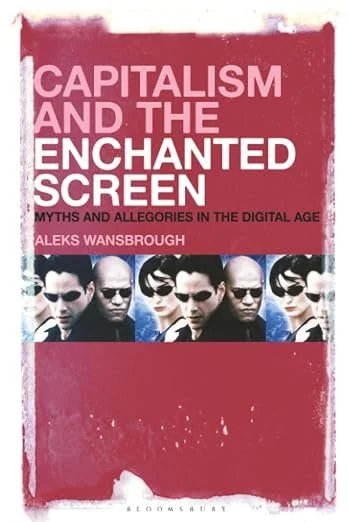
In the book titled Capitalism and the Enchanted Screen: Myths and Allegories in the Digital Age, Aleks Wansbrough takes us on a journey of myths and allegories in the digital age. He not only provides an avenue for us to comprehend how screens are changing our life and world, but also compellingly argues that capitalist forces are behind this fascination with what seems a magical technology.
By referencing dozens of science-fiction classics, Wansbrough presents key moments in the film, extrapolating their meaning, and points to age-old myths that we are faced with today. He emphasizes that much of the current underlying phenomena of our technological fascination, collectively with their categories of meaning, are not new, despite the medium itself is new.
Wansbrough’s depth and breadth of reading is apparent, as he seamlessly interweaves technology and cultural production, political analysis, and the economics of power, illustrating the precise execution of myths, for example, Narcissus’s reflection, and the allegory of Plato’s Cave. It seems as if nowadays we are revisiting ancient myths, much as Freud employed Oedipus, together with their perils and forewarnings in new and innovative ways. These regularly point to online media subcultures connected to the preoccupation with the “self” as the center of the total personality at the increasingly harmful diminishment of all our other relationships.
As readers, we learn that our emerging technologies are so alluring today because of their proliferation and pervasiveness. They not only penetrate in terms of mass-market adoption, but they also penetrate our psychological state, and soon they will even penetrate our very being in the physical sense by way of their embeddedness. This is the supreme form of customer “lock-in” and ultimate dependence for survival and repair on something “other” than the self.
Aleks Wansbrough takes us from the echo of Narcissus embedded in the selfie-taking generation to the application of social media and its political implications, right through to neoliberal institutionalism that affirms the value of interpersonal relationships and yet paradoxically employs the very same technologies it is fighting. These phenomena are clearly having an impact on societal perceptions of the self, the source of introspection and reflexive action, as we have seen a spike in plastic surgeries, and other conditions such as body dysmorphia and personality disorder, as a result of the attention we have placed on the outward appearance.
Wansbrough often refers to the notion of the “happiness effect.” It becomes even more convincing through his explorations that modern society is chasing perfection through the curation of the digital self, and at the same time falling progressively deeper into disconnection with other relationships on the ground. In his chapter, “Interactive Entrapment beyond Plato, Popcorn, and The Matrix,” he compares Plato’s Cave as a cinema to Plato’s Internet, and critiques changes in art, referring to Socrates and his description of how emergent forms of entertainment, for example, poetry that was performed, could well arrest our minds rather than inform them of knowledge.
Guy Debord’s theory of the spectacle is presented in the context of the use of modern technologies and Wansbrough describes it all as “Disnified” and at the same time dizzying. It is in this chapter that Wansbrough cites The Matrix extensively He uses Debord’s spectacle theory, noting that the reason why people are hooked up to power machines is because they perceive the machines to be standing for capitalism, shifting the individual from heavy labor work toward cognitive labor that requires the mind’s energy to engage in a kind of simulated reality toward conformity with the capital ideal.
It is in fact a contradiction that the reader is faced with, in Chapter 3, that with all of this seemingly powerful technology to connect, we have in fact succumbed even more to coercive propaganda, and one might even argue, to precise propaganda tailored for individual consumption. This leaves us even more powerless than we would want to recognize. It is particularly exemplified, when those who pronounce to be for freedom—the absence of constraints—can only share their message of hope through the very media that they are calling out through which enslavement is occurring.
In the chapter on “Digital Haunting, Vampires, and Time Loops,” we are introduced to a multiplicity of metaphors that continue to be preoccupied with images of the perfect and the frictionless self, always in an artificial happy state. At the same time, our online avatars are immersing us in digital graves. The Internet has a selective memory through its search capabilities, and it will continue far beyond our lifetimes, potentially skewing matters in unexpected ways and creating false narratives of who we really were. In fact, we could even spend a lifetime preoccupied with the screen, while everything around us is disintegrating. It is like a perpetual endless loop is watching other people in action, while we ourselves spend huge amounts of time sitting in a sedentary state of being, which is inhumane. If this is the new capitalism, sitting and watching, and putting our health in jeopardy given our lack of attention to the outside world and to the welfare of our very selves, then anyone observing this perpetual state would think we are entirely miserable in that we have fixated ourselves to the conditions of the zombie-like walking dead. There was television before, of course, one of the fundamental differences we could leave it at home once we left the house, and it was not bidirectional or constantly triangulating our user behavior and viewing patterns with our individual personas.
It is true that while there are those living outlandishly and engaging in unwieldy behavior, some might even say shockingly in reference to the religious, our mindless clicking is propagating someone else’s economic benefit somewhere. At the same time in our own different and secretive ways, we inwardly perish lost in a multitude of disparate media technologies and architectured identities. Wansbrough clearly shows us how easily we can be duped by the machine, and into buying into the machine behind “ the Machine ” which is not the “cogs and wheels” thing in itself but the socio–economic system that propels the myth. If our superstars, at least on the surface, do not know what they stand for and seek to cultivate a “shock and awe” philosophy to sell their merchandise, then how do we expect to raise a generation who can think and act differently? This is certainly not a position of forcing someone’s political or religious worldview onto another, but rather in trying to find a sympathetic meeting place of a shared sensibility.
In Chapter 6, Wansbrough cites the one-time doyen and now dramatically fallen Christian apologist Ravi Zacharias noting that “social media is the new Tower of Babel.” He makes reference to the manner in which those with microphones, that is the powerful, can drown out minority voices demanding social justice. The right and left sides of politics are distinguished in this chapter, and yet share the underlying mechanism by which they communicate and have their positions heard. The left begins to sound a lot like the right notes Wansbrough, citing Angela Nagel, who describes the left as the new moralists. Wansbrough reflects that “without a Tower, we fail to have a God’s eye view of social conflicts and fragmentation engendered by capitalism.” Citing Dean, he notes, “comrade” is about working together, whereas an ally will put in the extra work to grow and develop, but often on a personal level. “To be an ally is to work to cultivate in oneself habits of proper listening, to decenter oneself, to step aside.” While this development sounds positive, Wansbrough echoes Dean in fearing that the concept of ally-ship sometimes risks making politics a therapeutic focus on personal growth at the expense of solidarity, shared goals, and communication.
Perhaps, the most provocative part of the book is in Chapter 7 titled, “The Invisible Cloaks, Rings, and Trappings of the Capitalist Systems.” Here, we learn more about the proliferation of pornography on the Internet, and the fact that perversion pornography, that is the demand for more dramatic pornography and more specialized perversions, has increased as roles in the adult industry have decreased in remuneration due to the reach and access of the online digital form after the collapse of the DVD standard. The question then becomes “where to next?” What comes after this perversion, this extreme point of view (POV) surveillance, if not hate itself through films that escape any reasonable definition with literally murderous endings termed “snuff flicks.” We then have a bizarre linking between the capitalist mentality and this treatment of humans as mere subjects, for purely entertainment purposes.
Contrastingly, in the same chapter, we are given an insight into media monopolies and how they function. The author compares the rise of the world’s largest technology companies from garage to startups and demonstrates the inequity between owners, workers, and end-users. The disparities are shamefully mind-numbing. But what happens when the visionaries who had hoped for freedom of the press and a large number of newspapers with independent editors end up becoming the “Giants” themselves? What is appalling in all of this, in particular, is that the workers are not experiencing the same level of wealth as the “visionaries” own regular increases. Amazon’s CEO, Jeff Bezos, as of May 2018 made $ 3,182 every second. In 2021, the average annual salary of an Amazon worker was only $ 28,446. Bezos raked in that same worker’s annual salary amount in less than nine seconds.
In his conclusion, Wansbrough summarizes very well, stating: “instead of accepting claims that the digital has an animas of its own, my position has been that the digitals’ animas is often manipulated by the capitalist system, the digital screen becoming an enchanted object.” It is apparent that being heard in the 21st century, unless you have a powerful politico-economic system backing you, becomes herculean labor to swim upstream. Readers of social media and the end-user generating the content are left repeatedly trying to remake themselves, augmenting their reality to attract more and more followers. This can lead to many disturbances in everyday life, pressures that individuals do not need, anxieties from digital fatigue, and online competition that can develop into psychotic disorders.
We ask ourselves, surely there must be another way? Because the dystopias we are projecting into a science fiction world, the foundations of which were laid in myths with depictions that could not be displayed unless they were acted out in person all those millennia ago, have been brought to life through the trajectory we are set on today. It is difficult to imagine any other way, despite that futurologists have underscored that in order for us to achieve what we dreamed of with the invention of the Internet, something does have to change. Short of calling the Internet a new religion, Wansbrough points to the notion of a “black pill” (reminding us of Aldous Huxley’s pill-popping Brave New World). He can see how the Internet has connected people together in a virtual congregation, but at the same time, he analogously points out that the Internet does not have embodied structures or a physical manifestation like a church building where people go together and nurture one another. On the Internet, there are no material limits, and dreams can be further heightened.
Wansbrough asks: has the Internet, propelled by capitalist production, paradoxically created digital communism? Wansbrough uses the term to evoke the utopian promise of the Internet. At the level of ideology and hype, the Internet promises this kind of communist ideal where we can all access it for free, where users own the means of production. It is a promise Wansbrough does not believe can be honored. But Wansbrough also poses the question as to whether capitalism in the digital era has started to resemble communism in another, more Orwellian sense, namely the Soviet Union, a surveillance system that valorizes constant work and encourages users to denounce one another. It is a chilling question with which the reader is left to grapple, suspended, and stunned at the possibilities.
Authors
Independent Researcher, University of Wollongong, Wollongong, NSW, Australia
M. G. Michael, formerly an honorary associate professor with the School of Information Systems and Technology, University of Wollongong, Wollongong, NSW, Australia, is a theologian and historian with cross-disciplinary qualifications in the humanities who introduced the concept of berveillance into the privacy and bioethics literature to denote embedded surveillance devices in the human body. His formal studies include theology, ancient history, general philosophy, political sociology, linguistics, government, and modern Greek. Michael has a PhD from ACU.
School for the Future of Innovation in Society and School of Computing and Augmented Intelligence, Arizona State University, Tempe, AZ, USA
Katina Michael is a tenured professor at Arizona State University, Tempe, AZ, USA, and a Senior Global Futures Scientist with the College of Global Futures with a joint appointment in the School for the Future of Innovation in Society and the School of Computing and Augmented Intelligence. She is the director of the Society Policy Engineering Collective (SPEC). She is the Founding Editor-in-Chief of IEEE Transactions on Technology and Society and the Founding Chair of the MSc in Public Interest Technology. Michael has a Doctor of Philosophy from the University of Wollongong, Wollongong, NSW, Australia. She is a Senior Member of IEEE.
Citation: M. G. Michael and K. Michael, "Capitalism and the Enchanted Screen: Myths and Allegories in the Digital Age—Aleks Wansbrough (London, U.K.: Bloomsbury Publishing, 2021, 232 pp.)," in IEEE Technology and Society Magazine, vol. 41, no. 2, pp. 10-13, June 2022, doi: 10.1109/MTS.2022.3173354.