Biometric Surveillance and the Future of War
Citation: K. Michael, "Biometric Surveillance and the Future of War," in Computer, vol. 56, no. 7, pp. 21-30, July 2023, doi: 10.1109/MC.2023.3249416.
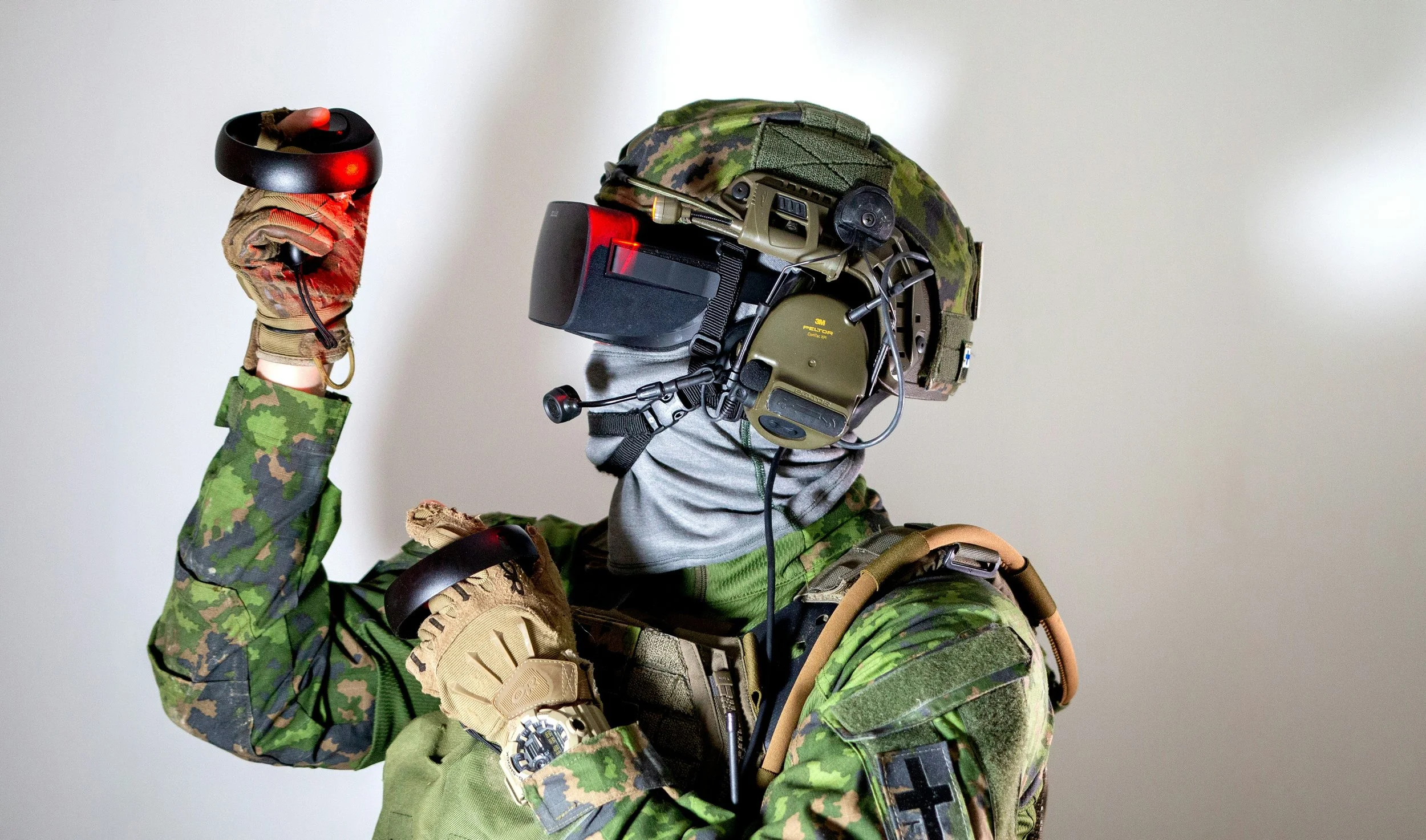
Photo by Jimi Malmberg on Unsplash
The military conflict in Russia and Ukraine has been a testbed for the application of emerging technologies in the context of war.1,2 While conflict zones are not foreign to the adoption, for example, of biometric technologies for providing survivors of genocide, displaced persons, and refugees with “identity,”3 the application of biometric technologies for surveillance in the Russian–Ukraine conflict, has a very different value proposition.4 On the one hand, biometrics once empowered people to move across borders as a “registered person,”5 but one of the uses of biometric surveillance in the Ukraine war has had more to do with reporting the deaths of enemy soldiers6 than their survival. Additional secondary uses of the technology have also focused on preemption, for example, knowing when soldiers are in enemy territories through biometric recognition, or when soldiers have voluntarily defected their posts, among other use cases.7
While on face value this might seem a legitimate use of available emerging technology, on further inspection we find that there are many corresponding social implications and un/intended consequences.8 In the case of a death of an enemy soldier, a one-to-many biometric search can be conducted in the hope of identifying that fallen soldier in order to communicate the news to loved ones. In the case of a preemptive attack, where we are led to believe that an enemy soldier can be detected in a foreign territory in “real time,” we can speculate that a many-to-many search will be applied, thus requiring the blanket coverage of the populace in that given territory.9 We can then deduce that the limited and proportional use of biometric surveillance technology in war might well have a legitimate use, but we might ponder more deeply on the need to draw in all publics from civil society, for the possible near real-time intervention of a preemptive local attack.10 The plot thickens further when we consider who is offering these biometric services during times of war.11 And whether biometric surveillance applications designed for conflict will ultimately find themselves being deployed for everyday use.12
There was no live audience, and the interview felt like a conversation among seven people, each with different perspectives and backgrounds.
Humane Tech
A team of researchers at the Lincoln Center of Applied Ethics at Arizona State University (ASU) are exploring technology development and deployment using a variety of research methods.13 According to director Elizabeth Langland, humane technology is a concept that empowers the ethical management of technology, is the hope of aligning technology with human values, and rejects the current exploitation of users. While there are many upsides to technological change, our current collective relationship to technology is characterized by control, misinformation, and exploitation as Big Tech and other companies compete to profit from our attention.13 Langland emphasizes that humane technology “centers the humanities in conversations and decisions around technology to deliberately prioritize the health and humanity of users. With the humanities in mind, people can equip themselves and empower others to prevent and reduce these negative effects from tech.”13
Codirector Gaymon Bennett states it is no longer enough to adapt humanly as technologies transform our world. The challenge is to reimagine technology for a more humane world. Bennett believes humanities-inspired research will be vital to realizing the potential of this shift, to empower students, faculty, entrepreneurs, and the community at large, to examine the impact of technologies on our lives with the goal of designing a future keyed to human flourishing.13
Toward ethical innovation
Langland and Bennett lead a team of researchers at ASU who are engaging with diverse stakeholders toward the aim of developing ethical innovations that they have called humane technology. The hope is to be inclusive of representative stakeholders, engaging faculty, tech leaders, entrepreneurs, activists, and investors, to respond collaboratively to the profound effects that digital technologies are exercising on everyday lives. Bennett points out that “digital technologies transform everything they touch.”13 Furthermore, Langland notes that the technologies companies develop, and society adopt have a “lasting impact on who we are—what kind of democracy we inhabit, what social justice we achieve, how we think, feel, act, and even love.”13 There is no underestimating the importance of striving for ethical innovation.
But how can this be achieved in practice? While we have standards, such as “ethically aligned design”14 and other processes such as value-based design15 and value-sensitive design,16 the Lincoln Center faculty are taking an approach that focuses on participatory and action-oriented research, employing collaborative and experimental modalities, to garner collective wisdom and good will to make a difference.13 To date, the Center has run numerous design studios and created new products and processes to support future inquiry.17 They are catalysts toward asking those poignant questions that may make stakeholders stop and think about the future they are contributing to building and the positive impact they can make through their participation and intervention. It is an acknowledgment that ethical innovation ecosystems are required to ensure the success of humane technology.18
Roundtable Methodology
Among the initiatives at the Center are ongoing Roundtable conversations. In this Roundtable, readers learn of the application of biometric surveillance techniques during war, together with open source intelligence (OSINT), such as public images found on the Internet. The virtual roundtable takes place between Katina Michael, the Director of the Society Policy Engineering Collective and six academics and staff from the Lincoln Center for Applied Ethics at Arizona State University, including Gaymon Bennett, Elizabeth Grumbach, Sean Kenney, Erica O’Neil, Elizabeth Langland, and Victoria Vandekop. The 35-minute interview was conducted on 15 April 2022 and the transcript revised on 24 April 2022. The topic of the roundtable was biometric surveillance in the Russian–Ukraine war. The questions posed to Michael were unseen which made for spontaneous responses. There was no live audience, and the interview felt like a conversation among seven people, each with different perspectives and backgrounds.
Stimulus material
Langland reached out to the prospective interviewee citing Hill4 in e-mail communications and the possible emphasis of the roundtable. In preparing broad notes for the meeting, Michael came across a BBC News article.7Reuters noted that Mr. Ton-That, CEO of ClearView AI, had sent a letter to Kyiv offering free assistance.19 In the letter, the CEO noted the following potential use case scenarios could be offered by his company’s biometric recognition services,4 as follows:
identifying infiltrators by matching a photo of them or their ID card
identifying the dead without the need for fingerprints
fighting misinformation
family reunification by identifying people without paperwork.
While all of these use cases seem speculative, it is a clear demonstration of the relationship between Big Tech and war. It provides yet more evidence of the link between industry, war, and conflict. “Humane tech,” it might well be labeled given the use cases proposed by the CEO but proving in the technology for the context and evaluating its true capability is indeed questionable. How humane really is it to web scrape the images of billions of innocent citizens? The technology is predicted to work, and the marketing maneuver is supposed to deflect attention away from the company’s many court cases, among them the timely Italian fine of €20 million for “illegally monitoring and processing biometric data of Italian citizens.”20
While all of these use cases seem speculative, it is a clear demonstration of the relationship between Big Tech and war.
Virtual Roundtable: Transcript
Erica O’Neil: This is a series of informational conversations with experts in areas of different tech as it relates to the Russian-Ukraine war. And we were really interested in getting your perspective today on the positives and negatives of Clearview AI and facial recognition technology capabilities. There was a recent article published in The New York Times detailing how Clearview made its artificial intelligence (AI) available to the Ukrainian Government free of charge to identify Ukrainians and Russians in various contexts, so that they can kind of say who they are, and it has a lot of implications for privacy and dissent in a war zone or dissent in Russia and how it’s been used across all this for different contexts.4 So, we are just curious on picking your brain and hearing what you see to be the pros and cons of using something like this in such a heated environment.
Katina Michael: So, the first thing to say is that all technology is inherently political.21 This story is about weaponizing facial recognition systems. Whereas once our face was used for identification purposes to afford us access to services or repatriate displaced persons, the technology has also been used to detect spies, dissidents, protestors, and activists for state surveillance. The adoption of new technologies in new contexts such as war tests what might work on a mass scale and what does not, what citizenry will accept and what they will not. In other words, what are the limits of facial recognition technology in a public setting where the “system” is purportedly “open,” and in the name of “national security” and “social securitization”?
This is also very much about the military-industrial complex. We’ve seen a few private organizations whose business it is to build artifacts, software and hardware and corresponding components, seek to conduct evaluative demos of their facial recognition technology to various government agencies and policing organizations, touting “tech for good” or “beneficial tech,” and its potential in asymmetric conflicts such as war zones. More cameras in smart cities mean more multimedia data collection; images that can be captured and parsed using facial recognition and other video analytical techniques, near real-time. This is a new breed of “just-in-time” tech, that is in the field “overt” in some ways that humans might see the embedded tech in signage on lampposts, and “covert” in other ways as the analysis takes place “invisibly” and “after the fact.” Into the future, emotion detection systems may well be preemptive in warning of impending civil disobedience or even war or even soldiers that are mentally or physically fatigued.
Victoria Vandekop: How does facial recognition technology work, especially when it’s used in such different contexts?
Michael: Well, one way to test facial recognition technology “at scale” is to position it as either a perceived weapon of defense for the “common good,” or even as a compassionate technology that will aid, for example, in the identification of fallen soldiers in enemy territory. The Russian–Ukraine war involves soldiers and citizens who are predominantly white. Facial recognition technology performs well in contexts where white males are heavily represented, although we do not know the technology’s accuracy in “noisy” environments in the field where one-to-many (1:N) matches are presupposed, or where there is a greater diversity in race, gender, and ethnicity. The question is, how does facial recognition technology stack up in unstructured environments, with possible poor lighting (especially at night or in bright sun), various climate exposures (rain, snow), tilting of heads that are not still, apparel like helmets, scarves or balaclavas, and other disruptive environmental conditions?22
So, if you have a passport-style still shot registered in a database, and you personally present in front of a controlled camera setting to verify who you are, you are trying to do what is called a one-to-one match. That’s when photographs have been officially registered just like when an individual unlocks their smartphone using their facial image. In the case of soldiers or people in the field who are roaming and unaware their facial image is being captured and compared to a large database of faces that have been scraped from the Internet (and whose personal identity is also unknown) that can prove to be a lot harder and fraught with significant issues sometimes categorized as false positives or false negatives. One search can return many matches and the accuracy of a match in this instance is highly debatable and based on what is called degrees of confidence. Clearview AI has amassed a facial image dataset of 10 billion images [now reported by the Commission Nationale de l’Informatique et des Libertés to be 20 billion images23] by web scraping open source information, from public social media profiles among many other online sources.24 In this instance, people are not really cooperating when they’re in the field walking around minding their own business, completely unaware their face is being photographed and stored in the cloud.
Vandekop: Considering the use of facial recognition in war, what does all this mean for the general public?
Michael: I think what we’re looking at here has more to do with “blanket coverage” surveillance of the populace; and less about identifying fallen soldiers or enemy spies in one another’s territory.25 Sure, purportedly drones can conduct signature strikes at a micro level using a “kill list” relying possibly on facial image matches in the future, but is this war now being used as a front to test the latest “technology for good” scenario? Prior to the Aadhaar system in India,47 the largest biometric databases were not more than 50 million records in size, unimodal and single-site, as opposed to multi-modal.26,49 In what other context would this kind of facial recognition technology be considered proportional or even viable for the individual citizen? Imagine, the whole world had a grid of Internet-worked smart cameras and every single person on Earth had a registered image in a global database for emergency purposes. But who is the enemy? And I won’t get into the geopolitics here because that’s beside the point; the point is that we’ve got commercial technology which in 1993 through the joint effort of the Defense Advanced Research Project Agency and the Army Research Laboratory established the face recognition technology program FERET to develop automated face recognition capabilities for security and intelligence and law enforcement.27 It doesn’t take any stretch of the imagination to see how the technology might be used in the future.
Erica O’Neil: Can you tell us how this technology has been used in related contexts?
Michael: In the past, this kind of technology has also been used in policing. Clearview AI has proactively approached policing agencies around the world (for example, the Australian Federal Police), asking for the opportunity to demonstrate their tech using live cases, without a commensurate privacy impact assessment (PIA), and without explicit internal policing management approval.28 In short, this is permission-less tracking, and may even impede the warrant process. Inflated customer numbers are often presented to the media about the number of police forces that Clearview AI have entered contracts with, however The New York Times reported some 600 law enforcement agencies had begun to use Clearview AI in 2021.29 Regardless, we are now saying that we should be using OSINT for a variety of applications, despite these images or processes have never been verified, and were never recorded for the purposes of intelligence. There are three issues at hand: 1) citizen consent for the use of images from private platforms for public purposes, 2) the retrospective use of images that were never taken with accuracy in mind, and 3) the potential to flood the Internet with “deep fakes” or “fake images” that can corrupt facial recognition matches and implicate the wrong person?
One search can return many matches and the accuracy of a match in this instance is highly debatable and based on what is called .
Elizabeth Langland: You mentioned that there are some good uses of facial recognition technology, for example, to identify infiltrators. One might also be able to identify those who are committing war crimes. But I read about another use today in the Washington Post: People are using this technology to identify Russian soldiers who have died and then sending images to their mothers. That is a brutal way to stir up dissent, potentially one of its goals, and appears to be classical psychological warfare. So here we have an example of something that’s cruel and potentially dangerous. Do we have the capacity to begin to regulate these kinds of emerging technologies, particularly AI technologies? 48
Michael: What we’re seeing here is Conflict 3.0 not just 2.0. It’s when war gets personal “dead or alive” and when utter strangers you’ve never met before, know you better than you know yourself based on your digital footprints. In Conflict 2.0 we witnessed the Israeli Defense Force and the Al Qassam Brigade wage war via SMS and even Twitter messages direct to the soldier’s mobile phone.30 Indeed, this was a form of psychological warfare right to the enemy’s device. But in Conflict 3.0, enemies can detect a soldier and even an undercover officer by simply taking a photograph from the field and using OSINT at an unforeseen level. Consider scouring the web not just for facial images but also personal information that might be used to strike fear in individuals, the use of people’s online profiles and their respective personally identifiable information (PII) that could be used to make threats on safety at various levels. (Postmark note: One need only consider how a ChatGPT-style bot might be used to create profiles on soldier identities using specific search criteria.)
Theoretically, I can right now take a photograph from a Russian or Ukrainian news agency and simply go to Google and do a “Results like this image” search and guarantee within about five minutes could make certain assumptions about the individual.31 This kind of tactical use of intelligence can be off-putting because it is so personalized that it evokes psychological responses, not just in an individual but in communities at large. However, we still need to be mindful that the information being generated could be deliberate misinformation or disinformation to cause panic. One need only look at the statistics that Russia has released of the confirmed dead soldiers, 1,351 as of 25 March 2022 versus the estimated figures of between 7,000 and 15,000.32 Surely misinformation by someone but oppositely, imagine the reporting of an alleged fallen soldier to family because of an inaccurate biometric search. Reliability is still a huge issue with facial recognition. I think we have a really difficult time ahead trying to navigate the appropriateness of such technologies both within war and outside of it. What we might decide in the war setting may well become the de facto policy stance in the public sphere. This is what we can refer to as scope creep, but even more sinister as it doesn’t affect a single system, but societal systems at large.
Langland: Well, it seems a huge challenge. A couple of years ago, I went to a Techonomy Conference at which the tech innovators themselves said that there are no longer any guardrails on many technologies. And it certainly appears there are no guardrails on facial recognition.
Michael: This is a really important point. It is true that innovators are pushing the bounds of regulation and law by their incremental and radical innovations. What we are witnessing presently is the integration and convergence of once disparate technologies that are bringing about significant social change. But new guardrails are emerging to address the new challenges. And already there have been some efforts to raise awareness of the potential abuse of facial recognition. In 2020, big players like Amazon, Microsoft, and IBM ceased sales to police forces of facial recognition technology, but smaller players have since filled the void.33 Some U.S. cities have also banned facial recognition for policing purposes, including Boston, San Francisco, Oakland, and Portland.34 There just are not the commensurate regulations in place to ensure safeguards against technology-driven discrimination (for example, based on race or gender), although major initiatives are underway, both in Europe (AI Act) and the United States (the proposed Algorithmic Accountability Act).
Smaller players however, like Clearview AI led by Ton-That or Georgian company PimEyes continue to test the waters, “let’s keep going and see how far we can push until authorities tell us to go no further.”35 As noted earlier, before Italy’s data privacy watchdog recently fined Clearview AI, ordering the company to delete data relating to people within its borders and banning it from further data collection or information processing.36 But hold that thought for a moment because what we’re seeing at the same time as bans and penalties is Europe building a huge international facial recognition system.37 In 2008, I did some research on the Prüm Convention for my thesis in my National Security studies investigating the use of digital evidence between police forces in Europe, especially related to transnational crime.5 Initially, Prüm allowed for fingerprints and DNA to be shared across borders, with permission and a whole database matching system was set up between nations to assist Europol and Interpol and all these other policing agencies when they required mutual legal assistance.
Now Europe is proposing that Prüm II should enable the collation of millions of photos of people’s faces allowing for unprecedented facial recognition, but this is just of convicted criminals, this is not blanket coverage surveillance. This means that people who are perceived to be at risk of reoffending due to previous ties to crime groups end up on a database for ease of searchability. It’s important to note that these proposed solutions are fraught with their own challenges, for instance, negating the chance for an individual to rehabilitate and not accidentally be suspected of a crime due to inaccuracies of facial recognition technologies (for example, the Robert Williams case38). We assume these new technologies work but there is overwhelming evidence that they don’t work for some demographics.
So where to next? I think regulation must be drafted and ethical practices need to be emphasized across the industry as a result of this case study. We need international standards at the very least, a governance body that can give us some consensus on best practices. Knowing the power of technology, well it is just going to get more and more invasive.
Elizabeth Grumbach: So, if these technologies continue to get more invasive what can we do? How do we resist? How do we educate ourselves knowing that this is happening, and what would you recommend?
Michael: Now, introducing safeguards into the technological design process is one way of considering future prospects. Where is the participation of the people for aspects of technology that affect their lives, “before the fact,” before the rollout? Jumana Abu-Gazaleh of Pivot for Humanity has it right when she states that technology should be built and considered in the context of being used by your friend and your foe.50 In short, she is referring to public interest technology. The development of technologies and systems that affect everyone must have privacy and security provisions embedded in the functional design of the technology.51 If the risks outweigh the benefits, then the design should be changed, or the technology abandoned altogether. What we have here is a good mix of technology hype and hope.
So, for a moment, might we consider how this technology could be used in the hands of a trusted person or someone whom you love, and you are loved by? What if I said to you a future whereby, we could use this technology, to support the identification of those living with dementia or autism,40 who have wandered.39 Using both location services and biometrics (for example, gait recognition) we might be able to save someone’s life. But again, we must think about proportionality. Could this technology help us identify “at risk” persons and/or “missing persons”?
These are potential uses, but the trust in the systems is the factor we cannot reckon with at the moment. Not just in facial recognition technology to actually work and not discriminate against people but also trust in the data stewards and so many other direct stakeholders. We do not have to look too far back, to realize how digital data collection was used in World War II. Edwin Black in 2001, wrote a revealing book titled IBM in the Holocaust, in which he uncovered how the Hollerith system had been used by Nazi government supporters and by the government itself through the use of punch cards and national census data in the identification of those of Jewish origin, those who identify as Jehovah’s Witnesses, those who were gay or lesbian, and even those living with mental health issues. If we did that back in World War II where there was no Internet, limited electronic serialization, what are we doing now, and what are we about to unleash?
Gaymon Bennett: Are there positive uses of biometric technologies?
Michael: I don’t think we are aware of what is really going on and at what scale- technology’s reach for the greater part is invisible and so are the implications of technology for those who are discriminated against or persecuted (for example, Uyghur people in Xinjiang).41 The matter now is to say, well, we can see the positive uses of this technology, but what must happen to us as a populace to be able to embrace the technology for its benefit (acknowledging its many shortcomings) without us using it in the wrong way.42
And I’m not saying that such a system will save millions of lives, I’m not saying that at all because we might well open a can of worms by unleashing this technology in the way that we perceive benefits on behalf of others without the proper codesign. Facial recognition is already being incorporated into medical trials as an aid to determine whether syndromes people carry can be automatically detected without a DNA test. For example, whether people are living with schizophrenia, or other conditions like autism, whether people have granted their consent or not, these new technologies are indiscriminate in performing the analysis. They dehumanize the person to a set of numbers, and we are more than numbers. Few would know that photographs of someone’s face and body can reveal Turner Syndrome (among many other syndromes) using musculoskeletal analysis.43
Victoria Vandekop: I know you have great insights on the future of work from our Humane Tech Design Studio events. Do you see technologies like these being used in the future of work?
Michael: Yes. Our laptops and computers and smartphones now have pinhole cameras and can be used as pseudosurveillance technologies to preemptively diagnose someone in the workplace who may seem unhappy or angry. We started investigating these scenarios in a National Science Foundation Research Traineeship Program “Smart City Infrastructure and Technology” course at ASU in 2020, and students from multiple disciplines (science, technology, engineering and mathematics; humanities management; and social sciences) were indeed surprised by the social implications of this kind of emotion detection technology, going beyond mere facial recognition.44 The next thing we might soon see is an employer say, “look our workplace surveillance has identified you as “at risk” for depression, we’re sorry to inform you that you won’t be able to work till further notice.” We’re still concerned about Internet cookies, but the bigger questions we may soon be challenged by is biometrics beyond keystroke analysis; among which might be voice intonation, eyeball tracking, and gait recognition. What type of information is going live? What kinds of embedded sensors are collecting what type of information? And what is being done with that data? These algorithms may well be applying in real-time some of the models that Aleksandr Kogan instituted for Cambridge Analytica,45 but now imagine that during a war context.
And here we still are making claims that biometrics can identify fallen soldiers, and that we should use this technology to notify loved ones. But if we can’t prove the technology for living people, how can we for battlefield casualties? War is ugly. You can’t identify a person whose face has been affected by shelling or a bullet or profuse blood loss or disfigurement, or a body that has begun to decompose a day or more on.
Sean Kenney: Do you have any concluding remarks?
Michael: We can’t be sucked in by the hype. The future of work is one thing, the future of policing and even war quite another. Some of the most advanced technologies are trialed during combat for operations research, attempting to provide allied forces with superior decision-making capabilities. Facial recognition may well be the “edge” that forces are looking for, and it has unfortunately very little to do with identifying soldiers who have died in conflict. That’s where we are going, I think: It’s dystopian. But if we can find it within ourselves to deploy these technologies being mindful of the negative externalities and actively do something about them through technological or regulatory proactive responses,46 then we might get somewhere, but for now, I don’t think the world is at that point.
Roundtable Panelists
Gaymon Bennett is Associate Director of the Lincoln Center of Applied Ethics, and associate professor of religion, science, and technology at Arizona State University. He works on the problem of modernity in contemporary religion and biotechnology: its shifting moral economies, contested power relations, and uncertain modes of subjectivity. His 2016 book Technicians of Human Dignity examines the figure of human dignity in 20th century international and religious politics and its current biopolitical reconfigurations. Gaymon has conducted multiple experiments in cross-disciplinary collaboration with contemporary biologists and bioengineers. These experiments emphasize collaborative empirical inquiry, a shift from theory to shared concept work, and sustained attention to the culture and politics of knowledge production. He holds a Ph.D. degree in cultural anthropology and a second Ph.D. degree in philosophical theology.
Elizabeth Grumbach is Program Manager for Digital Humanities and Research for the Lincoln Center for Applied Ethics, an organization committed to exploring cocreative and participatory strategies for ethical technological innovation, at Arizona State University. Liz serves on the Board of Directors for Digital Frontiers, a nonprofit organization that brings together the makers and users of digital resources for the humanities. Her current research and scholarly goals include investigating critical methodologies for sharing cultural data, digital public humanities, and the formation of feminist, antiracist digital commons and cooperatives that actively engage with questions of labor and social justice.
Sean Kenney is Education Program Lead for the Lincoln Center for Applied Ethics. He holds a Master of Education and a B.S. in Political Science and Government.
Elizabeth Langland is Director of the Lincoln Center for Applied Ethics. She was previously the interim Dean for Humanities in the College of Liberal Arts and Sciences. She subsequently became Director of the Institute for Humanities Research from 2018–2020. Prior to moving to ASU, Dr. Langland served as Provost and Vice President for Academic Affairs at Purchase College, State University of New York, from 2004–2007; as Dean of the Division of Humanities, Arts, and Cultural Studies at the University of California, Davis, from 1999–2004; and as Associate Dean for Faculty Affairs at the University of Florida from 1995–1998. A scholar specializing in Victorian literature, feminist and gender theory, cultural studies and theory of the novel, Langland has authored four books and dozens of articles, edited/coedited five books, and received several teaching awards. During her tenure at ASU she was appointed Foundation Professor English. She is also Professor of English, Emerita, University of California, Davis.
Erica O’Neil is Research Program Manager in the Lincoln Center for Applied Ethics, where she explores humane technology and the cultivation of ethical research cultures. She holds a Ph.D. degree in biology with an emphasis in history and philosophy of science, and previously examined how emerging disease states become objects of political and legislative focus. For a decade prior to that, she worked as an anthropologist and lab manager for a cultural resource management firm in the Southwest. Erica also holds an M.S. in biology, and a B.A. in anthropology and B.A. in history from Arizona State University.
Victoria Vandekop was Communications Program Coordinator for the Lincoln Center for Applied Ethics. She specializes in communications with a B.A. and was a Barrett, The Honors College student at Arizona State University passionate about digital communications, social media marketing, and community outreach. She was also a member of the scholarship program Next Generation Service Corps, in which she earned a certificate in Cross-Sector Leadership.
References
1. A. Satariano and S. Frenkel, “Ukraine war tests the power of tech giants,” NY Times, Feb. 2022. [Online]. Available: https://www.nytimes.com/2022/02/28/technology/ukraine-russia-social-media.html
2. M. E. O’Hanlon et al., “Terminator on the battlefield: Emerging and evolving tech in the Russia-Ukraine war,” Brookings Inst., Washington, DC, USA, Nov. 2022. [Online]. Available: https://www.brookings.edu/events/terminator-on-the-battlefield-emerging-and-evolving-tech-in-the-russia-ukraine-war/
3. A. Aloudat, K. Michael, and R. Abbas, “The Implications of Iris-recognition technologies: Will our eyes be our keys? ” IEEE Consum. Electron. Mag., vol. 5, no. 3, pp. 95–102, Jul. 2016, doi: 10.1109/MCE.2016.2556901.
4. K. Hill, “Facial recognition goes to war,” NY Times, Apr. 2022. [Online]. Available: https://www.nytimes.com/2022/04/07/technology/facial-recognition-ukraine-clearview.html
5. K. Michael, “The road from S and Marper to the Prüm treaty and the implications on human rights,” in Cross-Border Law Enforcement Regional Law Enforcement Cooperation–European, Australian and Asia-Pacific Perspectives, S. Hufnagel, C. Harfield, and S. Bronitt, Eds. London, U.K. : Routledge, 2011, p. 16, doi: 10.4324/9780203813058.
6. J. Bhuiyan, “Ukraine uses facial recognition software to identify Russian soldiers killed in combat,” Guardian, Mar. 2022. [Online]. Available: https://www.theguardian.com/technology/2022/mar/24/ukraine-facial-recognition-identify-russian-soldiers
7. “Ukraine offered tool to search billions of faces,” BBC, Mar. 2022. [Online]. Available: https://www.bbc.com/news/technology-60738204
8. K. Michael and M. G. Michael, “Historical lessons on ID technology and the consequences of an unchecked trajectory,” Prometheus, vol. 24, no. 4, pp. 365–377, Nov. 2006, doi: 10.1080/08109020601029938.
9. T. Holmes, “Security and surveillance in film,” Oxford Res. Encyclopedia Criminology, Jul. 2017. [Online]. Available: https://oxfordre.com/criminology/view/10.1093/acrefore/9780190264079.001.0001/acrefore-9780190264079-e-196
10. M. G. Michael and K. Michael, “Toward a state of Überveillance,” IEEE Technol. Soc. Mag., vol. 29, no. 2, pp. 9–16, Summer 2010, doi: 10.1109/MTS.2010.937024.
11. K. Michael, H. A. Love, and J. Wajcman, “Speaking out against socially destructive technologies: Norbert Wiener and the call for ethical engagement,” IEEE Technol. Soc. Mag., vol. 36, no. 2, pp. 13–26, Jun. 2017, doi: 10.1109/MTS.2017.2705779.
12. K. Michael and M. G. Michael, Innovative Auto-ID and Location-Based Services: From Bar Codes to Chip Implants. Hershey, PA, USA : IGI Global, 2014.
13. “Vision: What is humane technology? ” Lincoln Center for Applied Ethics, Arizona State Univ., Tempe, AZ, USA, 2020. [Online]. Available: https://lincolncenter.asu.edu/vision
14. A. F. Winfield, K. Michael, J. Pitt, and V. Evers, “Machine ethics: The design and governance of ethical AI and autonomous systems,” Proc. IEEE, vol. 107, no. 3, pp. 509–517, Mar. 2019, doi: 10.1109/JPROC.2019.2900622.
15. S. Spiekermann, Ethical IT Innovation: A Value-Based System Design Approach. Boca Raton, FL, USA : CRC Press, 2015.
16. B. Friedman and D. G. Hendry, Value Sensitive Design: Shaping Technology with Moral Imagination. Cambridge, MA, USA : MIT Press, 2019.
17. “Initiatives: Humane tech design studios,” Lincoln Center for Applied Ethics, Arizona State Univ., Tempe, AZ, USA, 2020–2022. [Online]. Available: https://lincolncenter.asu.edu/studios
18. B. C. Stahl, “Responsible innovation ecosystems: Ethical implications of the application of the ecosystem concept to artificial intelligence, ” Int. J. Inf. Manage., vol. 62, Feb. 2022, Art. no. 102441, doi: 10.1016/j.ijinfomgt.2021.102441.
19. P. Dave and J. Dastin, “Exclusive: Ukraine has started using Clearview AI’s facial recognition during war,” Reuters, Mar. 2022. [Online]. Available: https://www.reuters.com/technology/exclusive-ukraine-has-started-using-clearview-ais-facial-recognition-during-war-2022-03-13/
20. L. Carrer and R. Coluccini, “Italian DPA fines clearview AI for illegally monitoring and processing biometric data of Italian citizens,” EDRi, Brussels, Belgium, Mar. 2022. [Online]. Available: https://edri.org/our-work/italian-dpa-fines-clearview-ai-for-illegally-monitoring-and-processing-biometric-data-of-italian-citizens/
21. L. Winner, “Do artifacts have politics? ” Daedalus, vol. 109, no. 1, pp. 121–136, Winter 1980. [Online]. Available: https://www.jstor.org/stable/20024652
22. W. Crumpler, “How accurate are facial recognition systems–And why does it matter? ” Center for Strategic and International Studies, Washington, DC, USA, Apr. 2020. [Online]. Available: https://www.csis.org/blogs/technology-policy-blog/how-accurate-are-facial-recognition-systems-%E2%80%93-and-why-does-it-matter
23. P. Ducklin, “Clearview AI image-scraping face recognition service hit with €20m fine in France,” Naked Security, Sophos, Paris, France, Oct. 2022. [Online]. Available: https://nakedsecurity.sophos.com/2022/10/26/clearview-ai-image-scraping-face-recognition-service-hit-with-e20m-fine-in-france/
24. K. Michael, R. Abbas, P. Jayashree, R. J. Bandara, and A. Aloudat, “Biometrics and AI bias,” IEEE Trans. Technol. Soc., vol. 3, no. 1, pp. 2–8, Mar. 2022. doi: 10.1109/TTS.2022.3156405.
25. R. Pringle, K. Michael, and M. G. Michael, “Unintended consequences: The Paradox of technological potential, ” IEEE Potentials, vol. 35, no. 5, pp. 7–10, Sep./Oct. 2016, doi: 10.1109/MPOT.2016.2569672.
26. K. Michael, S. Kobran, R. Abbas, and S. Hamdoun, “Privacy, data rights and cybersecurity: Technology for good in the achievement of sustainable development goals,” in Proc. IEEE Int. Symp. Technol. Soc. (ISTAS), 2019, pp. 1–13, doi: 10.1109/ISTAS48451.2019.8937956.
27. P. J. Phillips, P. J. Rauss, and S. Z. Der, “FERET (Face Recognition Technology) recognition algorithm development and test results,” U.S. Army Res. Lab., Adelphi, MD, USA, ARL-TR-995, Oct. 1996.
28. C. Kwan, “OAIC determines AFP interfered with privacy of Australians after using Clearview AI,” ZDNet, Dec. 2021. [Online]. Available: https://www.zdnet.com/article/oaic-determines-afp-trial-of-clearview-ai-interfered-with-privacy-of-australians/
29. K. Hill, “Clearview AI have entered contracts with, however the New York Times reported some 600 law enforcement agencies had begun to use Clearview AI in 2021,” NY Times, Jan. 2020. [Online]. Available: https://www.nytimes.com/2020/01/18/technology/clearview-privacy-facial-recognition.html
30. K. Michael, “Israel, Palestine and the benefits of waging war through Twitter,” The Conversation, Nov. 2012. [Online]. Available: https://theconversation.com/israel-palestine-and-the-benefits-of-waging-war-through-twitter-10932
31. T. Simonite, “Online sleuths are using face recognition to ID Russian soldiers,” Wired, Mar. 2022. [Online]. Available: https://www.wired.com/story/facial-recognition-identify-russian-soldiers/
32. C. Jee, “Ukraine claims it’s using facial recognition to identify dead Russian soldiers,” MIT Technol. Rev., Mar. 2022. [Online]. Available: https://www.technologyreview.com/2022/03/24/1048268/the-download-ukraine-claims-its-using-facial-recognition-to-identify-dead-russian-soldiers/
33. J. Greig, “One year after Amazon, Microsoft and IBM ended facial recognition sales to police, smaller players fill void,” ZDNet, May 2021. [Online]. Available: https://www.zdnet.com/article/one-year-after-amazon-microsoft-and-ibm-ended-facial-recognition-sales-to-police-smaller-players-fill-void/
34. S. Wray, “Portland bans private companies from using facial recognition technology,” Cities Today, Sep. 2020. [Online]. Available: https://cities-today.com/portland-bans-private-companies-from-using-facial-recognition-technology/
35. J. Nash, “Face-scrapers say they won’t help Russia in Ukraine, but …,” Biometric Update, Apr. 2022. [Online]. Available: https://www.biometricupdate.com/202204/face-scrapers-say-they-wont-help-russia-in-ukraine-but
36. “Facial recognition: Italian SA fines Clearview AI EUR 20 million,” Eur. Data Protection Board, Mar. 2022. [Online]. Available: https://edpb.europa.eu/news/national-news/2022/facial-recognition-italian-sa-fines-clearview-ai-eur-20-million_en
37. M. Burgess, “Europe is building a huge international facial recognition system,” Wired, Apr. 2022. [Online]. Available: https://www.wired.co.uk/article/europe-police-facial-recognition-prum
38. B. Allyn, “‘The computer got it wrong’: How facial recognition led to false arrest of black man,” Nat. Public Radio, Washington, DC, USA, Jun. 2020. [Online]. Available: https://www.npr.org/2020/06/24/882683463/the-computer-got-it-wrong-how-facial-recognition-led-to-a-false-arrest-in-michig
39. R. Abbas and K. Michael, “Co-designing location-based services for individuals living with dementia: An overview of present and future modes of operation,” IEEE Technol. Soc. Mag., vol. 41, no. 2, pp. 42–46, Jun. 2022, doi: 10.1109/MTS.2022.3173353.
40. K. Michael and R. Abbas, “Mobile alerts for people who wander: Where RFID/NFC, biometrics and GPS meet,” in Proc. 12th Annu. Int. Conf. IEEE RFID, Orlando, FL, USA, Apr. 2018. [Online]. Available: https://2018.ieee-rfid.org/mobile-alerts-for-people-who-wander-where-rfidnfc-biometrics-and-gps-meet/
41. P. Mozur, “One month, 500,000 face scans: How China is using A.I. to profile a minority,” NY Times, Apr. 2019. [Online]. Available: https://www.nytimes.com/2019/04/14/technology/china-surveillance-artificial-intelligence-racial-profiling.html
42. K. Michael, “The benefits and harms of national security technologies,” in Proc. Int. Women Law Enforcement Conf., Leadership, Collaboration Security. Hyderabad, India : Sardar Vallabhbhai Patel (SVP) National Police Academy, Oct. 2015. [Online]. Available: http://works.bepress.com/kmichael/550/
43. S. Chen et al., “Development of a computer-aided tool for the pattern recognition of facial features in diagnosing Turner syndrome: Comparison of diagnostic accuracy with clinical workers, ” Scientific Rep., vol. 8, no. 1, pp. 1–9, Jun. 2018, doi: 10.1038/s41598-018-27586-9.
44. N. Dodd et al., “Facial emotion recognition and the future of work,” in Proc. IEEE Int. Symp. Technol. Soc. (ISTAS22), Hong Kong, China, Nov. 9–12, 2022.
45. C. Bickmore et al., “Is sorry too little, too late from Facebook’s Mark Zuckerberg? ” Project, Mar. 2018. [Online]. Available: https://www.katinamichael.com/documentary/2018/3/22/is-sorry-too-little-too-late-from-facebook-the-project
46. K. Michael and R. Abbas, “Technology, information systems and sustainability: A public interest research agenda,” in “Climate change and COP26: Are digital technologies and information management part of the problem or the solution? An editorial reflection and call to action,” Int. J. Inf. Manage., vol. 63, pp. 14–15, Apr. 2022, Art. no. 102456, doi: 10.1016/j.ijinfomgt.2021.102456.
47. U. Ramanathan, “Considering social implications of biometric registration: A database intended for every citizen in India [Commentary], ” IEEE Technol. Soc. Mag., vol. 34, no. 1, pp. 10–16, Mar. 2015, doi: 10.1109/MTS.2015.2396113.
48. A. Kak, Ed., Regulating Biometrics: Global Approaches and Urgent Questions, New York, NY, USA : AI Now Institute, Sep. 2020, pp. 1–112. [Online]. Available: https://ainowinstitute.org/regulatingbiometrics.pdf
49. P. J. Flynn, “Biometrics databases,” in Handbook of Biometrics, A. K. Jain, P. Flynn, and A. A. Ross, Eds. Boston, MA : Springer, 2008, pp. 529–548, doi: 10.1007/978-0-387-71041-9_252008.
50. R. Abbas, S. Hamdoun, J. Abu-Ghazaleh, N. Chhetri, N. Chhetri, and K. Michael, “Co-designing the future with public interest technology,” IEEE Tech. Soc. Mag., vol. 40, no. 3, pp. 10–15, Sept. 2021, doi: 10.1109/MTS.2021.3101825.
51. R. Abbas, J. Pitt, and K. Michael, “Socio-technical design for public interest technology,” IEEE Trans. Technol. Soc., vol. 2, no. 2, pp. 55–61, Jun. 2021, doi: 10.1109/TTS.2021.3086260.
Author
Arizona State University, Tempe, USA
Katina Michael is a professor with Arizona State University, Tempe, AZ 85287 USA. Contact her at katina.michael@asu.edu.
ACKNOWLEDGMENT
I would like to acknowledge Victoria Vandekop for transcribing the original roundtable conversation.
Citation: K. Michael, "Biometric Surveillance and the Future of War," in Computer, vol. 56, no. 7, pp. 21-30, July 2023, doi: 10.1109/MC.2023.3249416.