Beyond Human: Lifelogging and Life Extension
Citation: K. Michael, "Beyond Human: Lifelogging and Life Extension [Editorial]," in IEEE Technology and Society Magazine, vol. 33, no. 2, pp. 4-6, Summer 2014, doi: 10.1109/MTS.2014.2322915.
I have often wondered what it would be like to rid myself of a keyboard for data entry, and a computer screen for display. Some of my greatest moments of reflection are when I am in the car driving long distances, cooking in my kitchen, watching the kids play at the park, waiting for a doctor's appointment, or on a plane thousands of meters above sea level. I have always been great at multitasking, but at these times it is often not practical or convenient to be head down typing on a laptop, tablet, or smartphone.
It would be much easier if I could just make a mental note to record an idea and have it recorded, there and then. And who wouldn't want the ability to “jack into” all the world's knowledge sources in an instant via a network [1]? Who wouldn't want instant access to their life-pages filled with all those memorable occasions? Or even the ability to slow down the process of aging [2], as long as living longer equated to living with mind and body fully intact.
Transhumanists would have us believe that these things are not only possible but inevitable.
In short: we Homo sapiens may dictate the next stage of our evolution through our use of technology.
Transhumanism
Shortly after starting my Ph.D., I came across a newly established organization known as the World Transhumanist Association (WTA), now known as Humanity+ (H+), which was founded by Nick Bostrom and David Pearce.
Point 8 of the Transhumanist Declaration states [3]:
“We favour allowing individuals wide personal choice over how they enable their lives. This includes use of techniques that may be developed to assist memory, concentration, and mental energy; life extension therapies; reproductive choice technologies; cryonics procedures; and many other possible human modification and enhancement technologies.”
First let us consider briefly the traditional notion of a cyborg, part man/part machine, where technology can act to replace the need for human parts.
In this instance, some might willingly undergo surgical amputations for reasons of enhancement and longevity which have naught to do with imminent medical prosthesis.
This might include the ability to get around the “wetware” of the brain, enabling our minds to be downloaded onto supercomputers.
Homo Electricus
Perhaps those who love the look and feel of their human body more than machinery would much rather contemplate a world dominated by a Homo Electricus – a human that will use electro-magnetic techniques for ambient communication with networks [4].
An Electrophorus is thus one who becomes a bearer of technology, inviting nano-and micro-scale devices into his or her body.
An Electrophorus might also use brain-wave techniques, such as the electroencephalogram (EEG), which measures the electrical activity of the brain in order to perform actions by thinking about them [5].
This might be the best approach to retaining our inner thoughts for recollection though there are myriad vital issues related to security, access control, and privacy that must be addressed first.
Lifelogging
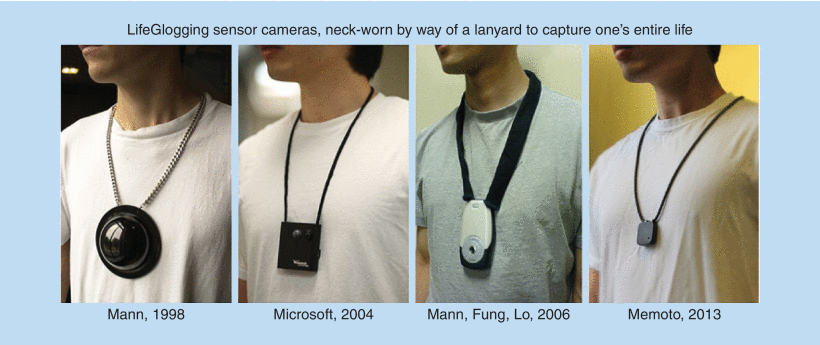
Steve Mann: “Here's a picture I took of my neckworn camera in 1998, along with other similar more recent devices. The 1998 camera was a “wearable wireless webcam” that had various other sensors in it as well. The microsoft sensecam picture I took in a similar style, and over the years various other products became available. The most recent picture I actually took in exactly the same location as my original camera necklace dome 15 years earlier: 2nd floor of university of toronto bookstore, St. george street entrance.
Twenty years ago, when I was still in high school, I would observe my headmaster, who was not all that fond of computers, walking around the playground carrying a tiny Dictaphone in his hands recording things for himself so that he could recollect them afterwards.
When I once asked him why he was engaging in this act, he said:
“Ah … there are so many things to remember! Unless I record them I forget them.”
He was surely onto something. His job required him to remember minute details that necessitated recollection.
Enter Steve Mann in the early 1990s, enrolled in a Ph.D. program at M.I.T. Media Labs and embarking on a project to record his whole life – himself, everyone else, and mostly everything in his field of view, 24/7 [6].
At the time it would have sounded ludicrous to want to record your “whole life,” as Professor Mann puts it. With Mann's wearcam devices (such as Eyetap), one can walk around recording, exactly like a mobile CCTV. The wearer becomes the photoborg.
It is an act Mann has called “sousveillance,” which equates to “watching from below” [7].
This is as opposed to watching from above, like when we are surveilled by CCTV stuck on a building wall such as in George Orwell's dystopic Nineteen Eighty-Four.
Since Mann's endeavor there have been many who have chosen this kind of blackbox recorder lifestyle, and more recently even Google has thrown in their Glass Project equivalent [8].
My guess is that we are about to walk into an era of Person View systems that will show things on ground level through the eyes of our social network, beyond just Street View fly-throughs [9].
Other notable lifeloggers include Gordon Bell of Microsoft [10] and Cathal Gurrin from Dublin City University [11].
M.I.T. researcher Deb Roy lifelogged his son's first year of life (with exceptions) by wiring up his home with video cameras [12].
When we talk about big data, you can't get any bigger than this [13] – chunky multimedia, chunky files of all types from a multitude of sensors, and chunky data ripe for analysis (by police, the government, your boss, and potentially anyone).
But I have often wondered where these individuals have drawn the line – at which occasions they choose to “switch off” the camera, and why [14].
This glogging still does not satisfy the possibility that I might be able to retain and indeed download all my thoughts for retrieval later [15].
A series of still photographs and continuous footage does help me to remember people I've met, things I've shared, knowledge I've gained, and feelings I've experienced. However, lifelogging is limited and cannot record the thoughts I have had at every moment in my life.
In addition, there is an innate problem with recording all my thoughts automatically with some kind of futuristic digital neural network: I would not want every thought I have ever had to be recorded [16].
Let's face it, no-one is perfect and sometimes we think silly things that we would never want stored, shared with others or replayed back to us [17].
These are thoughts which are apt to be misconstrued or misinterpreted, even perhaps in an e-court. We also do and say things at times which may not be criminal but are not the best practice for family, friends, colleagues, or even strangers to witness.
And there are those moments of heartbreak and horror alike that we would never wish to replay for reasons we might be overcome with grief and become chronically depressed.
The beginning and end of Ingmar Bergman's film Persona is reminiscent of a longitudinal glog [18]. See also “The Entire History of You” in the Black Mirror[16] available for download at https://archive.org/details/BlackMirror-Series. Directed by Brian Welsh and written by Jesse Armstrong and Charlie Brooker, the movie depicts the future, thanks to the “Grain,” a chip which can be implanted on a hard drive in the brain, with every single action that a person makes being recorded and played back at a later time.
Is More than Human Better?
Evolving in ways that could better our lives can only be a good thing. But evolving to a stage where we humans become something other than human could be less desirable.
Dangers could include:
electronic viruses,
virtual crimes (such as getting your e-life deleted, rewritten, rebooted, or stolen),
having your freedom and autonomy hijacked because you are at the mercy of so called smart grids.
Whatever the likelihood of these potentialities, they too, together with all of the positives, need to be interrogated.
Ultimately we need to be extremely careful that any artificial intelligence we invite into our bodies does not submerge the human consciousness and, in doing so, rule over it.
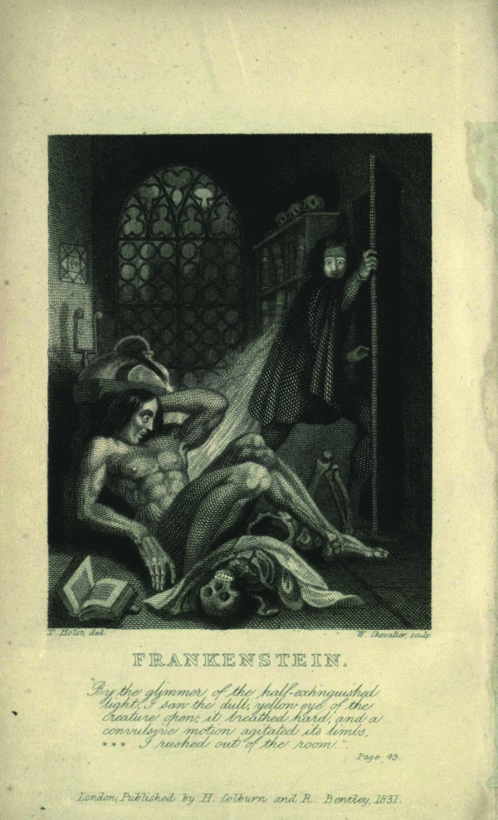
Remember, in Mary Shelley's 1816 novel Frankenstein, it is Victor Frankenstein, the mad scientist, who emerges as the true monster, not the giant who wreaks havoc when he is rejected.
ACKNOWLEDGMENT
“The author would like to thank her fellow collaborator Dr. MG Michael, an honorary associate professor at the University of Wollongong, NSW, Australia, for his insights and valuable input on the initial draft of this article.
This article was first published under the title “People plus: Is transhumanism the next stage in our evolution?” in The Conversation, Oct. 29, 2012. The original article can be found at https://theconversation.com/people-plus-is-transhumanism-the-next-stage-in-our-evolution-9771.
References
1. W. Gibson Neuromancer 1984 Ace
2. A. de Grey A roadmap to end aging TED 2007 https://www.youtube.com/watch?v=8iYpxRXlboQ/
3. Transhumanist Declaration humanity 2012 http://humanityplus.org/philosophy/transhumanist-declaration/
4. K. Michael M.G. Michael The Encyclopaedia of Information Ethics and Security 1st 312 318 2007 IGI Global Homo Electricus and the continued speciation of humans
5. K.D. Stephan K. Michael M.G. Michael L. Jacob E. Anesta Social Implications of Technology: Past, Present, and Future Proc. IEEE 100 13 1752 1781 Proc. IEEE 2012 http://ieeexplore.ieee.org/stamp/stamp.jsp?arnumber=06187687
6. S. Mann D. RikkeFriis The Encyclopedia of Human-Computer Interaction 2nd 2013 Interaction Design Foundation Wearable computing http://www.interaction-design.org/encyclopedia/wearable_computing.html/
7. S. Mann Through the glass, lightly IEEE Technology & Society Mag. 2 10 14 2012
8. Project Glass: One day… Google 2012 http://www.youtube.com/watch?v=9c6W4CCU9M4/
9. Map My Tracks 2010 http://www.mapmytracks.com/blog/entry/new-feature-street-view-and-google-earth-fly-through-bring-your-activities-to-life/
10. G. Bell Microsoft Research Silicon Valley 2013 http://research.microsoft.com/en-us/um/people/gbell/
11. C. Gurrin Lecturer at Dublin City University 2013 http://www.computing.dcu.ie/~cgurrin/
12. D. Roy The birth of a word TEDhttp://www.ted.com/talks/deb_roy_the_birth_of_a_word
13. K. Michael K. Miller Big data: New opportunities and new challenges IEEE Computer 46 6 22 24 2013
14. K. Michael M.G. Michael No limits to watching? Commun. ACM 56 11 26 28 2013
15. S. Mann MetaSpaceglasses now available to CYBORGloggers interested in becoming AR developers glogger.mobihttp://glogger.mobi/
16. C. Brooker Episode 3 - The entire history of you Black Mirror 2011 http://www.channel4.com/programmes/black-mirror/4od#3327868
17. M.G. Michael K. Michael The fallout from emerging technologies: On matters of surveillance, social networks, and suicide IEEE Technology and Society Mag. 30 3 13 17 2011
18. I. Bergman Persona 1966 https://www.youtube.com/watch?v=vMfqSuRlerU
19. Inside cover art, Frankenstein 1831 http://www.archive.org/details/ghostseer01schiuoft
Authors
Citation: K. Michael, "Beyond Human: Lifelogging and Life Extension [Editorial]," in IEEE Technology and Society Magazine, vol. 33, no. 2, pp. 4-6, Summer 2014, doi: 10.1109/MTS.2014.2322915.