Assistive Technologies for Greatly Improved Quality of Life for People Living With MND/ALS
Citation: S. Hamdoun, K. Michael, R. Monteleone and T. Bookman, "Assistive Technologies for Greatly Improved Quality of Life for People Living With MND/ALS," in IEEE Consumer Electronics Magazine, vol. 10, no. 3, pp. 76-81, 1 May 2021, doi: 10.1109/MCE.2020.3035523.
Abstract:
Assistive technologies (ATs) are designed to enhance the quality of life of people living with disabilities. The integration of these technologies with the home or work environment are often combined with a variety of processes, services, and other devices. ATs have also been imperative in addressing some of the physical limitations that are caused by motor neuron disease (MND). This disease, which impacts the neurological system in various ways, can require severe adjustments in the daily lives of people and hence ATs are able to provide critical support. This article draws from an interview with Dr. Justin Yerbury, a Professor of Neurodegenerative Disease at the University of Wollongong who has MND, supplemented by technical product literature. It explores his living experience to improve familiarity with the technology and the challenges in terms of access, use, and the uncertainties presented to people with MND.
In early March 2019, Justin Yerbury, a world-renowned University of Wollongong (UOW) researcher in motor neuron disease (MND, or ALS, Lou Gehrig's Disease) who has the degenerative disease himself, traveled with his family and two caregivers to Sydney, Australia. There they lined up to board an eagerly anticipated seven-day cruise to New Caledonia.
Yerbury, who uses many assistive technologies, and his wife Rachel had spent months preparing for the journey, filling out special needs forms, emailing Royal Caribbean, the cruise line, and painstakingly packing the equipment needed to keep Yerbury both alive and functioning on such a trip. But when they arrived for boarding—they were refused entry to the ship because “the ship would be unable to provide the level of care required in the event of an emergency.” This is despite entreaties over the phone that day from Yerbury's neurologist that he was indeed, safe to travel.
The Yerburys were devastated. “This was an opportunity for my family and extended family to make memories and have some quality time together,” Professor Yerbury told the Sydney Morning Herald. “We may not have many other opportunities.”[11]
Royal Caribbean refunded expenses, but the damage was done.
“There's things that money can't reimburse,” Rachel Yerbury told the Herald. “It's so hard for Justin already to do the daily things everyone takes for granted. And it's hard too, for him to get respect and be treated as a person. And he didn't get the respect he deserved here. He felt invisible.”[11]
DISABILITY RIGHTS
The Yerburys did everything right in preparation for their trip, yet still found themselves dealing with the discriminatory and dehumanizing experience of being barred from boarding the ship. Prof. Yerbury is a public figure and well-known researcher in MDS. His work allows him access to assistive technologies and treatments that help maintain his quality of life, yet he and his family still endured this experience. When their story became public, the Yerburys reached a settlement with Royal Caribbean whereby the company enacted new policies to better accommodate travelers with disabilities. Later that year, Qantas airlines arranged to fly the Yerburys on a working family vacation to Perth, where Dr. Yerbury presented at a medical symposium. The airline employed a custom hoist that allowed Prof. Yerbury to be seated on the plane.[15]
SHIFT IN LIFE FOCUS
In 1995 and 1996, Justin Yerbury was living life as a professional basketball player with the Illawarra Hawks in the Oceania National Basketball League of Australia. Around that time, two of Yerbury's extended family members were diagnosed and died of MDS.
Eventually, Yerbury learned that 50% of his family members—including himself—carried the gene for the genetic, or familial, form of MND.
Yerbury decided to leave basketball behind, and by 1999 was reenrolled in college, this time at the University of Wollongong. He studied science to better understand the disease that was affecting his family. In 2002 within a six-week span, Yerbury lost three family members—his mother, grandmother, and aunt—to MND. And in 2008, he lost his younger sister Sarah to MND when she was just 26 years old. Yerbury had no prior background in science, but was a quick study once he made the decision to pursue the subject, earning his B.Sc. degree from UOW with first class honors in 2004. In 2008, Yerbury received his Ph.D. from UOW. Today, he is Professorial Fellow in Neurodegenerative Disease, School of Chemistry and Molecular Bioscience and Senior Research Fellow at the Illawarra Health and Medical Research Institute (IHMRI), UOW. He has built an international reputation for his research into the origins of MND, and continues to research effective treatments.
In 2016, when presenting at a conference in the U.S., Yerbury noticed weakness in his thumbs. When he returned to Wollongong, his physician confirmed that he had developed the disease. Today Yerbury relies on multiple assistive technology devices in order to continue his work and daily life. His condition was relatively stable until 2018 when he started to lose the ability to walk or breathe on his own. In 2018, he underwent radical surgery for a tracheostomy and laryngectomy, similar to the procedures that extended Stephen Hawking's life for decades.
MND MOLECULAR PROCESSES
The nerve cells that control the muscles that enable us to move, speak, breathe, and swallow are known as motor neurons. MND refers to a collection of neurodegenerative conditions related to the loss of motor neuron function. MND causes the gradual weakening of muscles as the motor neurons degenerate and eventually fail. Some common types of MND are amyotrophic lateral sclerosis (ALS), progressive muscular atrophy, and progressive bulbar palsy.[1]
Yerbury's work in particular focuses on molecular processes relating to MND, with a particular emphasis on protein misfolding, protein aggregation, and inclusion formation.
While MND operates on the molecular level, it has social and emotional dimensions as well. Charmaz noted about MND in 1993, “the lived experience of MND reflects experiences of chronic illness more broadly, including generating feelings of isolation, loneliness, and being a burden to others, in addition to financial pressures, but it is a unique and particularly debilitating illness..”[16] Still, the causes of MND remain unknown. Over the past several decades, work by researchers, including Dr. Yerbury's work at his research center at UOW have made great contributions to the understanding of MND and the development of treatments and therapies.
While there is no cure, there are now both commercially available and experimental treatments designed to improve the quality of life.[12] Some recent breakthroughs in treatments have included improved outcomes through respiratory management and disease-modifying therapy.[2] Published results from 2018 show “early treatment with noninvasive ventilation has a survival benefit (or has evidenced benefit toward survival).”[2] Cheng et al also report improvements in supportive approaches for the quality of life such as “nutritional maintenance and optimization of symptomatic treatments, including management of communication and neuropsychiatric issues.”
Approximately 90–95% of the cases of MND occur randomly, meaning there is no family history or genetic transference.[13] Dr. Yerbury falls into the remaining 5–10%. Following his diagnosis in May 2016, Dr. Yerbury's physical condition has gradually worsened, and he describes his current condition as “totally paralyzed.” Dr. Yerbury continues his research, in part through the development of the technological ecosystem that allows him to actively continue his research work at UOW.
Progress in Assistive Technologies
Collaborating with hardware developers at UOW, Yerbury also continues to test new assistive and supportive technologies. “The technology is always evolving,” he says, “and I am in a position where I have the opportunity to work with developers and test the latest technology.” There has been progress, “[m]y reference point is my mother [who died in 2002] who had access to very little in the way of assistive tech so things have come a long way in the last two decades” he notes.
EXTERNAL HIGH TECHNOLOGY
Listed equipment/software/makers are not mentioned for endorsement, simply to note the range of high tech and international involvement, all very important factors to make this solution workable. For example, Neuralink and AI promises or exaggerations can be cited in many references.
Environmental Control Units (ECU)
The types of assistive technology used by Yerbury and others with MND can broadly be categorized in three groups. First are ECU. These computer-based devices primarily function to operate other devices within the direct environment of the user, such as the TV.
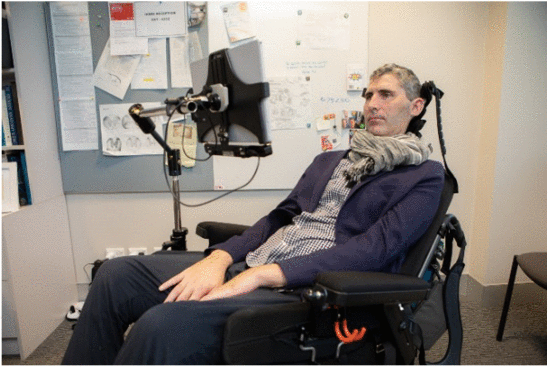
Figure 1. Professor Yerbury using assistive tech.
Yerbury identifies his eye gaze system, called the TM5 Mini and developed by EyeTech in the U.S.[3] as primary to his functioning (see Figure 1). “There are so many pieces of assistive technology that make my day run smoothly, but I couldn't communicate with the people around me, work, or communicate with the world without my eye gaze attached to my Surface Pro. … My eye gaze system allows me to control a PC and anything that can be controlled through the PC, including little things like operating the TV that people take for granted.” The device is designed to be stored under any screen monitor and allows its user control over tasks via a Microsoft Surface Pro laptop. The software used for his eye gaze hardware is QuickAccess, developed by Microsoft, which is included with the EyeTech hardware. However, conventional operating systems such as Microsoft Windows 10 are currently developed with built-in eye control.
In addition to the TM5-Mini, Dr. Yerbury uses the NeuroNode System,[4] a watch-like wearable assistive communication device. The NeuroNode System, developed by Control Bionics,[4] is designed to detect minuscule bioelectric impulses in the thumb, which allows control over phone or other cellular devices.
Technologies for Mobility
The second category of technologies relates to Dr. Yerbury's mobility. He uses an electric wheelchair called the TA iQ MWD, produced by TA Service in Denmark.[5] The wheelchair provides movement independence which Yerbury says, “allows me to get around, out of the house, and in the office.” This wheelchair is designed to move in a tight minimum radius, which makes maneuvering in a variety of spaces more manageable.
Respiratory Technologies
The third group of technologies supports respiration. Dr. Yerbury uses a noninvasive life support Astral 150 ventilator. “As I can't breathe on my own, my Astral 150 from Resmed (Australia), which is a portable respirator that sits on the back of my wheelchair, gives me the most comfort” of all his assistive devices, he says.
Most Desired Future Innovation—Brain–Computer Interface
Yerbury greatly appreciates the ability to communicate through the use of his eyes, allowing him to connect with others and the world. For the future, he says, “I think that a brain–computer interface that could speed communication would be amazing.” Something like Elon Musk's Neuralink,[14] he says “is an interesting proposition, and … would make life for people like myself easier. It would certainly speed things up,” as currently eye gaze software users must spell out individual words in order to communicate. But, Yerbury notes, “My main concern [with a brain–computer interface] is integration with AI. There are so many questions we have to answer before we should go ahead with this type of technology.” (See [7] for further discussion of issues related to brain–computer interfaces and AI.)
EXTERNAL LOW TECHNOLOGY
Another crucial set of technologies Yerbury uses are classified as low-tech tools that assist with tasks such as going to the restroom, moving position in bed, getting out of bed, getting dressed, or eating. For example, he uses an electronic bed that allows for easy repositioning, and a hoist with runners on the ceiling which allows him to move from bed to a chair.
However, Yerbury is clear that human support is essential in his daily life. “A lot of basics have to be performed with the help of people,” he says, “and I don't see that these basic tasks could be automated.” He himself has a large team of support staff. His experience has also informed his opinion about the function of robotics. Yerbury points to the adaptive processes that may be difficult to mimic, as tasks vary by incremental amounts. In general, he says, “the human aspect to these tasks are not replaceable at the moment.”
TECHNOLOGY IS NOT ONE SIZE FITS ALL
There are barriers to the use of technology for people with MND as well. Hobson et al.[8] report that technology use among people with MND varies widely, concluding that physical inaccessibility of certain functions and digital illiteracy are among the most common reported difficulties. They further note that the dependence on technology is a real concern as human care is gradually replaced by assistive technologies. “It would be impossible to have a one tech fits all in the case of MND because of the inherent heterogeneity” and varied expressions of progression of the disease, Yerbury agrees. “Site of onset plays a major role but so too does rate of progression. Two types of technology can be consistently used, eyegaze and neuronode.”
The role of manufacturers in the setup of the hardware and training on the technology varies greatly. Access to an occupational therapist also remains crucial to the setup process. In terms of learning how to use the hardware, Yerbury says, “I have found that the assistive technology that I have used is intuitive and normally takes me a few minutes to master.” Although, he says, “this is not the case for everyone.” Most of the electronic hardware Dr. Yerbury uses requires overnight charging, although his laptop and phone can charge through his wheelchair battery during the day. Yerbury reboots his computer regularly to maintain optimal processing power. For backup, “the most important pieces of equipment have to be duplicated. Things like the equipment that breathes for me is too important to not have a backup. I also have two eyegaze setups for the same reason. All of my work is stored on the cloud so I don't rely on any PC with my data.”
The Surface Pro laptop used by Dr. Yerbury has the maximum available capacity, but he says additional processing power would benefit the functionality of his systems.
Additionally, the technology Dr. Yerbury has adopted occupies a significant amount of space in his home. “Technology for myself takes up a lot of space,” he says, “the living space in our home has been drastically reduced.”
SOCIO-TECHNICAL ISSUES
There are many physical and social barriers that people with MND face in their environment on a daily basis. As more precise and cutting-edge innovations continue to be developed, it is essential to understand individual experiences in order to address MND concerns. In terms of advice to others dealing with MND, Yerbury remarks, “There is no instruction manual or advice that can make MND/ALS manageable. You really have to take it day by day.” He continues, “One piece of advice would be to stay ahead of the symptoms, don't wait until you need assistive technology because by then it is too late.”
There is also a great financial burden for those diagnosed with MND, and research indicates that there is inadequate government support and funding.[9] According to Dr. Yerbury, this deficiency is a serious concern for people with MND in Australia, as “the National Disability Insurance Scheme is looking for value for money so they balk at spending tens of thousands of dollars on equipment if your prognosis is poor.”
Yerbury also acknowledges that his position where he is able to work with developers to test the latest technologies is not the case for many living with MND. The costs of MND in Australia have been examined by Deloitte in 2015, and were estimated to be around AUD 1.1M annually per person.[10] However, Yerbury says, cost must not be a determining factor in supporting people with MND. “As a society,” he argues, “we need to decide if a basic quality of life is a fundamental right and if so stop evaluating whether someone's life is worth a dollar amount.”
ACKNOWLEDGMENTS
Yerbury generously agreed to a primary interview for this article on June 12, 2019. He conveyed his responses on August 18, 2019, and approved the piece for submission to the Magazine on September 4, 2020.
References
1. Dept. Health, Western Australia, “Motor neurone disease services for western Australia,” Perth, Western Australia : Health Networks Branch, Dept. Health, 2008. [Online]. Available: http://www.healthnetworks.health.wa.gov.au/modelsofcare/docs/Motor_Disease_Model_of_Care.pdf. Accessed: Oct. 1, 2019.
2. H. W. B. Cheng, “Supportive & palliative interventions in motor neurone disease: What we know from current literature?,” Ann. Palliative Med. vol. 7, no. 3, pp. 320–331, 2018.
3. TM5 Mini. 2019. [Online]. Available: https://www.eyetechds.com/tm5mini.html. Accessed: Oct. 1, 2019.
4. NeuroNode System. 2019. [Online]. Available: https://www.controlbionics.com/clinicians/. Accessed: Oct. 1, 2019.
5. TA IQ MWD. 2019. [Online]. Available: https://www.ta-service.dk/uk/power-wheelchair/produkter/896-ta-iq-mwd. Accessed: Sep. 28, 2019.
6. Astral 150. [Online]. Available: https://www.resmed.com/us/en/healthcare-professional/products/devices/astral-150.html. Accessed: Sep. 28, 2019.
7. A. S. Rutschman, “Stephen Hawking warned about the perils of artificial intelligence—yet AI gave him a voice,” Conversation, 2018. [Online]. Available: https://theconversation.com/stephen-hawking-warned-about-the-perils-of-artificial-intelligence-yet-ai-gave-him-a-voice-93416. Accessed: Sep. 30, 2019.
8. E. V. Hobson, S. Fazal, P. J. Shaw, and C. J. McDermott, “‘Anything that makes life's journey better.’ Exploring the use of digital technology by people living with motor neurone disease,” Amyotroph. Lateral Scler. Front. Degener., vol. 18, pp. 378–387, 2017.
9. C. Birks, “Introducing competition and informed user choice into human services: Reforms to human services,” Sydney, Australia, 2017.
10. Deloitte, “Economic analysis of motor neurone disease in Australia,” 2015. [Online]. Available: https://www2.deloitte.com/au/en/pages/economics/articles/economic-analysis-motor-neurone-disease-australia.html Accessed: Oct. 10, 2019.
11. L. Wachsmuth, “`They didn't treat me as a person’: Scientist with MND denied family cruise holiday,” Sydney Morning Herald, Mar. 11, 2019.
12. B. Turner and J. Atkin, Motor Neuron Diseases Causes, Classification and Treatments (Neurology–Laboratory and Clinical Research Development Series). New York, NY, USA : Nova Science, 2012.
13. U.S. NIH, “Arterial lateral sclerosis,” Genetics Home Res., U.S. Nat. Lib. Med., Jul. 28, 2020 ; [Online]. Available: https://ghr.nlm.nih.gov/condition/amyotrophic-lateral-sclerosis#inheritance
14. E. Mack, “Elon Musk says an ‘awesome” Neurolink update is coming soon,” CNET, Feb. 4, 2020. [Online]. Available: https://www.cnet.com/news/elon-musk-says-an-awesome-neuralink-update-is-coming-soon/
15. A. Drewitt-Smith and N. Rheinberger, `` Despite MND, Dr Justin Yerbury takes to the skies for working holiday thanks to custom hoist,” ABC News, Nov. 27, 2019 ; [Online]. Available: https://www.abc.net.au/news/2019-11-28/first-flight-for-nsw-man-with-severe-disability/11746000
16. K. Charmaz, Good Days, Bad Days: The Self in Chronic Illness and Time. New Brunswick, NJ, USA : Rutgers Univ. Press.
Authors
Salah Hamdoun is currently working toward the Ph.D. degree with the School for the Future of Innovation in Society, Arizona State University. His work is focused on human development and innovation. He is the administrator of the IEEE Transactions on Technology and Society. Contact him at shamdoun@asu.edu.
Arizona State University
Katina Michael is a tenured professor with the School for the Future of Innovation in Society and the School of Computing, Informatics and Decision Systems Engineering, Arizona State University. She is the Director of the Society Policy Engineering Collective, and the founding Editor-in-Chief of the IEEE Transactions on Technology and Society. She is a board member of the Australian Privacy Foundation. Contact her at katina.michael@asu.edu.
The University of Toledo
Rebecca Monteleone is an Assistant Professor of Disability Studies at the University of Toledo, focusing on the social and political dimensions of assistive and medical technology design and use. Contact her at Rebecca.Monteleone@utoledo.edu.
IEEE Technology and Society Magazine
Terri Bookman is an Editor and Journalist. She was the Managing Editor of IEEE Technology and Society Magazine from 1990 to 2020. Contact her at t.bookman@ieee.org.
We remember Justin Yerbury for his celebration of life and his contribute to academia. He reposed on 28 July 2023. He was 49 years old.
Citation: S. Hamdoun, K. Michael, R. Monteleone and T. Bookman, "Assistive Technologies for Greatly Improved Quality of Life for People Living With MND/ALS," in IEEE Consumer Electronics Magazine, vol. 10, no. 3, pp. 76-81, 1 May 2021, doi: 10.1109/MCE.2020.3035523.