Are You Addicted to Your Smartphone, Social Media, and More?
Citation: K. Michael, "Are You Addicted to Your Smartphone, Social Media, and More?: The New AntiSocial App Could Help," in IEEE Consumer Electronics Magazine, vol. 6, no. 4, pp. 116-121, Oct. 2017, doi: 10.1109/MCE.2017.2714421.
Back in 1998, I remember receiving my first second-gen eration (2G) mobile assign ment at telecommunications vendor Nortel: a bid for Hutchi son in Australia, a small alternate opera tor. At that time, I had already grown accustomed to modeling network traffic on traditional voice networks and was beginning to look at the impact of the Internet on data network dimensioning. In Australia, we were still relying on the public switched telephone network to dial up the Internet from homes, the Integrated Services Digital Network in small-to-medium enterprises, and leased lines for larger corporates and the gov ernment. But modeling mobile traffic was a different affair. Your Smartphone, Social Media, and More? The new AntiSocial app could help.
I remember thinking: how will we begin to categorize subscribers, and what kinds of network patterns could we expect in mobility? I recall begin ning to define the market segments into four categories, which included security (low-end users), road warriors (high-end corporate users), socialites (youth market), and everyday users (average users). Remember, this was even before the rise of the Wireless Application Proto col. As naysayers said that the capital expenditure spent on 2G networks would be prohibitive and that investments would never be recouped for decades, subscribers’ usage rapidly increased with devices like the Research in Motion Blackberry, which allowed for mobile e-mail.
Fast-forward to 2000. I was already knee-deep in third generation (3G) mobile bids, predicting the cost of 3G spec trum in emerging and developed markets, increasing my categories of subscriber types from four to nine segments, and calculating upload and download rates for top mobile apps like gaming, images (photos and imaging), and e-mail with chunky PowerPoint attachments and other file types. We knew what was coming was big, but perhaps we our selves sitting on the coalface didn’t realize what a big impact it would actually have on our lives and the lives of our children. Our models showed average revenues per user of US$120 per month for corporates. At the time, most of us believed the explosion that would take place in the coming decade (but not as big as it turned out to be), despite preach ing the mantra that voice is now just another bit of data. In calculating pricing models, we brainstormed with one another: who would spend over 100 min on a mobile? Or who would spend hours gaming on a handset rather than a larger gaming console?
Enter social media, enabled by this wireless Internet pro tocol (IP) revolution and the rapid increase in diverse mobile hardware from netbooks to tablets to smartphones and smartwatches. Then things rapidly changed again. LinkedIn, Facebook, Twitter, Instagram, Snapchat, and WeChat are all enjoyed by social media users (consumers and professionals) around the globe today, and it is estimated that there will be 2.67 billion social network users by 2018 [1]. Over one-third of consumers worldwide, more than 2.56 billion people, will have a mobile phone by 2018, and more than half of these will have smartphone capability, making feature phones the minority [2].
The Social Media Boom
When Google announced that a staggering 24 billion selfies were uploaded to its servers alone in 2015, consuming 13.7 pet abytes of storage space, I stopped and contemplated the meaning of these statistics [3]. What about the zillions of selfies uploaded to Apple’s iCloud, posted to Facebook, Instagram, Snapchat, and Twitter? It means that in one’s average lifetime, most people are taking at least one selfie a day and sharing their image publicly. This figure is much higher for the impressionable teen market, with a 2015 Google study reporting that youth take, on average, 14 selfies and 16 photos or videos, check social media 21 times, and send 25 text messages per day [4]. This number continues to grow steadily, according to fresh evidence by Pew Internet Research [5], and is now even impacting workplace productivity [6]. In the same year that Google announced the selfie statistics, Russia’s Ministry of Internal Affairs began a Safe-Selfie cam paign [7], stating: “When you take a selfie, make sure that you are in a safe place and your life is not in danger!” (Figure 1). This was followed, of course, by the acknowledged deaths that had occurred while younger and older individuals were in the process of taking selfies, and the rate of frequency outnumbered shark attacks in 2015 [8]. One cannot fathom.
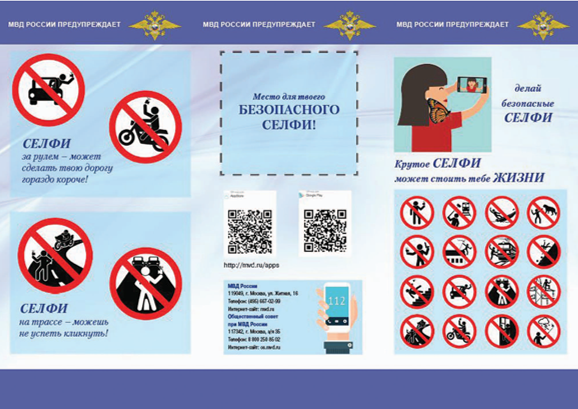
Figure 1. Russia’s Safe-Selfie campaign flyer.
Noticeable is the adoption of high-tech gadgetry, especially in the childhood to youth markets, with an even greater penetra tion by teenagers and individuals younger than 34 years. It is rather disturbing to read that 24% of U.S. teens go online “almost constantly” [5], facilitated by the widespread penetra tion of smartphones and increasing requirement of tablets in the secondary education system. The sheer affordability of tech gear and its increasing multifunctionality now means that most people have digital Swiss Army knives at their disposal with a smartphone. By accessing the Internet via your phone, you can upload pictures, browse websites, navigate locations on maps, and be reachable any time of the day. The allure of how to kill time while waiting for appointments or in public transportation means that most people are frequently engaged in some form of interaction through a screen. The short-lived Google Glass was a hands-free solution that would have brought the screen right up to the eye [9], but while momentarily halted, one can envis age a future where we are seeing everything through filtered lenses. Google Glass Enterprise edition is now on sale [35]!
“Preoccupied, Distracted, or Addicted to Social Media? Social networking already accounts for 28% of all media time spent online, and users between the ages of 15 and 19 spend at least 3 h per day, on average, using platforms like Facebook, Twitter, and Instagram. Approximately 60–80% of the amount of time that people spend on the Internet at work has nothing to do with work. It’s estimated that the average American spends nearly one quarter of his or her work day browsing social media for nonwork-related activities.”
“▼ I spend a lot of time thinking about Facebook or planning my use of Facebook.
▼ I feel an urge to use Facebook more and more.
▼ I use Facebook to forget about personal problems.
▼ I’ve tried to cut down on my use of Facebook without success.
▼ I’ve become restless or troubled if I am prohibited from using Facebook.
▼ I use Facebook so much that it has had a negative impact on my job or studies.”
The Rise of Internet Addiction
Experts have tried to quantify the amount of time being spent on screens, specific devices (smartphones), and even particular apps (e.g., Facebook), and have identified guidelines for various age groups for appropriate use. Most notable is the work started by Dr. Kimberly Young in 1995 when she established her website netaddiction.com and clinical practice, the Center for Internet Addiction. She has been conducting research on how the Inter net changes people’s behavior. Her guideline “3-6-9-12 Screen Smart Parenting” has gained worldwide recognition [10].
Increasingly, we are hearing about social media addiction sto ries (see “Social Media Addiction” [11] and “Mental Health and Social Media” [36]). We have all heard about the toddler scream ing for his or her iPad before breakfast and gamers who are reluctant to come to dinner with the rest of the family (indepen dent of gender, age, or ethnicity) unless they are instant messaged. There is a growing complexity around the diagnosis of various addiction behaviors. Some suffer from Internet addiction broadly, while others are addicted to computer gaming, smartphones, and even social media. It has been postulated by some researchers that most of these modern technology-centric addictions are age-old causes, such as obsessive-compulsive disorder, but they have defi nitely been responsible for triggering a new breed of what I con sider to be yet-to-be-defined medical health issues.
In the last five years, especially, much research has begun in the area of online addiction. Various scales for Internet addic tion have been developed by psychologists, and there are even scales for specific technologies now, like smartphones. The South Koreans have developed the Smartphone Addiction Scale, Smartphone Addiction Proneness Scale, and the KS-scale, a method for Koreans to self-report Internet addiction using a short-form scale. Unsurprisingly, these scales are significant for the South Korean market, given it is the world leader in Internet connectivity, having the world’s fastest average Inter net connection speed with roughly 93% of citizens connected. It therefore follows that the greater the penetration of high speed Internet in a market, the greater the propensity for a sub scriber to suffer from some form of online addiction. There are even scales for social media applications, e.g., the Bergen Facebook Addiction Scale (BFAS) developed by Dr. Cecile Andraessen at the University of Bergen in Norway in 2012 (see “BFAS Survey Statements” [12]).
Accessible Internet Feeds the Addiction
Despite its remoteness to the rest of the world, Australia sur prisingly does not lag far behind the South Korean market. According to the Australian Bureau of Statistics, in 2013, 94% of Australians were Internet users, but regional areas across Australia do not enjoy the same high-speed access as in South Korea, despite the National Broadband Network initiative that was founded in 2009, with the actual rollout beginning in 2015. Yet, alarmingly, one recognized industry report, “Digital Down Under,” stated that 13.4 million Australians spent a whopping 18.8 h a day online [13]. This statistic has been contested but commensurately backed by Lee Hawksley, managing director of ExactTarget Australia, who oversaw the research. She has gone on record saying, “...49% of Australians have smart phones, which means we are online all the time…from waking to sleep, when it comes to e-mail, immersion, it’s even from the 18–65s; however, obviously with various social media channels the 18–35s are leading the charge.”
According to the same study, roughly one-third of women living in New South Wales are spending almost two-thirds of their day online. And it is women who are 30% more likely to suffer anxiety as a result of participating in social media than men [14]–[16]. This is even greater than the Albrecht and Michael deduction of 2014, which estimated that people in developed nations are spending an average of 69% of their waking life behind the screen [17]. That is about 11 h behind screens out of 16 waking hours. But, no doubt, people are no longer sleeping 8 h with access to technology at arm’s reach within the bedroom, and, as a result, cracks are appearing in relationships, employment, severe sleep deprivation, and other areas as a result of screen dependencies [18].
It is difficult to say what kinds of specific addictions exist in relation to the digital world, and various countries identify market-relevant scales and measures. While countries like China, Taiwan, and South Korea acknowledge there is something called “Internet addiction” as a diagnosed medical condition, other countries, e.g., the United States, prefer not to be explic it about the condition, such as in the Diagnostic and Statisti cal Manual of Mental Disorders, 5th edition (DSM-V) [19]. Instead, a potential new diagnosis, Internet gaming disorder, is dealt with in an appendix of the DSM-V [20], [21]. Generally, Internet addiction is defined as “the inability of individuals to control their Internet use, resulting in marked distress and/or functional impairment in daily life” [22]. Some practitioners have likened online addiction as being akin to substance-based addiction. Usually it manifests predominantly in one of three quite separate but sometimes overlapping subtypes in an indi vidual: excessive gaming, sexual preoccupations [23], and e-mail/text/social media messaging [24].
Shared Data and the Need to Know
For now, what has been quantified and is well known is the amount of screen time spent by individuals in front of multiple platforms: Internet-enabled television (e.g., Netflix), play stations (for video games), desktops (for browsing), tablets (for pictures and editing), and smartphones (for social media messaging). Rest assured, the IP-enabled devices we are enjoying are passing on our details to corporations, who in the name of billing now accu rately know about our family’s every move, digitally chronicling our preferences and habits. It is a form of pervasive social and behavioral biometrics, allowing big business to know app-by-app your individual thoughts. What is happening to all this metadata? Of course, it is being repurposed to give you more of the same, generating even more profit for interested businesses. For some capitalists, there is nothing wrong with this calculated engineer ing. Giving you more of what you want is the new mantra, but it does have its side effects, obviously.
The Australian Psychological Society issued its “Stress and Wellbeing in Australia” report last year, which included a By accessing the Internet via your phone, you can upload pictures, browse websites, navigate locations on maps, and be reachable any time of the day. section on social media fear of missing out (FOMO) [25]. Alongside FOMO, we also now have a fear of being off the grid, or FOBO, and the fear of no mobile, or NoMo [26]. I personally know adults who will not leave their homes in the morning unless they have watched the top ten YouTube vid eos of the day or won’t go to sleep until every one of those last e-mails has been answered and placed in the appropriate folder and actioned. Screen times are forever increasing, and this has come at the expense of physical exercise and one-to one time with loved ones.
There are reports of men addicted to video games who cannot keep a nine-to-five job, there are women suffering from depression and anxiety because they compare their online status with that of their peers, there are children who message on Instagram throughout the night, and there are those who are addicted to their work at the expense of all physical relationships around them. Perhaps most disturbingly are the increasing cases of online porn exposure by children between the ages of 9 and 13 years in particular [27], cyber sexual activities in adolescence, or extreme social-media com munities that spread disinformation. If it’s being conducted virtually, then it must not be real, with no physical repercus sions; but far from it, online addictions generate a guilt that remains and is hard to rid. This is particularly true of misde meanors published to the websphere that can be played back, disallowing individuals to forget about their prior actions or break out of stereotypes [28].
A New Tool: The Antisocial App
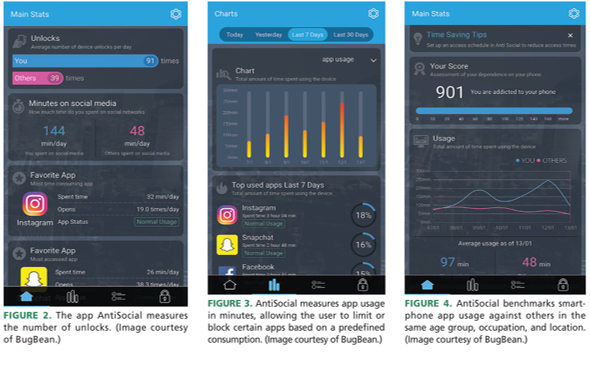
Figure 2. The app AntiSocial measures the number of unlocks. (Image courtesy of BugBean.) Figure 3. AntiSocial measures app usage in minutes, allowing the user to limit or block certain apps based on a predefined consumption. (Image courtesy of BugBean.) Figure 4. AntiSocial benchmarks smart phone app usage against others in the same age group, occupation, and location. (Image courtesy of BugBean.)
Endless pings tend to plague smartphone users if their set tings have not been tweaked for anything but a default [29]. Notifications and alerts are checked while users are driving (even if it is against the law to text and drive), in the middle of a conversation, in bed while being intimate, while using the restroom, or even while taking a shower. But no one has ever measured the end-to-end use through actual surveying of digital instrumentation in an open market setting. It has been left to self-reporting mechanisms or applications that have run on a desktop that might monitor how long workers use various work applications or are on e-mail or closed survey ing of populations participating in trials. But manual volun tary audit logs are often incomplete or underreport actual usage, and closed trials are not often representative of reality. At best, we can point to the South Korean smartphone verifi cation and management system that has helped to raise awareness that such a system is needed for intervention [30].
And yet, the concern is so high that we can say with some confidence that it won’t take long for companies to come out with socially responsible technologies and software to help us remain in the driver’s seat with some confidence. Figure 4. AntiSocial benchmarks smart phone app usage against others in the same age group, occupation, and location. (Image courtesy of BugBean.) challenge is about empowering you, and letting you exploit the technology at your fingertips without it exploiting you. The anTiSocial app will help
Enter the new app called AntiSocial, created by Mel bourne, Australia, software company BugBean, which has consumer interests at heart [31]. Antisocial.io has taken the world by storm and has been downloaded on GooglePlay by individuals in over 150 countries within just a few months. The fact that it ranked number three on the U.K. GooglePlay downloads after only a few days demonstrates the need for it. It will not only accurately record usage in multiple application contexts but also encourage mindfulness about usage. AntiSo cial does not tell users to stop using social media or stop video gaming for entertainment, but it reminds people to consider their digital calorie intake by comparing their behaviors with other anonymous users in their age group, occupation, and location. It is not about shaming users but raising individual awareness and wasting less time. We say we are too busy for this or that, and yet we don’t realize we are getting lost and absorbed in online activities. How do we reclaim some of this time [32]? It may well be as simple as switching off the phone in par ticular settings, deliberately not taking it with you on a given outing, or having a digital detox day once a week or once a month. It might be taking responsibility for the length of screen time you have when you are away from the office or using AntiSocial to block certain apps after a self-determined amount of time has been spent on the app on any given day [33]. Whatever your personal solution, taking the AntiSocial challenge is about empowering you, and letting you exploit the technology at your fingertips without it exploiting you.
Some of the social problems that arise from smartphone and/ or social media addiction in particular include sleep depravi ty, anxiety, depression, a drop in grades, and anger manage ment issues. AntiSocial provides a count of the number of unlocks you perform on your handset (Figure 2) and tells you in minutes how long you use each application (Figure 3), including cameras, Facebook and Instagram, and your favor ite gaming app. It will help you to compare yourself against others and take responsibility for your use (Figure 4). You might choose to replace that time spent on Facebook, e.g., with time walking the dog, helping your kids with their homework, or even learning to cook a new recipe [34]. There is also a paired version that can be shared between parents and their children or even colleagues and friends. You might like to set yourself a challenge to detox digitally, just like you might do at your local gym in terms of fitness and weight loss. Have fun within a two-week timeframe, declar ing yourself the biggest loser (of mobile minutes, that is) and report back to family and friends on what you feel you have gained. You might be surprised how liberating this actually feels.
You’ll come away appreciating the digital world and its conveniences a great deal more. You’ll also likely have a clearer head and not be tempted to snap back a reply online that might hurt another or inadvertently hurt yourself. And you’ll be able to use the AntiSocial app to become more social and start that invaluable conversation with those loved ones around you in the physical space. aBouT The auThor Katina Michael (katina@uow.edu.au) is a professor in the School of Information Systems and Technology at the Universi ty of Wollongong, New South Wales, Australia. She is the edi tor-in-chief of IEEE Technology and Society Magazine. She is also a senior editor of IEEE Consumer Electronics Magazine.
References
[1] Statista. (2017). Number of social media users worldwide from 2010 to 2020. [Online]. Available: https://www.statista.com/statistics/278414/ number-of-worldwide-social-network-users/
[2] eMarketer. (2014). 2 billion consumers worldwide to get smart(phones) by 2016. [Online]. Available: https://www.emarketer.com/Article/2- Billion-Consumers-Worldwide-Smartphones-by-2016/1011694
[3] R. Gray. (2016).What a vain bunch we really are! 24 billion selfies were uploaded to Google last year. Daily Mail. [Online]. Available: http://www.dailymail.co.uk/sciencetech/article-3619679/What-vain bunch-really-24-billion-selfies-uploaded-Google-year.html
[4] DNA. (2015). Average youth clicks 14 selfies a day, says Google study. Daily News and Analysis. [Online]. Available: http://www. dnaindia .com/lifestyle/report-average-youth-clicks-14-selfies-a-day-says-google study-2117522
[5] A. Lenhart. (2015). Teens, social media & technology overview 2015 Pew Internet Research. [Online]. Available: http://www.pewinternet .org/2015/04/09/teens-social-media-technology-2015/
[6] K. Olmstead, C. Lampe, and N. B. Ellison. (2016). Social media and the workplace. Pew Research Centre. [Online]. Available: http://www .pewinternet.org/2016/06/22/social-media-and-the-workplace/
[7] MOIA. (2015). Safe selfie. Ministry of Internal Affairs. [Online]. Available: https://xn–b1aew.xn–p1ai/safety_selfie
[8] H. Horton. (2015). More people have died by taking selfies this year than by shark attacks. [Online]. Available: http://www.telegraph.co.uk/ technology/11881900/More-people-have-died-by-taking-selfies-this year-than-by-shark-attacks.html
[9] K. Michael. (2013). For now we see through a glass, darkly. IEEE Technol. Soc. Mag. [Online]. 32(4), pp. 4–5. Available: http://ieeexplore .ieee.org/stamp/stamp.jsp?arnumber=6679307
[10] K. Young, “Children and technology: Guidelines for parents—rules for every age,” IEEE Technol. Soc. Mag., vol. 36, no. 1, pp. 31–33, 2017.
[11] S. Bennett. (2014). Social media addiction: Statistics & trends. AdWeek. [Online]. Available: http://www.adweek.com/digital/social media-addiction-stats/
[12] C. S. Andreassen, T. Torsheim, G. S. Brunborg, and S. Pallesen. (2012). Development of a Facebook addiction scale. Psychol Rep. [Online]. 110(2), pp. 501–517. Available: https://www.ncbi.nlm.nih.gov/ pubmed/22662404
[13] M. J. Angel. (2013). Living the “iLife”—are Australians Internet junkies? Sydney Morning Herald. [Online]. Available: http://www.smh .com.au/lifestyle/life/living-the-ilife–are-australians-internet-junkies 20130418-2i2fu.html
[14] M. Maldonado. (2016). The anxiety of Facebook. PsychCentral. [Online]. Available: https://psychcentral.com/lib/the-anxiety-of-facebook/
[15] R. Williams. (2014). How Facebook can amplify low self-esteem/ narcissism/anxiety. PsychologyToday. [Online]. Available: https://www .psychologytoday.com/blog/wired-success/201405/how-facebook-can amplify-low-self-esteemnarcissismanxiety
[16] J. Huntsdale. (2015). Unliking Facebook—the social media addic tion that has you by the throat. ABC. [Online]. Available: http://www.abc .net.au/local/stories/2015/01/23/4177043.htm
[17] K. Albrecht and K. Michael. (2014). We’ve got to do better. IEEE Technol. Soc. Mag. [Online]. 33(1), pp. 5–7. Available: http://ieeexplore .ieee.org/abstract/document/6763240/
[18] M. Gradisar, A. R. Wolfson, A. G. Harvey, L. Hale, R. Rosenberg, and C. A. Czeisler. (2013). The sleep and technology use of Americans: Findings from the National Sleep Foundation’s 2011 sleep in America poll. J. Clin. Sleep Med. [Online]. 9(12), pp. 1291–1299. Available: https://www.ncbi.nlm.nih.gov/pmc/articles/PMC3836340/
[19] R. Pies. (2009). Should DSM-V designate “Internet addiction” a mental disorder? Psychiatry. [Online]. 6(2), pp. 31–37. Available: https:// www.ncbi.nlm.nih.gov/pmc/articles/PMC2719452/
[20] N. M. Petry, F. Rehbein, C. H. Ko, and C. P. O’Brien. (2015). Inter net gaming disorder in the DSM-5. Curr. Psychiatry Rep. [Online]. 17(9), p. 72. Available: https://www.ncbi.nlm.nih.gov/pubmed/26216590
[21] K. Albrecht, K. Michael, and M.G. Michael, “The dark side of video games: Are you addicted?” IEEE Consum. Electron. Mag., vol. 5, no. 1, pp. 107–113, 2015.
[22] J. H. Ha, H. J. Yoo, I. H. Cho, B. Chin, D. Shin, and J. H. Kum. (2006). Psychiatric comorbidity assessed in Korean children and adolescents who screen positive for Internet addiction. J. Clin. Psychiatry. [Online]. 67, pp. 821–826. Available: https://www.ncbi.nlm.nih.gov/pubmed/16841632
[23] K. Young. (2016). Help for cybersex addicts and their loved ones. IEEE Technol. Soc. Mag. [Online]. 35(4), pp. 13–15, 2016. Available: http://ieeexplore.ieee.org/stamp/stamp.jsp?arnumber=7790994
[24] Y. H. C. Yau, M. J. Crowley, L. C. Mayes, and M. N. Potenza. (2012). Are Internet use and video-game-playing addictive behaviors? Biological, clinical and public health implications for youths and adults. Minerva Psichiatr. [Online]. 53(3), pp. 153–170. Available: https://www .ncbi.nlm.nih.gov/pmc/articles/PMC3840433/
[25] L. Merrillees. (2016). Psychologists scramble to keep up with growing social media addiction. ABC News. [Online]. Available: http:// www.abc.net.au/news/2016-04-03/psychologists-scramble-to-keep-up with-social-media-addiction/7293862
[26] P. Valdesolo. (2015). Scientists study Nomophobia—fear of being without a mobile phone. Scientific American. [Online]. Available: https:// www.scientificamerican.com/article/scientists-study-nomophobia mdash-fear-of-being-without-a-mobile-phone/
[27] M. Ybarra and K. J. Mitchell. (2005). Exposure to Internet pornog raphy among children and adolescents: A national survey. Cyberpsychol ogy and Behaviour. [Online]. 8(5), pp. 473–486. Available: http://online .liebertpub.com/doi/abs/10.1089/cpb.2005.8.473
[28] K. Michael and M. G. Michael, “The fallout from emerging technol ogies: Surveillance, social networks and suicide,” IEEE Technol. Soc. Mag., vol. 30, no. 3, pp. 13–17, 2011.
[29] J. Huntsdale. (2017). Social media monitoring apps shine spotlight on Internet addiction. ABC News. [Online]. Available: http://www.abc .net.au/news/2017-02-22/social-media-addiction-monitoring-app/8292148
[30] S.-J. Lee, M. J. Rho, I. H. Yook, S.-H. Park, K.-S. Jang, B.-J. Park, O. Lee, D. K. Lee, D.-J. Kim, and I. Y. Choi. (2016). Design, development and implementation of a smartphone overdependence management sys tem for the self-control of smart devices. Appl. Sci. [Online]. 6, pp. 440 452. Available: http://www.mdpi.com/2076-3417/6/12/440/pdf
[31] Bugbean, AntiSocial.io. (2017). Google Play. [Online]. Available: https://play.google.com/store/apps/details?id=com.goozix.antisocial_ personal&hl=en
[32] P. Peeke. (2013). Hooked, hacked, hijacked: Reclaim your brain from addictive living: Dr. Pam Peeke TEDxWall Street. [Online]. Avail able: https://www.youtube.com/watch?v=aqhzFd4NUPI
[33] K. Michael. (2017). Facts and figures: The rise of social media addic tion: What you need to know PC World. [Online]. Available: http://www .pcworld.idg.com.au/article/614696/facts-figures-rise-social-media-addiction/
[34] C. Dalgleish. (2017). 10 things you should do instead of sitting on social media. The Cusp. [Online]. Available: http://thecusp.com.au/10 things-instead-sitting-social-media/15142
[35] A. Myrick. (2017) Google Glass makes an unexpected return with its new Enterprise Edition. [Online]. Available: https://phandroid.com/ 2017/07/18/google-glass-enterprise-edition/ [36] (2017). Mental Health and Social Media. [Online]. Available: https:// www.youtube.com/watch?v=VDx9djMuIFg&t=140s, July 15, 2017
Author
Katina Michael
Katina Michael (katina@uow.edu.au) is a professor in the School of Information Systems and Technology at the Universi ty of Wollongong, New South Wales, Australia. She is the edi tor-in-chief of IEEE Technology and Society Magazine. She is also a senior editor of IEEE Consumer Electronics Magazine.
Citation: K. Michael, "Are You Addicted to Your Smartphone, Social Media, and More?: The New AntiSocial App Could Help," in IEEE Consumer Electronics Magazine, vol. 6, no. 4, pp. 116-121, Oct. 2017, doi: 10.1109/MCE.2017.2714421.