Socio-Technical Design for Public Interest Technology
Citation: R. Abbas, J. Pitt and K. Michael, "Socio-Technical Design for Public Interest Technology," in IEEE Transactions on Technology and Society, vol. 2, no. 2, pp. 55-61, June 2021, doi: 10.1109/TTS.2021.3086260.

Photo by Milad Fakurian on Unsplash
SECTION I.
Introduction
French political and social scientist, Ellul [1, pp.52–60] explained that in prehistoric times, invention was a necessity, a movement to ensure humans could survive the elements. By the beginning of the Industrial Revolution, he noticed an obvious shift in the reason for invention: from necessity to that of the special interest of the state. By the 19th century again, the reason for invention changed to that of the special interest of the bourgeoisie who could see the profits that could be generated by the deliberate development of a technique. Since about the 1600s people have invested their money in stock in order to receive dividends; this practice became particularly attractive in the 20th century.
As innovations aided the creation of networked routes by air, rail, road, and ocean, systems of innovation (SI) evolved to bring relevant stakeholders closer together both geographically and in the specialization of various technology types. In our digital age, the deployment of electronic services means that complex and open systems are being created in the name of progress. But how do we ensure that such open socio-technical systems satisfy the needs of society, through embedding values by design? This special issue brings together socio-technical design for public interest technology (PIT), acknowledging the role of innovation and its place in modern democracies.
SECTION II.
Finite Resources and Self-Determination
Throughout history and across geography, communities of people have encountered structurally similar problems: for example, common-pool resource management, whereby a community has to sustain a finite and depletable resource in the long term by limiting its consumption in the short term; or collective risk dilemmas, where a community has to invest in protection against a potential disaster whose occurrence and severity is unknown.
Such situations can and have been extensively modeled using game theory [2], with solution concepts (such as the Nash equilibrium) providing a significant degree of predictive leverage, and also establishing the basis for the folklore of the inevitable tragedy of the commons. However, Ostrom [3] offered an alternative approach to resolving such problems, observing that many communities successfully managed to free themselves from the supposedly remorseless constraints of an operational-choice resource-distribution game (i.e., sustaining a shared commons). They achieved this by self-determination: collectively, voluntarily, and mutually agreeing to comply with a set of conventional rules (that Ostrom called an institution), thereby defining a collective-choice political metagame which effectively side-effected the outcome utilities of the object-level (operational-choice) game.
However, according to the iron law of oligarchy proposed by Michels [4], it is equally tragically inevitable that a minority should succeed in gaming the political metagame, i.e., to engage in strategic manipulation through political machination [5]. As a result, such sets of rules are exploited so that the institution operates to further the narrow interest of a clique rather than the common interest of the entire community. This is one reason why agent-based modeling of Ostrom’s constitutional-choice rules (the metagame) is so difficult (see [6]): it presupposes that the agents are capable of learning how to exploit the collective-choice rules within the context of a social network of powerful (or rather, power-usurping) self-interested agents [7]. Preventing such manipulation is one of the cornerstones of Ober’s [8] theory of Basic Democracy, through the agreement on, and entrenchment of, foundational rules that are intended to avoid tyranny in any of its various forms: autocracy, majoritarianism, or oligarchy.
Fueled by the rapid pace of technological development (in particular Artificial Intelligence), the Digital Transformation to the Digital Society, and the consequent increase in the deployment of ever more complex socio-technical systems, is bringing about another manifestation of these types of problem, only now occurring in digital environments or networked infrastructure [9]. One example is provision to (and appropriation from) data, information, and knowledge in participatory sensing applications [10]; another is the idea of attention itself as a common-pool resource in the so-called attention economy[11]; and yet another is the use of local renewables generation and storage to create a common-pool resource for demand-side energy distribution in community energy systems.
However, in all these examples, we can observe a tension between the common good and a commercial or financial imperative. For instance, in participatory sensing applications, the “work” is performed at the edge but the benefit (and profit) mostly accrues at the center. A similar asymmetry of power exists in the attention economy, as the private ownership of the means of social coordination enables unscrupulous misinformation and disinformation to monopolize, distract, and commodify attention, polarize communities, and fragment common knowledge [12], [13] thereby inhibiting opportunities for meaningful collective action, e.g., to tackle climate change. In community energy systems, the Matthew effect is brought to the fore, as those already with assets can, during storms, for example, be paid to charge their electric cars, while those without have to choose between heating their food or heating their homes [14], [15]. Where, in all these examples is the common good, or even social justice—indeed: where is the public interest, [16], [17] in the context of such rapid technological progress?
SECTION III.
Complexity and Technological Progress
Much deliberation has gone into the question of what constitutes technical progress. Westrum wrote that technological progress “occurs when better devices replace less adequate ones.” He emphasized however that innovation did not always mean progress, that is, a transition to something better [18, p.160]. Kuhns [19, p. 11] saw technological change as an almost “necessary historical and ecological development.” But it was Ellul [20, p. 421] who observed that as the world accelerates into “an astonishing degree of complexity” that it is met with commensurate “new problems that raise new difficulties.” Furthermore, he noted: “we succeed progressively in solving these difficulties, but only in such a way that when one has been resolved we are confronted by another. Such is the progress of technology in our society.”
In “The Technological Order,” Ellul [20] called attention to the ambiguous nature of technological progress, noting that technological progress in itself cannot be deemed good or bad, but rather the nature of this progress is characterized by elements that are both antithetical and inextricably linked. Elements that contribute to this ambiguity relate to: the inescapable (nonmonetary) costs of technical progress; the emergent problems that technique produces as opposed to those which it solves; the entangled nature of its desirable and undesirable effects; and the inevitability of unintended consequences [21], [22]. Ellul’s sentiments on technological progress, technique, ambiguity, and the associated complexities are valid today, and increasingly so given the digital transformation highlighted above and the pervasiveness of technological systems, or more accurately, complex socio-technical ecosystems within which we exist and form an integral part. But before we address the design of these complex socio-technical ecosystems [23] against the value and role of PIT, it is important to consider how systems of innovation (SI) form and function and why approaching phenomena from a multi/inter/transdisciplinary lens is critical when dealing with complexity and highly meshed stakeholders in open systems [24]. We cannot any longer rely purely on the disciplines of business and STEM to continue to evolve our systems thinking practice, and in this way, we are calling for at least a recognition of the humanities and social sciences in a hope they will infuse our future development processes [25]. This does not mean that interdisciplinarity does not come without criticism [26], but that there needs to be some acknowledgment that science and business must be with society and not for it. That the reason we create and design things is for the sustainability of ecosystems rich in biodiversity; and not to deplete for short-term gains. And this takes a nuanced coordinated effort, where the process is more important than products that make interim profits until they reach market saturation.
SECTION IV.
Systems of Innovation (SI)
The SI approach is a holistic and interdisciplinary framework that defines innovation as an evolutionary process, not as a process for achieving optimality [27]. Edquist [28, p. 21] explained that “the notion of optimality is absent from the SI approach. The notion of optimality stems from static equilibria and therefore is not applicable to process of technological change.” SI emphasizes that firms do not innovate in isolation but interact with other organizational actors in the economy (other firms, universities, standard setting organizations, industry alliances, and consortia) within existing institutional rules of engagement (laws, regulations, codes, norms, and technical standards). There is a distinction in SI that institutions focus on laying the foundations of how interactions occur, while organizations are the actors that are engaged in interactive learning. The strength of SI is in being inclusive of some or all of the following determinants of innovation—economic, social, political, organizational, and institutional—and additional factors that may be found to influence the invention, development, diffusion, and application of innovations [29, p. 14f)].
Sahal [30, p. 64] in his book Patterns of Technological Innovation noted that evolution was not just a matter of “chop and change”; it related to the “very structure and function of the object.” He stated that innovation was “inherently a continuous process that [did] not easily lend itself to the description in terms of discrete events” [30, p.23]. Nelson [31, p. 16] echoed Sahal, when he too wrote that “technical change [was] clearly an evolutionary process.” He believed that the innovation generator kept making technologies superior to those in an earlier existence. However, as later clarified by Edquist “only superior in a relative sense, not optimal in an absolute sense … [that] technological change was an open-ended and path-dependent process where no optimal solution to a technical problem [could] be identified” [32, p. 6].
In 2004, Geels [33] published a seminal article, that presented the interrelatedness of socio-technical systems; human actors, organizations, social groups; and rules and institutions. He provided evidence for the co-evolution of different literature inclusive of technology and society; science and technology; technology and users; technology and culture; and more. He explicitly made the link between SI and socio-technical systems. Geels [33, p.900] distinguished between the group responsible for the production of artifacts, and the group that applied the artifacts in user practice. In short, the production side was handled well by SI, and the functional/user side that incorporated the selection environment was heavily oriented toward socio-technical design [33, p. 901]. Meta-coordination was achieved through socio-technical regimes [33, p. 905]. It was the first real acknowledgment by scholars of evolutionary economic theory that stipulated that the user was key in designing systems for groups of people; however, earlier scholarship had alluded to co-evolving thought in the wider domain of innovation.
SECTION V.
Operationalizing Socio-Technical Design
While SI “absorb perspectives from different (social science) disciplines, including economic history, economics, sociology, regional studies, and other fields” [27, p. 4], its weakness was in a preoccupation with the production side. SI pointed to a process of innovation, but lacked the “how to” in terms of designing open socio-technical ecosystems with the end user at the heart of the development process. Furthermore, SI loosely considered the end user at the macro level, and socio-technical systems design valued not just the end user but all operational and nonoperational stakeholders [34, Ch. 6], [35], [36, Ch. 2], [37]–[39]. The design effort was also characterized by the use of socio-technical scenarios for informing choices to ensure the best configuration was defined [40]. Scenarios play a pivotal role in socio-technical systems that consider system innovations [41]–[43]. These limitations can be addressed through the employment of the socio-technical approach, built on the foundations of socio-technical theory [44]–[48]. Socio-technical theory was historically concerned with exploring the design, redesign, and interventions targeting a primary work system or organizational unit, in view of the social and technical components (subsystems) that constituted that system or unit [49], [50]. Extensions to the theory have identified the importance of the environmental dimension. The operationalization of socio-technical theory can be achieved through a range of design methodologies [51]–[54] incorporating individuals and communities in the socio-technical systems design effort, focussing on stakeholder inclusivity and engagement through participatory and or co-design processes [55]–[57]. A particular instance of socio-technical design, known as value-sensitive design (VSD) [58], [59], provides a means of operationalization in the context of PIT. Specifically, identifying democracy as the value, as per the Democracy by Design approach [61] provides an emerging, transdisciplinary framework that would facilitate the design of PIT whereby democracy is the supra-functional requirement.
SECTION VI.
Public Interest Technology
And so, we seek to answer the question we began with, “what is the public interest” [73], [74]? And what role does technology play “in affecting the good order and functioning of the community and government affairs for the wellbeing of citizens” [62]? How might technology seek to benefit society at large, the public, or the community as a whole? Wellbeing and welfare, in this instance, concern the public as opposed to “a private individual or company” [63]. In 2016, Freedman Consulting published several reports after conducting 60 interviews with support from the NetGain partnership, which emphasized the ethic of professional behavior, the need for an interdisciplinary pedagogy, and a new emergent design philosophy focused on beneficial technology for society [64], [65]. As technology has become an integral part of our everyday life, it has also become intertwined with the public interest. How might citizen rights be protected in the face of emerging technologies? What has to happen? What has to change? How might technology be used to improve civic operations, and at the same time, lessen the controversies of unintended consequences when values like privacy are ignored, for example, in the domain of social media (e.g., Cambridge Analytica Scandal) [66], [67]?
PIT, as defined by the Ford Foundation, involves harnessing technological potential “to serve justice and the public interest” through the creation of a diverse community, including activists, artists, educators, technologists, public servants, researchers, and more [68]. Just like public interest law (PIL) and public interest journalism (PIJ) before it, PIT work can be done by volunteers who are not on the official payroll but care deeply about a democratic and open systems future [69]. Here, we can say with certainty that citizen scientists who volunteer their time to PIT initiatives are the true designers bringing together the lived experience with their professional experience. Embedded within this socio-technical practice are community wellbeing, human-centered design, and inclusivity in systems design and development processes [70]. PIT, as a result, is highly aligned with socio-technical systems design, notably Democracy by Design, in its orientation toward a democratic, community-based approach centered on justice. PIT also discourages the siloing of the disciplines, and seeks to develop professionals who have fluency across transdisciplinary domains of knowledge and practice.
A complementary perspective of PIT describes it as “the application of design, data, and delivery to advance the public interest and promote the public good in the digital age” [71, p.ix]. Design referring to human-centered approaches, data referring to real-time data collection and analysis that may be utilized as the basis for problem solving, and delivery referring to a process of continuous improvement realized through rapid prototyping and pilot projects that allow for small-scale implementations prior to broader deployments [71]. Importantly, PIT requires the awareness and reconciling of both the public policy and technological landscapes to ensure informed debate [72] leading to operationalization into working systems. This special issue contributes toward the development of a suitable framework to achieve this vision. Fig. 1 provides a view of the bringing together of socio-technical design for PIT.
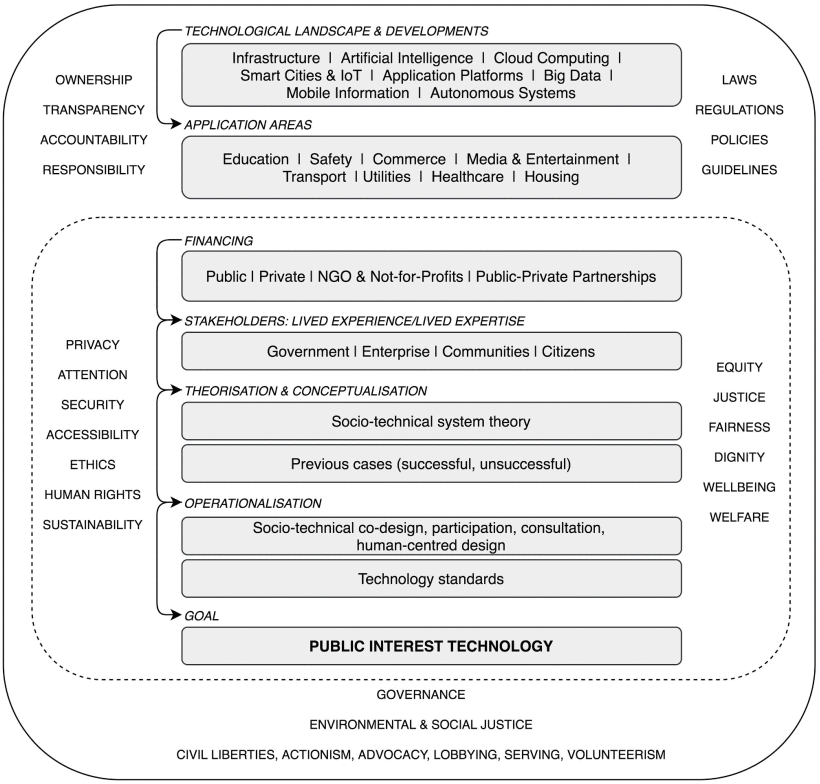
Fig. 1. PIT complex open socio-technical ecosystem.
Thus, we return full circle to Ellul who quoted Giedion [75, p.52] with respect to the period from 1750 to 1850: “Invention was a part of the normal course of life. Everyone invented. Every entrepreneur dreamed of more rapid and economical means of fabrication. The work was done unconsciously and anonymously. Nowhere else and never before was the number of inventions per capita as great as in America in the 60’s of that century.” Let us hope for that same spirit of inventiveness to return to the extraordinary citizen toward a mindful collective awareness in a future for everyone, where convergence toward a common aim of sustainability is achieved through care for one another and not merely for the transient goal of profit maximization.
SECTION VII.
Overview of Accepted Papers
Eight papers were accepted for the special issue. The opening paper is written by Sarah Dean, Thomas Gilbert, and Nathan Lambert pursuing their Ph.D. degree from the University of California at Berkeley, and Tom Zick a Postdoctoral Fellow at the Berkman Klein Center for Internet and Society, Harvard University. Their paper is titled “Axes for Socio-Technical Inquiry in AI Research” and emphasizes the importance of socio-technical enquiry in mitigating the harms presented by new technologies (i.e., artificial intelligence, machine learning, and human-in-the-loop autonomy) whose potential impacts remain poorly understood with respect to safety, fairness, and control. The authors provide a useful lexicon for socio-technical inquiry and use a consumer drone case study to illustrate their contribution. The researchers emphasize four directions for enquiry in the context of emerging technologies: 1) value; 2) optimization; 3) consensus; and 4) failure.
The second paper is a collaboration between Jeremy Pitt from Imperial College London, U.K., and Stephen Cranefield from the University of Otago, New Zealand. Their paper highlights the importance of prioritizing values in the design of PITs. We are presented with a conceptual model and metaplatform for PIT design that demands participation from communities and all stakeholders for jointly designing and jointly debating solutions that can be trusted by people because they helped create them. Pursuant of this theme of trust in socio-technical solutions is a transdisciplinary transnational team of 17 scholars and practitioners from Germany, Denmark, the USA, Iceland, and Finland, inclusive of Intel Labs. The team presents to us a process by which to assess trustworthy AI in what they have termed “Z-Inspection” which they have registered as a trademark. Their paper outlines a novel process based on applied ethics to assess if an AI system is trustworthy. Z-Inspection is a general inspection process that can be applied to a variety of domains where AI systems are used and it is the first process of its kind to assess trustworthy AI in practice.
The fourth paper presents research on community-oriented PIT facilitated by a blockchain where “time” is banked toward the exchange of services and skills in the community system based on reciprocity as the premise. The paper is written by Chengmeng Zhang, Haoyu Suo, and Gong Chen, affiliated with the Institute for Population Research at Peking University, and the second author Wenqing Yu from Case Western Reserve University. The paper goes into detail on how demand matching and volunteer services management can be facilitated through a distributed ledger and how the architecture for such an endeavor can work. The fifth paper is by Annie Y. Patrick of Virginia Tech who writes on bringing care and concern to engineering students through Science, Technology, and Society (STS) knowledge. Patrick leaves us with the need to have concern and care in engineering practice, and echoes several authors in the special pertaining to values. Among her outcomes are creating a sense of belonging, caring for invisible labor, and expanding diverse success types beyond traditional engineering work.
The sixth paper is by Canadian-based Beth-Anne Schuelke-Leech of the University of Windsor who presents a very brief overview of her study within the field of engineering education identifying that more has to be done to expose students to unstructured problems where they are able to practice problem-solving skills. We can thus make a judgment that the more we can expose engineering students to socio-technical issues, the more they will be equipped in the design of PIT. The seventh paper, “Collaborating to Build the Software Good Policy Deserves” by Emily Tavoulareas of the Beeck Center for Social Impact and Innovation at Georgetown University and Cyd Harrell Civic Designer and author of A Civic Technologist’s Practical Guide[76] that focuses on the creation of an effective environment for collaboration, incorporating designers with both hard skills and soft skills. The authors argue that this is the only way to improve software successes, especially in the context of PIT. The eighth and final paper is written by three scholars from Penn State University, inclusive of Lauren Dennis, Sarah Rajtmajer, and Caitlin Grady. This work demonstrated the importance of exploring social vulnerability characteristics of communities dependent upon critical infrastructure (CI) in addressing CI cyber–physical risk and resilience.
We thank all the contributors who also presented related short/full papers or abstract only presentations at the International Symposium on Technology and Society 2020 (ISTAS20) of which full proceedings can be found in IEEEXplore. We have tried to incorporate and present papers sequentially, from the outset focusing on socio-technical theory, conceptual modeling bringing together value-sensitive design and PIT through methodological tools for assessing trustworthiness in AI systems in practice. This was followed by considering the need for community-driven solutions that make use of new modes of stakeholder engagement, incorporating aspects of volunteerism. The human qualities of concern and care are emphasized for engineers, as is the need for students to be exposed to complex problems in assessment to develop appropriate skillsets when they face PIT challenges and consider the incorporation of emerging technologies that come with unanticipated and unintended consequences. Participatory design approaches are referred to throughout the special issue, and also in the context of creating a better policy with implementable software that respects a variety of stakeholders. The human factor is all important, especially in measuring social vulnerability in the context of CI for the public interest (e.g., dams, water, and transport).
To our knowledge, this is the first special issue that is dedicated to the socio-technical design of PIT. We are pleased to present this fusion of ideas in the study of open socio-technical ecosystems, democracy by design, emerging technologies, and the need for designers to collaborate in building solutions together with all stakeholder communities, ultimately empowering people with generative technology, enabling them to participate in civic systems that are fit-for-purpose and recognize the value of human dignity.
We wish to acknowledge the passing of one of the special issue contributors late in December 2020, Naveed Mushtaq. May you rest in peace.
References
1. J. Ellul, The Technological Society. New York, NY, USA : Vintage Books, 1964.
2. R. Myerson, Game Theory. Harvard, MA, USA : Harvard Univ. Press, 2013.
3. E. Ostrom, Governing the Commons: The Evolution of Institutions for Collective Action. Cambridge, U.K. : Cambridge Univ. Press, 1990.
4. R. Michels, Political Parties: A Sociological Study of the Oligarchical Tendencies of Modern Democracy. New York, NY, USA : Free Press, 1962.
5. W. Riker, The Art of Political Manipulation. New Haven, CT, USA : Yale Univ. Press, 1986.
6. J. Pitt, J. Schaumeier, and A. Artikis, “Axiomatization of socio-economic principles for self-organizing institutions: Concepts, experiments and challenges,” ACM Trans. Auton. Adapt. Syst., vol. 7, no. 4, pp. 1–39, 2012.
7. J. Pitt, “Interactional justice and self-governance of open self-organising systems,” in Proc. IEEE 11th Int. Conf. Self-Adapt. Self-Org. Syst. (SASO), 2017, pp. 31–40, doi: 10.1109/SASO.2017.12.
8. J. Ober, Demopolis: Democracy Before Liberalism in Theory and Practice. Cambridge, U.K. : Cambridge Univ. Press, 2017.
9. S. Pitt, M. van Meelis Lacey, E. Scaife, and J. Pitt, “No App is an Island: Collective action and sustainable development goal-sensitive design,” Int. J. Interact. Multimedia Artif. Intell. vol. 6, no. 5, pp. 24–33, 2021.
10. J. Pitt, “Transforming big data into collective awareness,” Computer, vol. 46, no. 6, pp. 40–45, Jun. 2013, doi: 10.1109/MC.2013.153.
11. T. Davenport and J. Beck, The Attention Economy: Understanding the New Currency of Business. Cambridge, MA, USA : Harvard Bus. Sch. Press, 2001.
12. K. Michael, “Bots trending now: Disinformation and calculated manipulation of the masses,” IEEE Technol. Soc. Mag., vol. 36, no. 2, pp. 6–11, Jun. 2017, doi: 10.1109/MTS.2017.2697067.
13. K. Michael, R. Abbas, R. A. Calvo, G. Roussos, E. Scornavacca, and S. F. Wamba, “Manufacturing consent: The modern pandemic of technosolutionism,” IEEE Trans. Technol. Soc., vol. 1, no. 2, pp. 68–72, Jun. 2020, doi: 10.1109/TTS.2020.2994381.
14. J. Sargent, K. Mehta, and K. Michael, “Social and economic sustainability,” IEEE Technol. Soc. Mag., vol. 34, no. 1, pp. 17–18, Mar. 2015, doi: 10.1109/MTS.2015.2407072.
15. J. Robbins, “Is technology a parasite masquerading as a symbiont? And if so Proc. IEEE Int. Symp. Technol. Soc. (ISTAS), 2018, pp. 125–132, doi: 10.1109/ISTAS.2018.8638281.
16. K. Michael, “Putting technology into perspective in Asia,” IEEE Technol. Soc. Mag., vol. 32, no. 3, pp. 5–6, Sep. 2013, doi: 10.1109/MTS.2013.2276662.
17. K. Michael, R. Abbas, and J. Pitt, “Maintaining control over AI,” in Issues in Science and Technology: Forum, vol. XXXVII. Washington, DC, USA : Nat. Acad. Sci. Eng. Med., May 2021. [Online]. Available: https://issues.org/debating-human-control-over-artificial-intelligence-forum-shneiderman/
18. R. Westrum, Technologies and Society: The Shaping of People and Things. Belmont, CA, USA : Wadsworth Publ. Company, 1991.
19. W. Kuhns, The Post-Industrial Prophets: Interpretations of Technology. New York, NY, USA : Harper Colophon Books, 1971.
20. J. Ellul, “The technological order,” Technol. Culture, vol. 3, no. 4, pp. 394–421, 1962.
21. R. Pringle, K. Michael, and M. G. Michael, “Unintended consequences: The paradox of technological potential,” IEEE Potentials, vol. 35, no. 5, pp. 7–10, Sep./Oct. 2016, doi: 10.1109/MPOT.2016.2569672.
22. K. D. Stephan, K. Michael, M. G. Michael, L. Jacob, and E. P. Anesta, “Social implications of technology: The past, the present, and the future,” Proc. IEEE, vol. 100, pp. 1752–1781, May 2012, doi: 10.1109/JPROC.2012.2189919.
23. J. Pitt, J. Dryzek, and J. Ober, “Algorithmic reflexive governance for socio-techno-ecological systems,” IEEE Technol. Soc. Mag., vol. 39, no. 2, pp. 52–59, Jun. 2020, doi: 10.1109/MTS.2020.2991500.
24. B. C. K. Choi and A. W. P. Pak, “Multidisciplinarity, interdisciplinarity and transdisciplinarity in health research, services, education and policy: 1. Definitions, objectives, and evidence of effectiveness,” Clin. Invest. Med., vol. 29, no. 6, pp. 351–364. Dec. 2006. [Online]. Available: https://pubmed.ncbi.nlm.nih.gov/17330451/
25. G. Adamson, R. R. Kline, K. Michael, and M. G. Michael, “Wiener’s cybernetics legacy and the growing need for the interdisciplinary approach,” Proc. IEEE, vol. 103, no. 11, pp. 2208–2214, Nov. 2015.
26. H. J. Graff, “The ‘problem’ of interdisciplinarity in theory, practice, and history,” Social Sci. History, vol. 40, no. 4, pp. 775–803, 2016.
27. C. Edquist, “Systems of innovation: Perspectives and challenges,” in The Oxford Handbook of Innovation, J. Fagerberg and D. C. Mowery, Eds. London, U.K. : Oxford Univ. Press, 2006.
28. C. Edquist, L. Hommen, L. Tsipouri. ( 1998 ). Findings and Conclusions of ISE Case Studies on Public Technology Procurement. [Online]. Available: https://citeseerx.ist.psu.edu/viewdoc/download?doi=10.1.1.199.8348=rep1=pdf
29. C. Edquist, Systems of Innovation: Technologies, Institutions and Organisations. London, U.K. : Pinter, 1997.
30. D. Sahal, Patterns of Technological Innovation. Reading, MA, USA : Addison-Wesley, 1981.
31. R. R. Nelson, Understanding Technical Change as an Evolutionary Process. Amsterdam, The Netherlands : Elsevier, 1987.
32. C. Edquist, Systems of Innovation: Technologies, Institutions and Organisations. London, U.K. : Pinter, 1997.
33. F. W. Geels, “From sectoral systems of innovation to socio-technical systems: Insights about dynamics and change from sociology and institutional theory,” Res. Policy, vol. 33, pp. 897–920, Sep. 2004.
34. K. Michael, “The technological trajectory of the automatic identification industry: The application of the systems of innovation (SI) framework for the characterisation and prediction of the auto-ID industry,” Ph.D dissertation, Sch. Inf. Technol. Comput. Sci., Univ. Wollongong, Wollongong, NSW, Australia, 2003. [Online]. Available: http://ro.uow.edu/theses/309
35. R. Abbas, “An approach to studying location-based services regulation in Australia,” in Proc. IEEE Int. Symp. Technol. Soc., 2010, pp. 77–86.
36. R. Abbas, “Location-based services (LBS) regulation in Australia: A socio-technical approach,” Ph.D. dissertation, Sch. Inf. Syst. Technol., Univ. Wollongong, Wollongong, NSW, Australia, 2012. [Online]. Available: https://ro.uow.edu.au/theses/3666
37. R. Abbas, K. Michael, and M. G. Michael, “The regulatory considerations and ethical dilemmas of location-based services (LBS): A literature review,” Inf. Technol. People, vol. 27, no. 1, pp. 2–20, 2014. [Online]. Available: https://doi.org/10.1108/ITP-12-2012-0156
38. E. G. Carayannis, T. D. Barth, and D. F. J. Campbell, “The Quintuple Helix innovation model: Global warming as a challenge and driver for innovation,” J. Innov. Entrepreneurship, vol. 1, p. 2, Aug. 2012. [Online]. Available: https://doi.org/10.1186/2192-5372-1-2
39. E. G. Carayannis and R. Rakhmatullin, “The Quadruple/Quintuple innovation Helixes and smart specialisation strategies for sustainable and inclusive growth in Europe and beyond,” J. Knowl. Econ., vol. 5, pp. 212–239, Jan. 2014.
40. R. Abbas, “Socio-technical theory: The role of scenarios in informing design choices. Threats and opportunities for AI in cybersecurity,” in Proc. Workshop 2 Examining Socio-Tech. Ecosyst. (STeS) Considerations, Feb. 2021.
41. P. S. Hofman, B. E. Elzen, and F. W. Geels, “Sociotechnical scenarios as a new policy tool to explore system innovations: Co-evolution of technology and society in The Netherland’s electricity domain,” Innovation, vol. 6, no. 2, pp. 344–360, 2004.
42. L. Perusco and K. Michael, “Control, trust, privacy, and security: Evaluating location-based services,” IEEE Technol. Soc. Mag., vol. 26, no. 1, pp. 4–16, Mar. 2007, doi: 10.1109/MTAS.2007.335564.
43. D. Gokyer and K. Michael, “Digital wearability scenarios: Trialability on the run,” IEEE Consum. Electron. Mag., vol. 4, no. 2, pp. 82–91, Aug. 2015, doi: 10.1109/MCE.2015.2393005.
44. E. L. Trist and K. W. Bamforth, “Some social and psychological consequences of the longwall method of coal-getting: An examination of the psychological situation and defences of a work group in relation to the social structure and technological content of the work system,” Human Relat., vol. 4, no. 1, pp. 3–38, 1951.
45. R. P. Bostrom and J. S. Heinen, “MIS problems and failures: A socio-technical perspective, part II: The application of socio-technical theory,” MIS Quart., vol. 1, no. 4, pp. 11–28, 1977.
46. F. Emery, “Designing socio-technical systems for ‘greenfield’ sites,” J. Occup. Behav., vol. 1, no. 1, pp. 19–27, 1980.
47. E. L. Trist, The Evolution of Socio-Technical Systems: A Conceptual Framework and an Action Research Program. Toronto, ON, Canada : Ontario Ministry Labour, 1981, pp. 1–67.
48. W. Pasmore, C. Francis, J. Haldeman, and A. Shani, “Socio-technical systems: A North American reflection on empirical studies of the seventies,” Human Relat., vol. 35, no. 12, pp. 1179–1204, 1982.
49. E. L. Trist, G. W. Higgin, H. Murray, and A. B. Pollock, Organizational Choice (RLE: Organizations): Capabilities of Groups at the Coal Face Under Changing Technologies. London, U.K. : Tavistock Inst. Human Relat., 1963.
50. R. Abbas, “Operationalising socio-technical theory: Examining social, technical environmental subsystems,” in Proc. 14th Workshop Social Implications Nat. Security (SINS) AI Cybersecurity Socio-Tech. Environ. Considerations, Feb. 2021. [Online]. Available: https://www.youtube.com/watch?v=ydgNog6xzMQ
51. A. Cherns, “The principles of socio-technical design,” Human Relat., vol. 29, no. 8, pp. 783–792, 1976.
52. A. Cherns, “Principles of socio-technical design revisited,” Human Relat., vol. 40, no. 3, pp. 153–161, 1987.
53. E. Mumford, “A socio-technical approach to systems design,” Requirements Eng., vol. 5, no. 2, pp. 125–133, 2000.
54. E. Mumford, “The story of socio-technical design: Reflections on its successes, failures and potential,” Inf. Syst. J., vol. 16, no. 4, pp. 317–342, 2006.
55. R. Abbas, H. Tootell, M. Freeman, and G. Ellmers, “Engaging young children as application design partners: A stakeholder-inclusive methodological approach,” IEEE Technol. Soc. Mag., vol. 37, no. 3, pp. 38–47, Sep. 2018, doi: 10.1109/MTS.2018.2857584.
56. R. Abbas, B. Traynor, and H. Tootell, “From good ideas to practical solutions: The changing nature of participation in our evolving digital landscape,” IEEE Technol. Soc. Mag., vol. 37, no. 3, pp. 27–28, Sep. 2018, doi: 10.1109/MTS.2018.2857602.
57. L. J. Robertson, R. Abbas, G. Alici, A. Munoz, and K. Michael, “Engineering-based design methodology for embedding ethics in autonomous robots,” Proc. IEEE, vol. 107, no. 3, pp. 582–599, Mar. 2019, doi: 10.1109/JPROC.2018.2889678.
58. B. Friedman, “Value-sensitive design,” Interactions, vol. 3, no. 6, pp. 16–23, 1996.
59. B. Friedman, P. H. Kahn, and A. Borning, “Value sensitive design and information systems,” in The Handbook of Information and Computer Ethics, P. Zhang and D. Galletta, Eds. Armonk, NY, USA : M. E. Sharpe, 2008, pp. 69–101.
60. A. Cavoukian, “Privacy by design: The definitive workshop. A foreword by Ann Cavoukian, Ph.D,” Identity Inf. Soc., vol. 3, no. 2, pp. 247–251, 2010, doi: 10.1007/s12394-010-0062-y.
61. J. Pitt and J. Ober, “Democracy by design: Basic democracy and the self-organisation of collective governance,” in Proc. IEEE 12th Int. Conf. Self-Adapt. Self-Org. Syst. (SASO), 2018, pp. 20–29, doi: 10.1109/SASO.2018.00013.
62. C. Wheeler, “The public interest we know it’s important, but do we know what it means,” in AIAL Forum, vol. 48. Canberra, ACT, Australia : Aust. Inst. Administ. Law, 2006. [Online]. Available: http://www5.austlii.edu.au/au/journals/AIAdminLawF/2006/2.pdf
63. Black’s Law Dictionary. Accessed: Feb. 5, 2019. [Online]. Available: https://thelawdictionary.org/public-interest/
64. Freedman Consulting. ( May 2016 ). A Pivotal Moment: Developing a New Generation of Technologists for the Public Interest. [Online]. Available: https://tfreedmanconsulting.com/reports/a-pivotal-moment-developing-a-new-generation-of-technologists-for-the-public-interest/
65. Freedman Consulting. ( 2016 ). A Future of Failure? The Flow of Technology Talen Into Government and Civil Society—A Report. [Online]. Available: https://tfreedmanconsulting.com/reports/a-future-of-failure-the-flow-of-technology-talent-into-government-and-civil-society/
66. K. Michael, S. Kobran, R. Abbas, and S. Hamdoun, “Privacy, data rights and cybersecurity: Technology for good in the achievement of sustainable development goals,” in Proc. IEEE Int. Symp. Technol. Soc. (ISTAS), 2019, pp. 1–13.
67. R. Farthing, K. Michael, R. Abbas, and G. Smith-Nunes, “Age appropriate digital services for young people: Major reforms,” IEEE Consum. Electron. Mag., vol. 10, no. 4, pp. 40–48, Jul. 1 2021, doi: 10.1109/MCE.2021.3053772.
68. ( 2018 ). Ford Foundation. [Online]. Available: https://www.fordfoundation.org/campaigns/public-interest-tech/
69. S. Costanza-Chock, M. Wagoner, B. Taye, C. Rivas, C. Schweidler, and G. Bullen, “#MoreThanCode: Practitioners reimagine the landscape of technology for justice and equity,” Res. Action Design Open Technol. Inst., Washington, DC, USA, Rep. T4SJ, 2018. [Online]. Available: https://morethancode.cc/T4SJ_fullreport_082018_AY_web.pdf
70. ( 2018 ). New America Foundation. [Online]. Available: https://www.newamerica.org/pit/about/
71. T. D. McGuinness and H. Schank, Power to the Public: The Promise of Public Interest Technology. Princeton, NJ, USA : Princeton Univ. Press, 2021.
72. B. Schneier, “Cybersecurity for the public interest,” IEEE Security Privacy, vol. 17, no. 1, pp. 84–83, Jan./Feb. 2019.
73. K. Michael, Enlightening Lunch: Master of Science in Public Interest Technology, Arizona State Univ., Tempe, AZ, USA, Mar. 2019. [Online]. Available: https://www.youtube.com/watch?v=u-kzhp8mEsg
74. K. Michael, Welcome to Public Interest Technology: Is Technology Being Applied for the Public Good? Sch. Future Innov. Soc., Arizona State Univ., Tempe, AZ, USA, Jun. 2020. [Online]. Available: https://sfis.asu.edu/public-interest-technology
75. S. Giedion, Mechanization Takes Command. New York, NY, USA : Oxford University Press, 1964.
76. C. Harrell, A Civic Technologist’s Practice Guide. San Francisco, CA, USA : Five Seven Five Books, 2020.
Authors
School of Business, University of Wollongong, Wollongong, NSW, Australia
Roba Abbas received the B.S. degree (with First Class Hons. and Distinction) in information and communication technology (business information systems) and the Ph.D. degree in location-based services regulation from the University of Wollongong, Wollongong, NSW, Australia, in 2006 and 2012, respectively.
Department of Electrical and Electronic Engineering, Imperial College London, London, U.K.
Jeremy Pitt is a Professor of Intelligent and Self-Organizing Systems with the Department of Electrical and Electronic Engineering, Imperial College London, London, U.K., where he was the Deputy Head of the Intelligent Systems and Networks Group, and is currently a departmental Equality, Diversity and Culture Champion. His research interests focus on developing formal models of social processes using computational logic, and their application in self-organizing multiagent systems, for example fair and sustainable common-pool resource management (based on the work of Nobel Prize winner Elinor Ostrom), computational justice (based primarily on the work of Nicholas Rescher) and algorithmic self-governance (based on the theories of political scientist Josiah Ober). He also has strong interests in human–computer interaction, socio-technical systems, and the social impact of technology; with regard to the latter he has edited two books, This Pervasive Day (IC Press, 2012) and The Computer After Me (IC Press, 2014). He has been an investigator on more than 30 national and European research projects and has published more than 200 articles in journals and conferences. This inter-disciplinary work on formal models of self-organization for collective action won two Best Paper awards from the IEEE Conference on Self-Adapting and Self-Organizing Systems, and is collected in a textbook on Self-Organizing Multi-Agent Systems (World Scientific).
School for the Future of Innovation in Society, Arizona State University, Tempe, AZ, USA
Katina Michael (Senior Member, IEEE) received the B.S. degree in information technology from the School of Mathematical and Computing Science, University of Technology, Sydney, NSW, Australia, in 1996, the Doctor of Philosophy degree in information and communication technology from the Faculty of Informatics, University of Wollongong, Wollongong, NSW, Australia, in 2003, and the Master of Transnational Crime Prevention degree (with Distinction) from the Faculty of Law, University of Wollongong in 2009.
Citation: R. Abbas, J. Pitt and K. Michael, "Socio-Technical Design for Public Interest Technology," in IEEE Transactions on Technology and Society, vol. 2, no. 2, pp. 55-61, June 2021, doi: 10.1109/TTS.2021.3086260.